
Three-Alarm Fire at Morristown Restaurant Triggers Apartment Evacuations on Spring Street
October 21, 2026· Brian Fitzgibbons
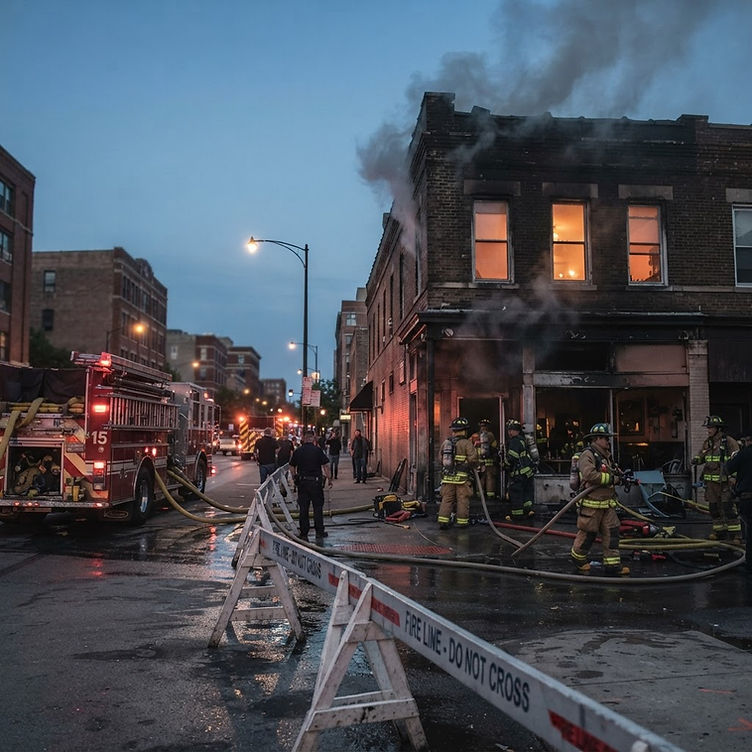
MORRISTOWN, N.J. — A three-alarm fire erupted Monday evening at Mega BBQ, a restaurant located on Spring Street in Morristown, New Jersey, prompting the evacuation of apartment tenants above the two-story building and forcing detours for evening commuters in the area. The blaze was called in at 5:01 p.m. on October 20, 2026, according to Morristown Public Safety Director Michael Corcoran Jr., as reported by Morristown Green. No injuries were reported.
Key Facts
- Alarm received: 5:01 p.m., Monday, October 20, 2026
- Location: Mega BBQ, Spring Street, Morristown, N.J.
- Alarm level: Three alarms
- Injuries: None reported
- Cause: Under investigation; preliminary indications point to exhaust chute near restaurant stove
- Structural damage: One apartment above the restaurant sustained damage; two others were unaffected
- Adjoining properties: A mattress store and the Spring Street Community Development Corp. reported unscathed
- Displaced tenants: Building owner arranged hotel accommodations; American Red Cross also offered assistance
- Mutual aid: Morris Township, Morris Plains, and Madison fire companies assisted Morristown
- Fire declared under control: Approximately 30 minutes after arrival; an additional hour spent extinguishing remaining pockets
What We Know
Multiple callers reported visible flames from the roof of the two-story structure before emergency crews arrived, according to Morristown Fire Chief Robert Flanagan, as cited by Morristown Green. Firefighters from Morristown were joined by mutual-aid companies from Morris Township, Morris Plains, and Madison — a response consistent with a three-alarm assignment, which in New Jersey typically draws resources beyond the first-due company to address the scale and pace of fire spread.
Crew members brought the fire under control within roughly 30 minutes. They then spent approximately one additional hour working through pockets of residual smoke and fire within the structure's wall and ceiling cavities, Chief Flanagan said. That extended overhaul period is notable: fires that travel through concealed spaces — behind walls and above ceiling tiles — are notoriously difficult to extinguish completely because suppression streams cannot reach every void where embers may persist.
One of the apartments above the restaurant sustained damage. Two others in the same building were reported unaffected. Electricity to the building was shut off as part of the emergency response, displacing all residential tenants regardless of whether their individual units were directly damaged. The building's owner arranged hotel accommodations for the displaced residents; the American Red Cross also offered temporary lodging, according to Chief Flanagan.
A mattress store and the Spring Street Community Development Corp., which occupy adjacent storefronts, were reported unscathed.
For the Morristown properties now working through recovery, USPA staffs both sides of that sequence: fire watch services in Morristown cover impaired protection systems until they are restored, and security guard services in Morristown protect fire-damaged storefronts and residential buildings while repairs proceed.
What Has Not Yet Been Released
As of publication, the cause of the fire has not been officially confirmed by investigators. Chief Flanagan indicated that preliminary indications suggest the fire originated at an exhaust chute near the restaurant's stove, from which it appears to have spread behind the wall, into the ceiling space, and eventually through the roof. This pathway is consistent with a grease duct or kitchen exhaust failure, but no official determination has been made, and the source material does not specify whether an arson investigation has been opened or ruled out.
The following information remains pending or has not been released:
- Official determination of fire origin and cause by investigators
- Whether the kitchen exhaust system was inspected, cleaned, or certified in compliance with applicable fire codes prior to the incident
- Extent of structural damage beyond the single apartment noted
- Status of fire suppression systems (if any) within the building
- Whether building fire alarm systems operated as intended
- Insurance status of the building and its occupants
- Timeline for restoration or re-occupancy
This article will be updated as the official investigation progresses.
Technical Analysis: Exhaust Systems, Concealed-Space Fire Travel, and NFPA Standards
The preliminary fire path described by Chief Flanagan — from an exhaust chute, behind a wall, into the ceiling, and through the roof — represents one of the most well-documented fire development patterns in commercial cooking environments. NFPA 96, Standard for Ventilation Control and Fire Protection of Commercial Cooking Operations, establishes requirements for the design, installation, operation, inspection, testing, and maintenance of commercial kitchen exhaust systems, including grease ducts. Among its core provisions, NFPA 96 requires that grease ducts be enclosed in a continuous enclosure or be constructed with clearances to combustibles adequate to prevent ignition. Grease accumulation inside ducts is a recognized ignition source; the standard specifies cleaning intervals based on cooking volume and fuel type.
When a duct fire does occur, the concern shifts rapidly to concealed spread. Fires traveling through interstitial spaces between walls and above drop ceilings are addressed in part by NFPA 1, Fire Code, and by building construction requirements under model codes such as the International Building Code, which New Jersey has adopted with amendments. Firestopping and draft-stop requirements are intended to slow the spread of fire through these cavities, but their effectiveness depends on proper installation and the construction type of the building. In older mixed-use commercial-residential structures, these protections may be less robust than in modern construction.
NFPA 72, National Fire Alarm and Signaling Code, governs detection systems that should alert occupants to a fire before it progresses beyond the point of origin. A kitchen hood suppression system, governed separately by NFPA 17A (Standard for Wet Chemical Extinguishing Systems), is designed to suppress a cooking surface or duct fire at its earliest stage. Whether either system was present, activated, or functioned as intended at Mega BBQ has not been reported.
NFPA 25, Standard for the Inspection, Testing, and Maintenance of Water-Based Fire Protection Systems, would govern any sprinkler or standpipe systems in the building. The presence or absence of such systems has not been confirmed in available reporting.
After a fire of this nature, NFPA 51B, Standard for Fire Prevention During Welding, Cutting, and Other Hot Work, and related impairment management protocols become relevant during the restoration phase. Contractors performing repairs — particularly cutting, welding, or torching operations — must implement hot work permits and fire watch procedures to prevent secondary fires in a structure that may have compromised fire barriers from the original incident.
Post-Fire Impairment and Fire Watch Obligations
Once fire suppression systems are compromised — whether by the fire itself, by water damage, or by deliberate impairment during repairs — the building enters what fire codes classify as an impaired condition. NFPA 25 Chapter 15 addresses impairment management, including the requirement to implement a fire watch when suppression or detection systems are out of service. A fire watch involves trained personnel conducting frequent patrols of the affected areas, maintaining the ability to promptly detect and report any rekindling or new ignition, and remaining in position until systems are restored and tested.
For the occupants and owner of the Spring Street building, the path forward will likely involve the following: a formal fire investigation and cause determination; structural assessment by a licensed engineer; inspection and potential replacement of the kitchen exhaust and duct system in compliance with NFPA 96; evaluation of any fire suppression systems for damage; and, if systems remain impaired during the repair period, maintenance of a continuous fire watch as required by the authority having jurisdiction — in this case, the Morristown Fire Department and applicable New Jersey state codes.
New Jersey's Uniform Fire Code, N.J.A.C. 5:70, incorporates NFPA model codes by reference and grants local fire officials broad authority to impose conditions on re-occupancy, including mandating fire watch coverage when life-safety systems are not fully operational.
Local Context
Spring Street is a mixed-use commercial corridor in Morristown's downtown core, bordered by restaurants, retail establishments, nonprofit offices, and residential units. The presence of both commercial tenants and residential occupants in the same structure is a common configuration in urban New Jersey downtowns and carries specific regulatory obligations under the Uniform Fire Code, particularly with regard to means of egress, fire separation assemblies between occupancy types, and alarm notification for sleeping areas.
The Spring Street Community Development Corp., one of the flanking neighbors that escaped damage, serves as a local community development organization. The absence of damage to adjoining structures suggests that the fire was contained to the building of origin, which speaks to the speed of the multi-company response and the effectiveness of the overhaul operation.
Chief Flanagan praised Morristown police for traffic control at the scene, which is a practical acknowledgment of the logistical burden a three-alarm response places on a downtown street grid during evening commute hours.
The Property's Next Obligations
Building owners and operators in New Jersey facing post-fire conditions have obligations that extend beyond physical repairs. Under N.J.A.C. 5:70 and the incorporated NFPA codes, the property owner must:
- Notify the authority having jurisdiction of any impaired fire protection systems and maintain records of impairment duration and corrective actions taken.
- Coordinate with the fire investigation unit to preserve the scene until a cause and origin determination has been made, to the extent required by investigators.
- Retain a licensed fire protection contractor to inspect, test, and certify any suppression or detection systems before re-occupancy is permitted.
- Have the kitchen exhaust system inspected and, if the duct was implicated in fire spread, replaced or rehabilitated to NFPA 96 specifications before resuming cooking operations.
- Implement fire watch coverage, staffed by qualified personnel, for any period during which required fire protection systems are out of service.
The displaced residential tenants' ability to return will depend on the local fire official's determination that the structure is safe for re-occupancy and that life-safety systems are either fully operational or adequately compensated for through alternative protective measures.
Sources and Open Questions
The primary source for this article is reporting by Kevin Coughlin published October 20, 2026, on Morristown Green (morristowngreen.com), which attributed facts to Morristown Public Safety Director Michael Corcoran Jr. and Fire Chief Robert Flanagan. Technical analysis draws on NFPA 96, NFPA 25, NFPA 72, NFPA 51B, and New Jersey's Uniform Fire Code (N.J.A.C. 5:70).
Open questions as of publication include: the official fire cause determination; the inspection and maintenance history of the kitchen exhaust system; the presence, condition, and performance of any fire suppression or detection systems in the building; the extent of structural damage to the building frame; and the projected timeline for investigation completion and re-occupancy assessment. USPA Nationwide Security will update this article as additional information becomes available from the Morristown Fire Department or Morris County officials.
Property owners, building managers, or contractors involved in post-fire restoration at this or any affected property in the Morristown area who require certified fire watch services may contact USPA Nationwide Security at (800) 214-1448.
Related Reading
Questions about fire watch, executive protection or guard coverage for your property? Request a quote or call our dispatch line.
More from the blog


Breaking News
Subtropical System Threatens East Coast with High Winds and Coastal Flooding as NHC Monitors Development
The National Hurricane Center is tracking a non-tropical area of low pressure off the Carolina coast with a 40 percent chance of subtropical storm development. Regardless of whether it organizes, the system is expected to produce dangerous surf, coastal flooding, and high winds along the U.S. East Coast this week.

Breaking News
Four Units Damaged in Overnight Apartment Fire Near Loop 410 and Starcrest on San Antonio's Northeast Side
Two units were damaged by fire and two by water in an overnight apartment fire near Loop 410 and Starcrest Drive on San Antonio's Northeast Side on Oct. 5. No injuries were reported, and the cause is under investigation by the San Antonio Fire Department.

Breaking News
One Dead, Two Injured in Second-Floor Fire at Primavera Square Apartments in Bensalem; Victim Identified as James Nugent
A fire in a second-floor apartment at Primavera Square Apartments in Bensalem's Andalusia section on Saturday, Oct. 17 killed James Nugent and injured two others, with six units affected. The cause of the fire remains under investigation by Bensalem Fire Rescue and police detectives.