
Emergency fire watch guards
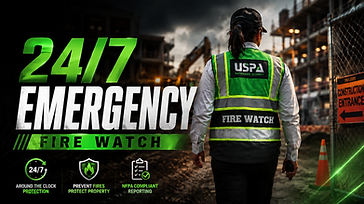
USPA provides licensed fire watch guards for buildings and job sites where a sprinkler system, fire alarm or suppression system is out of service. Dispatch answers around the clock, including overnight, weekends and holidays, and coverage can be staged the same day for a single impairment or coordinated across multiple buildings and properties.
- 21+ Years in Business
- A+ Rated
- Veteran Owned and Operated
- Licensed and Insured
- 24/7 Dispatch
Need fire watch now?
Fire protection system down? Call the dispatch line and coverage can be staged tonight. The coordinator works from a partial picture and collects the rest during dispatch.
When an emergency fire watch is ordered
An emergency fire watch is a standing, documented patrol of a property while one of its protective systems is out of service. The assignment exists for a specific reason: for as long as a sprinkler system, alarm, suppression system or standpipe cannot do its job, someone has to watch the protected areas, detect the conditions those systems would have detected, and raise the alarm immediately if a fire starts. The officer's presence is the interim measure that lets a building or a job site continue operating during the impairment.
The calls that come in at two in the morning usually trace back to one of a short list of events. A riser was closed so a leaking sprinkler head could be replaced. A fire panel failed and the building lost both detection and occupant notification. A kitchen suppression system was discharged and tagged out pending service. A standpipe is being replaced ahead of an inspection. Power to the building was interrupted, leaving systems unreliable. A hard freeze burst an unheated sprinkler line. A hurricane knocked out service to a property that still has to be secured. Hot work is about to start on a floor where the normal fire prevention precautions are not sufficient. Each of these produces the same basic condition: protection is removed before it is restored, and the interval in between has to be managed deliberately.
Who can require the watch matters as much as why. The authority having jurisdiction (AHJ) is the term codes use for the organization responsible for enforcing fire and life safety requirements in a given location. In practice that is usually the local fire marshal or fire prevention bureau, sometimes a building official, and it varies by municipality. An insurance carrier can require a watch as a condition of covering the property. A building owner can impose one as an internal safety policy. A general contractor can require coverage on a job site under its own site safety plan. Any of these can drive the requirement, and the documentation each one expects is not always identical.
What happens when a sprinkler system goes out of service
Water-based protection systems are governed by NFPA 25, the standard for inspection, testing and maintenance of water-based fire protection systems. Its impairment chapter lays out how a planned shutdown or an unplanned failure is supposed to be handled: the property notifies its authority having jurisdiction and its insurer where required, tags the impaired equipment, and puts interim measures in place for the full duration of the impairment. A documented fire watch is the interim measure most authorities and many insurers expect once an impairment will last more than a nominal period.
The reasoning behind that expectation is mechanical rather than administrative. A sprinkler system works because it reacts to a fire in its opening minute, discharging water directly over the seat of the fire before the room approaches flashover. Take that reaction away and the same small fire, in the same room, is free to grow until it reaches the ceiling, spreads into concealed spaces and involves the finishes that feed a large-loss fire. The response timeline changes as well. Detection may be silent, occupants may receive no warning, and the first confirmation of a fire can come from a passer-by, which adds minutes to an event that was previously measured in seconds.
This is why impairment rules focus on duration and occupancy. An hour of shutdown in a vacant wing is a different exposure from a multi-week impairment in an occupied apartment building, and the watch requirement, the patrol frequency and the documentation an authority expects all scale with that exposure. For impairments that run for weeks during a long repair or a renovation, continuous fire watch services are staffed on rotating shifts for the entire interval rather than arranged day by day.
Fire alarm outages: detection and notification both fail
Alarm impairments deserve their own discussion because an alarm system performs two separate functions. It detects, through smoke detectors, heat detectors and manual pull stations. It also notifies, through occupant notification devices, the monitoring company and the fire department dispatch channel. When a fire panel fails, or the system is taken down for repair, a building can lose both functions at once, and the people inside it have no way of knowing a fire has started.
A fire watch officer compensates for both losses. Walking rounds act as the detection layer: a trained observer moving through the impaired areas on a fixed schedule will find smoke, heat, burning odors and the other signs a detector would have caught. The radio and the telephone replace the automated notification layer: when the officer finds a condition, the fire department is called directly, the property contact is notified and USPA dispatch is informed, so the response begins the way it would have begun automatically. In occupied buildings such as hotels, apartment communities and healthcare settings, where most of the alarm's job is waking people at night, overnight rounds are held at the interval the jurisdiction requires rather than relaxed after business hours.
What the fire watch officer does on the ground
The duties are specific, and they are the reason a fire watch is staffed by trained personnel rather than a general guard shift. On each round the officer walks the impaired areas plus the paths people would use to escape a fire there: the egress routes, stairwells and exits. The officer watches for the conditions that start and spread fires, including ignition sources left energized, hot surfaces, combustibles stored against heat sources and the housekeeping lapses that turn a small fire into a large one. The officer confirms that the equipment the building still has is usable, which means extinguishers in place with current service tags, exits unobstructed, exit lighting working, and standpipe or hose equipment accessible where the building retains it.
If a hazard is found, the officer either corrects it within their authority, such as relocating a combustible or closing a propped-open fire door, or reports it to the property contact immediately. If smoke or fire is found, the officer calls 911 first, then notifies the property contact and USPA dispatch, and begins evacuation and extinguishment within the limits of their training and equipment. Notification is immediate and direct rather than waiting for the next scheduled round.
Every round is documented. The fire watch log records the time of each patrol, the areas observed, the conditions found and any action taken, with the officer's initials on each entry. Entries continue through shift changes so the record stays continuous for the full impairment. When a fire marshal, an insurer or a property owner reviews the event afterward, that log is the document that answers their questions, and it is the reason USPA personnel write entries in the format a reviewing authority expects to see.


The fire watch plan: what goes in it
Most authorities want a written fire watch plan before coverage begins, particularly for impairments lasting more than a few hours or for higher-risk occupancies. The plan is a working document sized to the specific property, and it answers the questions a responding inspector would ask: what is impaired, how the property is being covered, and who does what if a condition is found. A typical USPA plan covers:
- The reason the fire watch was initiated, and the specific system or permit that triggered it
- The impaired system and the exact areas being monitored, floor by floor or building by building
- The patrol route and the round interval the authority having jurisdiction requires
- Assigned personnel and the relief or shift-change schedule
- Communication procedure between the officer, the property contact and dispatch
- Emergency notification steps, including the direct fire department call
- Extinguisher locations the officer confirms on each round
- Hazard reporting and the conditions the officer corrects immediately
- Entry and exit controls where the impairment affects them
- Log start time, entries through shift changes, and the end time
- How the impaired system is restored, and who authorizes discontinuing the watch
- Any fire marshal, insurer or permit instructions that apply to the site
Requirements vary by jurisdiction, occupancy, building type, the specific impairment and the permit in force. A fire marshal in one municipality may specify a 30-minute patrol interval and a particular log layout; the neighboring jurisdiction may accept an hourly interval with a different format. An insurer can impose conditions beyond what the published code requires. A contractor's site safety plan can add hot work requirements to a construction fire watch. Because of that variation, USPA writes each plan against the specific site and the instructions the property has received from its authority having jurisdiction, and confirms the local requirement before the first round rather than assuming one national template covers every jurisdiction.
Sprinkler system impaired? Coverage can begin tonight.
24/7 emergency dispatch for single buildings, multi-building properties and construction sites, with relief staffed for the full impairment period.
What dispatch needs when you call after midnight
The dispatch coordinator can work with a partial picture. The three details that move an emergency assignment fastest are the property address, the reason the system is impaired and the time coverage has to begin. Everything else can be collected during dispatch while personnel are being staged, so do not delay the call to gather documents or wait for a fire protection contractor to confirm the repair schedule. The items below all help, and the more of them available, the faster the assignment can be built:
- Property address, including building or unit numbers where relevant
- Type of impairment: sprinkler, alarm, suppression, standpipe, fire pump or hot work
- Building or property type, and whether it is occupied, vacant or under construction
- Number of buildings or floors requiring coverage
- The time coverage has to begin
- The expected repair duration, if a fire protection contractor has confirmed one
- Any authority having jurisdiction or fire marshal instructions already issued
- The required number of personnel, if the jurisdiction or the permit has specified one
- Site contact and their phone number
- Access instructions: gate codes, key exchange, badging or escort requirements
- Certificate of insurance requirements for the property
- The billing or authorization contact
If the impairment is being driven by a fire marshal or an insurer with specific written instructions, forwarding that correspondence to dispatch makes the documentation easier to match. If nothing exists yet, USPA confirms the local requirement as part of mobilizing the assignment.
How USPA deploys and staffs the watch
Assignments are staffed from qualified personnel in the nearest available market and, where the jurisdiction requires it, licensed guards for that state. Before the first round, the officer receives written instructions covering the property layout, the patrol route, the round interval, the contact chain and the log format the assignment requires. A field supervisor confirms the officer is on site, briefed and logging rounds correctly, and stays in contact with both the officer and the client through the impairment.
Coverage is continuous for as long as it is needed, including overnight, weekends and holidays. Shift changes are managed so there is no gap in the record: the outgoing officer reviews the log with the incoming officer, hands off any open items, and both sign the record at the changeover. For large properties, multiple buildings or multi-floor impairments, personnel are added or the route is divided so every protected area is covered at the required interval.
The watch also has to fit the environment it is protecting. An occupied apartment building during an alarm repair calls for quiet rounds that respect the residents. A construction site during hot work puts the officer near the welding crew and the permit paperwork. A distribution center with a burst sprinkler main in a deep freeze combines fire watch duties with the access control and patrol work of warehouse security services, since the same officer is watching both the impairment and the property. Post-storm deployments pair the watch with disaster recovery security, where damaged buildings, staged equipment and utility crews all need to be tracked through the same gate.
Coordination with the fire protection contractor matters as much as the patrol itself. Repair crews need access to the riser, the panel and the impaired areas, and the officer on watch lets them work without breaking the patrol schedule or the log's continuity. When the contractor restores a system, the officer can support the reset and test process and confirm from the field that the system is back in service before coverage stands down.
When the fire watch ends
A watch ends when the impairment ends, and the ending is documented rather than assumed. The usual sequence is that a qualified fire protection contractor restores the system, resets and tests it, and confirms it is in service. The property owner or the authority having jurisdiction then authorizes discontinuation, either in writing or through the permit process that started the watch. USPA personnel stand down on that authorization, close the log with a final entry recording the end time and the system's restored status, and hand the completed records over to the property contact.
Coverage can be extended as easily as it was staffed. Repair windows move, parts are back-ordered, and a two-day impairment becomes a two-week one. Because the watch is staffed through a dispatch organization rather than a single crew, the schedule adjusts with the repair rather than lapsing on the day it was originally booked.
Fire watch during hot work: NFPA 51B and OSHA requirements
Hot work creates a different kind of fire watch requirement, and the controlling standard is NFPA 51B, the standard for fire prevention during welding, cutting and other hot work, currently published in its 2024 edition. The standard addresses work that produces sparks, flames or heat: welding, cutting, grinding, brazing, torch-applied roofing and similar operations. Its core method is the hot work permit, issued by a permit authorizing individual who has inspected the area and certified that conditions are acceptable before work starts.
The permit process exists because hot work fires rarely start where the work is done. Sparks travel well beyond the immediate work area, so NFPA 51B requires combustibles to be removed or shielded within the designated control zone around the work, and it treats the spaces sparks and heat can reach as part of the exposure: adjacent areas, openings in walls and floors, and the same wall's opposite side. Heat transferred through a partition can ignite a fire in a room that was never part of the work area, and combustibles hidden in concealed spaces are a recurring cause of hot work fires that break out after the crew has packed up for the day.
A dedicated fire watch is required during permitted hot work and for a monitoring period after the work stops. The 2024 edition of NFPA 51B sets a baseline post-work fire watch of one hour, with the permit authorizing individual able to adjust the duration based on the hazards involved. Separately, OSHA's guidance on fire watch duties during hot work calls for the work area to be monitored for at least 30 minutes after completion to confirm nothing is smoldering. In construction, 29 CFR 1926.352 addresses fire prevention during cutting and welding and provides for additional personnel to be assigned to guard against fire where the normal fire prevention precautions are insufficient.
On construction and renovation projects, the hot work fire watch is usually provided by a dedicated officer rather than by a member of the welding crew, whose attention is on the work and whose hands are full. A dedicated watch covers the work area, the adjacent exposures and the post-work period, keeps its own documentation, and has the authority to stop unsafe work until the condition is corrected. For scheduled hot work and multi-trade construction phases, coverage is arranged in advance as a line item in the site safety plan through the standard quote process, with a permit log the superintendent can present to the fire marshal.
Twenty-one years of fire watch operations
USPA was founded in 2005 and is now in its third decade of operation. The company is veteran owned and operated, family-run, and licensed and insured at the state level where each assignment takes place. Its commercial practice is concentrated in the environments where fire watch volume is highest: construction sites, warehouses and industrial facilities, office properties, apartment communities and hotels. Field leadership includes former Army Rangers, Navy SEALs, Marines and police officers, and that background shows in how assignments are briefed, supervised and documented. The company maintains a 4.9 Google rating and an A+ rating, and it does not add credit card fees to client invoices.
One part of the company's structure belongs in a sentence. USPA is managed by Kingsman Philanthropic Corp., a nonprofit whose work since 2005 has centered on locating and assisting missing and trafficked girls, and the company directs a share of its profits to that mission. The commercial fire watch operation and the humanitarian work are separate, and readers who want the fuller story can find it on the company's about page.
Submit the emergency request
Coverage start time, the impaired system and the property address are the three details that let dispatch assign personnel fastest. The coordinator follows up by phone before the first round begins.
Rated 4.9 by the clients we protect
Reviews are collected from real assignments across the country. Read them directly on Google before you call.
I have their pricing to be very affordable and competitive. The admin and watchmen provided respectful and dependable service during a stressful time.
William BeesleyGoogle reviewVerify This Review
Questions before you commit? Call (800) 214-1448 and ask for references on assignments like yours.
Fire watch questions from property managers and contractors
- How quickly can emergency fire watch begin?
- Dispatch answers 24 hours a day. Emergency assignments are typically staged the same day, and coverage for a single building often begins within a few hours of the call. The actual start time depends on the property's location, the personnel currently available in that market and how quickly site access can be arranged. Calling early in the impairment, even before the repair scope is fully known, is the most reliable way to hold a start time.
- What happens when a sprinkler system goes down?
- The impairment is supposed to be managed under NFPA 25's impairment procedure: notification to the authority having jurisdiction and the insurer where required, tagging of the impaired equipment and interim measures for the duration. A documented fire watch is the interim measure most authorities and many insurers expect, and it generally has to be in place for as long as the system is out of service, including overnight.
- Who determines whether a fire watch is required?
- The authority having jurisdiction, which is typically the local fire marshal or fire prevention bureau, sets the requirement for a given property. An insurer, a building owner or a general contractor can also require a watch as a condition of coverage, occupancy or site policy, and those requirements can be stricter than the published code.
- Does the fire marshal set the patrol frequency?
- In many jurisdictions, yes. The interval, the route and the log format may all be specified by the authority having jurisdiction, and they can differ between neighboring municipalities. USPA confirms the local requirement for each site and builds the fire watch plan and the log to match it.
- What information should I have when I call?
- The property address, the type of impairment and the time coverage must begin. The building type, the number of buildings, the expected repair duration, any fire marshal instructions, the site contact, access instructions, insurance certificate requirements and the billing contact are all useful as well. Do not delay the call to assemble them; dispatch can collect the rest while personnel are staged.
- How long does fire watch remain in place?
- Until the system is restored, tested and confirmed in service, and the property owner or the authority having jurisdiction authorizes discontinuation. If a repair takes longer than expected, coverage is extended on rotating shifts so there is no gap in the record.
- What documentation does a fire watch officer maintain?
- A written log recording each patrol: the time, the areas observed, the conditions found, any action taken and the officer's initials, with entries continuing through shift changes. The log also records the start of the watch, relief changes, any incidents found and the final entry when coverage is authorized to end.
- Can fire watch cover an occupied building overnight?
- Yes. Overnight coverage is among the most common emergency requests, particularly for hotels, apartment communities and healthcare settings where an alarm impairment affects people who are sleeping. Rounds are held at the interval the jurisdiction requires regardless of the hour.
- What is hot work fire watch?
- A dedicated watch assigned during welding, cutting, grinding, brazing and similar operations, required under NFPA 51B during the work and for a monitoring period after it stops. On construction sites it is usually staffed separately from the crew performing the work and documented through the hot work permit process.
Research · Fire watch regulations · Volume 13
NFPA 601: Security Services in Fire Loss Prevention
A national management, patrol, training and operational assurance reference for the security officers who carry fire-loss-prevention duties. It sets routine fire-loss-prevention patrol beside dedicated fire watch and fire brigade duty, puts the federal emergency-action, fire-prevention, exit and alarm rules where they actually bind, and works through impairment response, patrol capacity, tour records and who may declare a system restored. 35 pages, 18 cited sources. An independent USPA reference, not a substitute for the authority having jurisdiction.
Fact check and technical sources
The statements on this page are grounded in the standards and regulations below. Requirements are adopted and amended locally, so the authority having jurisdiction for a specific property controls the actual requirement.
- NFPA 601
Standard for Security Services in Fire Loss Prevention
2025 edition. Selection, duties and training criteria for security personnel performing fire loss prevention duties, including fire watch patrol documentation.
Official Source → - NFPA 51B
Fire Prevention During Welding, Cutting and Other Hot Work
2024 edition. Hot work permits, the permit authorizing individual, the control zone and post-work fire watch requirements.
Official Source → - NFPA 25
Inspection, Testing and Maintenance of Water-Based Fire Protection Systems
The impairment procedure that governs how a sprinkler or standpipe shutdown is notified, tagged and covered while repairs are made.
Official Source → - OSHA 29 CFR 1926.352
Fire Prevention (Construction)
Federal fire prevention requirements for cutting and welding in construction, including additional personnel assigned to guard against fire.
Official Source → - OSHA Guidance
Fire Watch Duties During Hot Work
OSHA's fact sheet on fire watch duties, including monitoring of the hot work area for at least 30 minutes after work stops.
Official Source → - International Fire Code
ICC Fire Code Provisions
Model fire code provisions on fire watch and hot work that state and local jurisdictions adopt and amend. The adopted edition and local amendments control.
Official Source →
Call USPA. Dispatch is staffed 24 hours a day.
Tell the coordinator the property address, what is impaired and when coverage has to begin. The remainder of the assignment is built during dispatch, and the first round starts on a documented schedule.