
Specialized Operations
Maritime and Port Security
Terminal gate and perimeter security, credential verification, cruise and cargo terminal staffing, and waterside patrol coverage at ports and harbors.
- 21+ Years in Business
- A+ Rated
- Veteran Owned and Operated
- Licensed and Insured
- 24/7 Dispatch
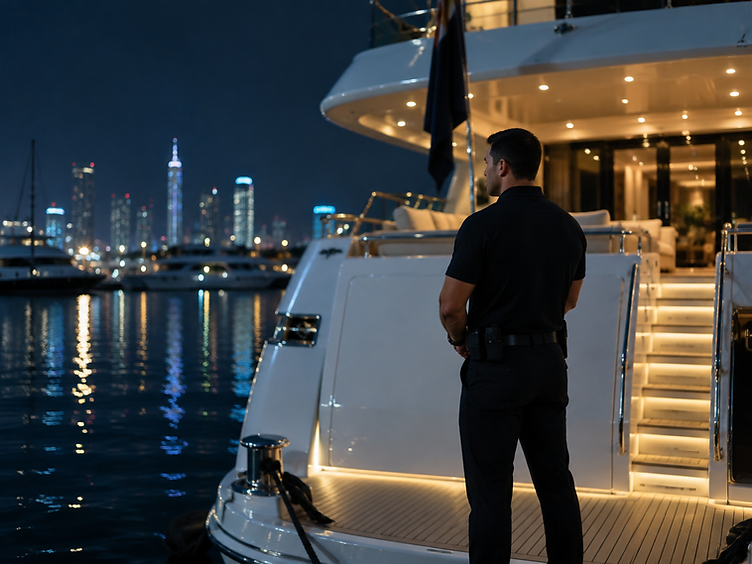
Maritime & Port Security in practice
USPA provides security for container terminals, cruise piers, bulk docks, shipyards and port authority facilities. Officers work from the facility security plan: credential verification at the gate, truck and driver checks against terminal paperwork, yard and waterside patrols with checkpoint documentation, and same-day written incident reporting.
Maritime assignments answer to several authorities at once. The Coast Guard enforces facility security requirements under the Maritime Transportation Security Act, Customs and Border Protection controls the cargo boundary, the TWIC program governs unescorted access, and the terminal operator applies its own rules. USPA writes the post orders against all of those layers and briefs every officer before the first shift.
USPA's maritime operations include coordination between vessel captains and regional personnel, supported by Associate Manager, Maritime Operations Michael Evans Jr.
Gate and credential control
TWIC and terminal credential verification, driver and paperwork checks, and escorted access for anyone without valid credentials.
Yard and waterside patrols
Rounds along container yards, bulk docks, rail sidings and the water line, documented at checkpoints.
Cruise terminal operations
Screening support, queue and crowd management, crew passageways and gangway coverage on turnaround days.
Cargo and inventory protection
Seal checks, load verification and high-value cargo coverage at the points where custody changes.
Vessel arrival and surge staffing
Coverage scaled to the terminal's sailing and vessel calendar, including reinforcement for ship operations.
Compliance documentation
Gate logs, patrol records and incident files maintained for the facility security officer, insurers and reviewing authorities.
Research · Subsea cables · Systemic risk
Subsea Communication Cable Protection & Physical Interception
A Systemic Risk Analysis of Maritime Infrastructure, Acoustic Sensing, and Enterprise Connectivity. A public-source monograph on anchor damage, acoustic sensing, landing-station exposure and repair bottlenecks on the cable routes that carry enterprise connectivity. 21 sections, 13 tables, 24 cited sources. Not a carrier or cable-owner assessment.
Research · Houston Ship Channel · Cyber-physical risk
Port Houston Maritime Cyber-Physical Security & Compliance Risk Analysis
A public-source analysis of industrial IT/OT dependencies at MTSA-regulated facilities along the Houston Ship Channel, the difference between the Coast Guard rule and its implementation guidance, and the Cybersecurity Assessment, Officer designation and Plan submission milestone of July 16, 2027. Authored by Michael Evans Jr.. Not a Coast Guard or facility-approved assessment.
Maritime authorities and source documents
The statements on this page about access control, credentialing and facility security obligations are grounded in the authorities below. Each links to the official source so the facility security officer, the insurer or the port authority can verify the basis directly.
- U.S. Coast Guard
Maritime security and facility requirements
The service that enforces facility security plans and the maritime security zones a port assignment operates inside.
Official Source → - Coast Guard Homeport
Sector notices, security zones and port conditions
Sector-level bulletins and marine safety information that change how a terminal or berth is worked.
Official Source → - TSA
Transportation Worker Identification Credential (TWIC)
The credential program governing unescorted access to regulated maritime facilities.
Official Source → - U.S. Customs and Border Protection
Cargo security at ports of entry
The cargo and border controls that apply at the terminal boundary, including seal and manifest integrity.
Official Source → - MARAD
Maritime Administration
Federal maritime policy, port and sealift programs, and the agency's published security guidance.
Official Source → - AAPA
American Association of Port Authorities
The port industry body whose published standards and security practice inform terminal operations.
Official Source →
Research and public links
Maritime coordination
Maritime patrol assignments are coordinated by Michael Evans Jr., Associate Manager of Maritime Operations, working with regional field operators and vessel captains across the company's port markets. His management profile sets out the role, the record behind it and the markets it covers.
Rated 4.9 by the clients we protect
Reviews are collected from real assignments across the country. Read them directly on Google before you call.
I have their pricing to be very affordable and competitive. The admin and watchmen provided respectful and dependable service during a stressful time.
William BeesleyGoogle reviewVerify This Review
Questions before you commit? Call (800) 214-1448 and ask for references on assignments like yours.
Questions clients ask before booking
- What does a port security guard do?
- Port officers enforce the facility's access rules: credential verification at the gate, driver and paperwork checks, yard and waterside patrols with checkpoint documentation, escorted access for anyone without valid credentials, and written incident reporting the same day. The post is built from the facility security plan rather than a template.
- How much does maritime security cost?
- Pricing is quoted per terminal: gates and patrols, armed or unarmed coverage, hours including surge staffing for vessel operations, and the supervision ratio. Multi-terminal clients are quoted on a schedule rather than shift by shift. Request a quote with the facility details for itemized pricing.
- Do your officers hold TWIC credentials?
- Officers assigned to regulated maritime facilities work under the Transportation Worker Identification Credential program, and unescorted access is granted only with a valid TWIC and the terminal's own vetting. Anyone without a credential is escorted, keeping the facility's access record compliant for Coast Guard review.
- Can you staff cruise terminals?
- Yes. Cruise assignments are staffed against the sailing calendar: screening support at the terminal entrance, queue and crowd management on turnaround days, baggage staging, crew passageways and gangway coverage. Recurring sailings are placed on a standing schedule with the same supervisors.
- Can you cover multiple terminals under one contract?
- Yes. Multi-terminal clients run one account: one contract, one dispatch line and one reporting format across every facility, with the same supervision standard from terminal to terminal. A quote for an additional facility starts from the existing program's documentation.
- How quickly can port coverage start?
- Standard posts start within one to two weeks of the site walk, and rush coverage is staged through 24-hour dispatch from the standing roster in the market, often for the next shift. Vessel operations and unplanned events are reinforced the same way.
Need coverage now?
Dispatch and quoting are answered 24 hours a day. Licensing, insurance certificates and a written scope are issued with the quote.
Services requested alongside this one
Clients commonly pair these services when a site has more than one exposure.



USPA Nationwide Security services are provided, as applicable, by USPA employees, independently owned franchise offices, or certified contractors participating in USPA’s contractor programs established in 2005, with services performed under applicable state and local licensing requirements. USPA is managed by Kingsman Philanthropic Corp., a nonprofit organization whose mission since 2005 has included locating and assisting missing and trafficked girls. Kingsman’s work has been featured on Crime Stories with Nancy Grace.
