
Specialized Operations
Technical Surveillance Countermeasures
Technical surveillance countermeasures for boardrooms, residences and vehicles, conducted by JSOC-trained personnel and former intelligence contractors.
- 21+ Years in Business
- A+ Rated
- Veteran Owned and Operated
- Licensed and Insured
- 24/7 Dispatch
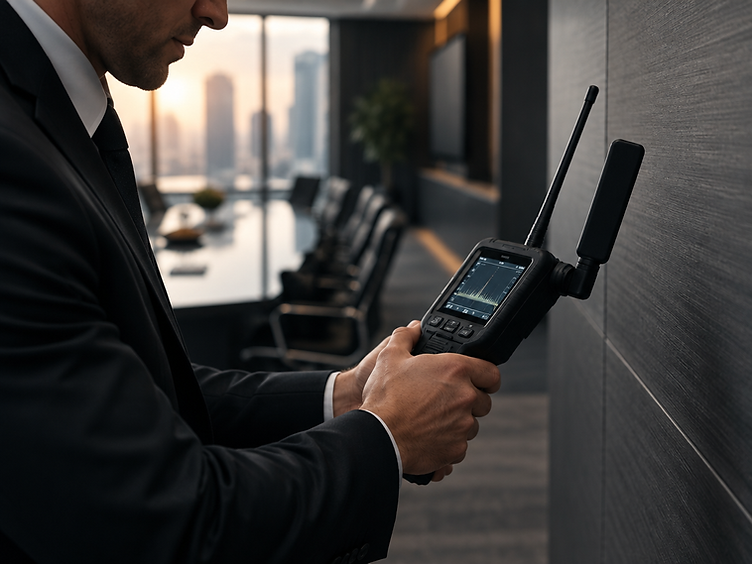
TSCM Bug Sweeps in practice
A TSCM survey looks for devices and pathways that carry a room's conversation outside the room: transmitters, hidden recorders, compromised cabling, wireless devices that should not be present and network equipment that does not belong. USPA teams include JSOC-trained personnel and former intelligence contractors who work from a baseline of what the space should contain.
Surveys are typically scheduled around board meetings, merger discussions, executive travel and residential moves. Findings are reported in writing, with a plain statement of what was found, what was ruled out, and what physical or technical change removes the exposure.
Boardroom and office surveys
Full sweep of meeting rooms, executive offices and communications equipment before sensitive discussions.
Residential and travel coverage
Executive residences, hotel suites and temporary locations, including sweep on arrival and after service visits.
Vehicle inspection
Inspection of executive and family vehicles for tracking devices and unauthorized equipment.
Written findings
A clear report of what was detected, what was cleared, and recommended remediation.
Standards that shape this work
- 18 U.S.C. § 2511
- The federal interception statute. Intercepting an oral, wire or electronic communication is a crime without a lawful basis, which is why a survey documents what is physically present in a space rather than what anyone says inside it.
- 18 U.S.C. § 2512
- Possession of an intercepting device is independently actionable. A device recovered during a survey is photographed, recorded and handed over on a written chain of custody instead of being kept, powered on or examined informally.
- 47 U.S.C. § 605 / FCC equipment rules
- Governs intercepted communications and the transmitting hardware itself. Radio-frequency devices found in a space are identified against FCC equipment authorization records before anything about them is put in writing.
- NIST SP 800-53 Rev. 5
- The control framework most federal, defense-adjacent and regulated clients organize physical and technical safeguards around. Surveys are scoped so findings map back to the client's own control set rather than standing alone.
- State all-party consent statutes
- California Penal Code § 632, Florida Statutes § 934.03 and New York Penal Law § 250.05 each reach further than the federal statute in different ways. City pages carry the statute that governs the survey in that market.
USPA surveys document conditions, not conversations. Nothing said in a swept space is captured, transcribed or retained, and findings are reported in writing to the client's designated contact. This page describes a service and is not legal advice; where a matter may become evidentiary, the client's counsel directs the handling.
What a TSCM survey actually establishes
A technical surveillance countermeasures survey answers a narrow question well: at the time of the survey, were there devices or pathways capable of carrying a conversation out of this space? It is an inspection with instruments and a method, not a certificate of privacy. The honest deliverable is a written record of what was examined, what was found, what was ruled out and what remains outside the scope of the examination.
That framing matters commercially because it is what a client can act on. A board that knows the boardroom's ceiling voids, cabling and network were examined before a merger discussion, and holds a document saying so, has something its general counsel can rely on. A verbal assurance that the room is 'clean' has none of that value, and it is not a claim a professional team can honestly make.
The work is also deliberately unglamorous. Most of a survey is wiring, access points, construction drawings, device inventories and the question of who has held keys to this room in the last year. The technical instruments resolve the rest.
Why the survey starts with a baseline, not a search
An instrument can only flag what it is not expecting. The first phase of a real survey is therefore an inventory: the access points and their MAC addresses, the cordless handsets, the wireless microphones, the building's life-safety and access-control emitters, the printers, the conference equipment, the client's own recording devices. Every legal emitter in the room is accounted for and logged before the room is judged.
That baseline is also the document the next survey reuses. A room swept quarterly against a recorded baseline is measurably easier to clear than the same room swept cold, which is why a program beats a one-off engagement in exactly the way a compliance program beats an annual audit.
Where no baseline exists — a new executive, a newly acquired floor, an inherited residence — building one is part of the first survey rather than an extra step, and it usually surfaces the same thing that a search would have: equipment nobody in the room can explain.
- Broadband radio-frequency survey
- A spectrum analyser and broadband receiver sweep the space across the bands a transmitter would realistically use, from low-frequency audio carriers through the Wi-Fi, cellular and satellite bands. What matters is the baseline: the survey starts by recording every legitimate emitter in the room — access points, DECT handsets, wireless microphones, building systems — so an unaccounted signal is visible rather than lost in ambient noise.
- Non-linear junction detection
- A non-linear junction detector transmits a low-power signal and listens for the harmonic response a semiconductor junction produces. It finds electronics that are switched off and not transmitting, including devices in walls, furniture and conduit, which is precisely the case an RF sweep alone cannot resolve. It locates candidates; each one is then verified physically before anything is called a finding.
- Thermal and physical inspection
- Thermal imaging shows the heat signature of equipment that is powered but dormant, and hand inspection covers what instruments miss: a device behind a vent, a recorder in a smoke detector, an additional cable in a run of structured wiring. Walls, ceilings, millwork, lighting fixtures, HVAC penetrations and furniture are inspected against the room's own construction record where one exists.
- Telephony, network and structured cabling
- Telephone and data infrastructure is where a room's conversation most often leaves without a radio transmitter: spare pairs, punchdown blocks, a rogue switch, a network drop that terminates outside the floor, or a device presenting itself as a printer. The survey traces the cabling and checks the network for equipment that does not belong to the client's inventory.
- Optical and line-of-sight inspection
- Borescopes and optical scopes inspect voids, ducts and sealed spaces without destructive opening, and windows, mirrors and adjacent spaces are checked for line-of-sight and reflective paths — the low-technology route a conversation takes out of a room that also happens to be the hardest to detect with an instrument.
- Vehicles, yachts and transient spaces
- A vehicle survey covers the cabin, underbody, aftermarket wiring, headliner, seat assemblies and the telematics installation; a yacht adds the bridge, salon, staterooms, engineering spaces and satellite and network equipment. Transient spaces — hotel suites, private aviation arrivals, event venues — are swept on arrival, when the baseline is short but the exposure is immediate.
The legal line a sweep sits inside
A defensive survey and an interception are different acts, and the distinction is what makes the work lawful. A survey detects, locates, photographs and documents equipment. It does not capture the content of anyone's communication, does not operate a device it finds and does not monitor the individual who placed it. The federal Wiretap Act at 18 U.S.C. § 2511 turns on interception of conversations in which the parties have a reasonable expectation of privacy; detection is not interception.
State law adds weight to the same discipline. California requires all parties to consent before a confidential communication is recorded (Penal Code § 632); Florida's statute (§ 934.03) and New York's eavesdropping provision (Penal Law § 250.05) work from similar premises. In every one of those jurisdictions the survey's value is unaffected by the restriction, because the client does not need the content to know the room is compromised — the device is the answer.
Finding a device creates its own obligations. Possession of equipment primarily useful for surreptitious interception is an offence under 18 U.S.C. § 2512, and a device found on a client's premises is evidence. It is photographed in place, its position and appearance recorded, power state noted without alteration, and the chain of custody started before anything is moved. Whether to preserve it, hand it to law enforcement or leave it in place under observation is a decision for the client and its counsel, taken with the survey team's factual report in hand.
What a survey cannot do
A survey cannot certify a room as free of surveillance, and any provider who promises that is describing something no instrument can deliver. It is a point-in-time examination: a device placed after the team leaves is outside the finding. Software-based collection on a phone or laptop, lawful interception by a carrier, and a compromised account are all distinct problems that a physical sweep does not address — they belong to forensic device examination and cyber work, which is a separate scope.
It also cannot substitute for access control. If the room's keys, codes and contractor history are not recorded, the survey is being used to compensate for a control that is failing, and it will keep finding the same thing. The report says so when that is the case, because the fix is a different control, not a more frequent sweep.
The deliverable
What the written report contains
The report is the product. It opens with the scope in plain language: every space and asset examined, the date and time of the survey, the personnel present and the instruments used. It records the baseline — the legitimate emitters identified in each room — and the examination record for walls, ceilings, cabling, telecom, network equipment, furniture and vehicles.
- Scope: spaces, assets, dates, personnel and instruments used
- Baseline: every legitimate emitter identified in each room
- Examination record: walls, ceilings, millwork, cabling, telecom and network
- Findings: location, description, photographs taken in place, disposition
- Unexplained signals reported as unresolved, with what would resolve them
- Recommendations limited to physical and access corrections the survey supports
- Limitations of the examination stated in the same plain language as findings
When to schedule a survey
Cadence follows events. The highest-yield triggers are a sensitive meeting or negotiation date, a merger, financing or litigation milestone, a renovation or AV or IT installation, a change of executive assistant, house manager or facilities vendor, a residential move or a new acquisition, a leak the client cannot explain, and an active threat picture that includes surveillance.
A standing program for the rooms that carry the most consequential conversations is the other half: quarterly or semi-annual verification of a boardroom, an executive suite and a residence, tied to the client's own calendar rather than a vendor's renewal date. Between those points, event-triggered sweeps do the work.
Scheduling is the constraint that matters most in practice. A survey needs the space empty of the people who would learn from watching it happen, which usually means an evening, an early morning or a weekend. Book against the meeting date, not against availability, and allow time for the report to be read before the conversation it protects.
Procurement: questions that separate capability from marketing
Ask what the team will do before it arrives: is a baseline built from the room's own inventory, or is the instrument simply waved around? Ask which instruments are used and what each one answers. Ask how a candidate is verified before it is called a finding, and what happens to a device that is found — because that answer describes the team's discipline more accurately than any credential.
Ask for a redacted sample report. A report that lists instruments but not scope, or findings without photographs and dispositions, tells you the deliverable is a sales document. Ask whether the provider sells detection hardware, remediation or counter-surveillance services alongside the survey; an independence statement is worth more than a lower price.
Finally, ask who is on the team and where they are licensed. TSCM is not a licensed title in every state, while private investigation activity is regulated in many, and the agency licence behind the assignment matters when the findings reach a courtroom or an insurer.
Primary sources
Sources · federal and state
Statute, regulator and standards behind this page
The statements on this page about what a survey may lawfully do, how recovered equipment is handled and what a written report must contain are grounded in the documents below. Each links to the primary source so a general counsel, insurer or facility security officer can verify the basis directly.
- 18 U.S.C. § 2511
Interception and disclosure of wire, oral, or electronic communications
The federal Wiretap Act provision that makes intercepting a conversation in which the parties have a reasonable expectation of privacy unlawful without consent or lawful authority. It is the yardstick a defensive survey is scoped against.
Primary source - 18 U.S.C. § 2512
Manufacture, distribution, possession of interception devices
Possession of a device primarily useful for surreptitious interception is itself an offence. This is why a device found during a sweep is documented and preserved as evidence rather than handled or removed informally.
Primary source - 18 U.S.C. § 2510
Definitions: electronic, mechanical, or other device
The definitional section behind the Wiretap Act, written broadly enough to reach modern transmitters, recorders and the hardware that carries a room's audio out of the room.
Primary source - 47 U.S.C. § 605
Unauthorized publication or use of communications
The radio-communication privacy provision relied on in cases involving intercepted satellite, cellular and cordless traffic — the class of exposure a radio-frequency survey is looking for.
Primary source - FCC Equipment Authorization
How a radio transmitter is lawfully marketed in the United States
Equipment authorization, labelling and marketing rules for RF devices. A transmitter installed in a boardroom without authorization is a finding on its own, independent of what it transmits.
Primary source - NIST SP 800-53 Rev. 5
Security and Privacy Controls: physical and environmental protection (PE)
The federal control baseline corporate security programs map to. The PE family covers facility access and physical protection — the controls a survey verifies are actually holding.
Primary source - CISA Insider Threat Mitigation
Physical security and insider threat program guidance
The people-and-process side of the same exposure: how an insider places, powers or conceals a device, and what program measures reduce the opportunity.
Primary source - CISA Physical Security
Physical security resources for facility owners and operators
Federal guidance on layered physical protection, used here for the access-control and visitor-management measures that pair with a sweep program.
Primary source - California Penal Code § 632
Confidential communications: all-party consent
California requires the consent of all parties to record a confidential communication. It governs how a Los Angeles survey is scoped, and why detection — not capture — is the objective.
Primary source - Florida Statutes § 934.03
Interception and disclosure of wire, oral, or electronic communications
Florida's interception statute, applied to communications where the parties expect privacy. It shapes scope, evidence handling and reporting on a Miami assignment.
Primary source - New York Penal Law § 250.05
Eavesdropping
New York's eavesdropping provision covering mechanical or electronic overhearing of a conversation without the consent of at least one party. It frames what a New York survey may lawfully do.
Primary source
A survey is a detection assignment, not an interception. Nothing on this page describes capturing the content of a communication, and nothing here is legal advice: where a finding may become evidence, the decision is taken with counsel.
Rated 4.9 by the clients we protect
Reviews are collected from real assignments across the country. Read them directly on Google before you call.
I have their pricing to be very affordable and competitive. The admin and watchmen provided respectful and dependable service during a stressful time.
William BeesleyGoogle reviewVerify This Review
Questions before you commit? Call (800) 214-1448 and ask for references on assignments like yours.
Questions clients ask before booking
- How do I know if my office is bugged?
- Most clients cannot tell on their own, and that is the point of a professional TSCM survey: it looks for transmitters, hidden recorders, compromised cabling, wireless devices that do not belong and network equipment outside the baseline of what the space should contain. If conversations have leaked, or a sensitive discussion is approaching, a sweep is the reliable way to answer the question.
- How much does a bug sweep cost?
- Pricing depends on the size and number of spaces, the equipment required and whether vehicles or residences are included. Boardroom and office surveys are usually quoted per location with a defined scope. Request a quote describing the spaces and the timeline, and the team will return pricing with the proposed survey plan.
- How long does a TSCM sweep take?
- A single boardroom or office typically takes a few hours; multi-room floors, residences and vehicles extend the time. Sweeps are scheduled around the client's calendar, often immediately before board meetings, merger discussions or executive travel, so the space is verified clean when the sensitive conversation happens.
- What gets found in a typical sweep?
- Most sweeps confirm the space is clean, which is itself a useful finding for the client's records. Where devices or anomalies are found, the written report states what was detected, what was ruled out and what physical or technical change removes the exposure. Findings are documented rather than delivered verbally.
- Who performs the sweeps?
- USPA TSCM teams include JSOC-trained personnel and former intelligence contractors working from a baseline of what the space should contain. The work is discreet: survey teams arrive without signage or uniforms, and results are reported only to the client's designated contact.
- Can you sweep vehicles and homes?
- Yes. Executive vehicles are inspected for tracking devices and unauthorized equipment, and residences and hotel suites are swept on arrival and after any service visit. Vehicle and residential sweeps are commonly paired with executive protection for clients with an active threat picture.
Need coverage now?
Dispatch and quoting are answered 24 hours a day. Licensing, insurance certificates and a written scope are issued with the quote.
Services requested alongside this one
Clients commonly pair these services when a site has more than one exposure.





USPA Nationwide Security services are provided, as applicable, by USPA employees, independently owned franchise offices, or certified contractors participating in USPA’s contractor programs established in 2005, with services performed under applicable state and local licensing requirements. USPA is managed by Kingsman Philanthropic Corp., a nonprofit organization whose mission since 2005 has included locating and assisting missing and trafficked girls. Kingsman’s work has been featured on Crime Stories with Nancy Grace.
