
Maritime Security
Superyacht and Maritime Security
Security aboard a vessel is the management of one boundary: the gangway, the tender and the crew decide who reaches the owner. Most of the risk arrives from the shore side, not from the water, so the work is planned with the captain and the yacht manager before the first watch.
- 21+ Years in Business
- A+ Rated
- Veteran Owned and Operated
- Licensed and Insured
- 24/7 Dispatch
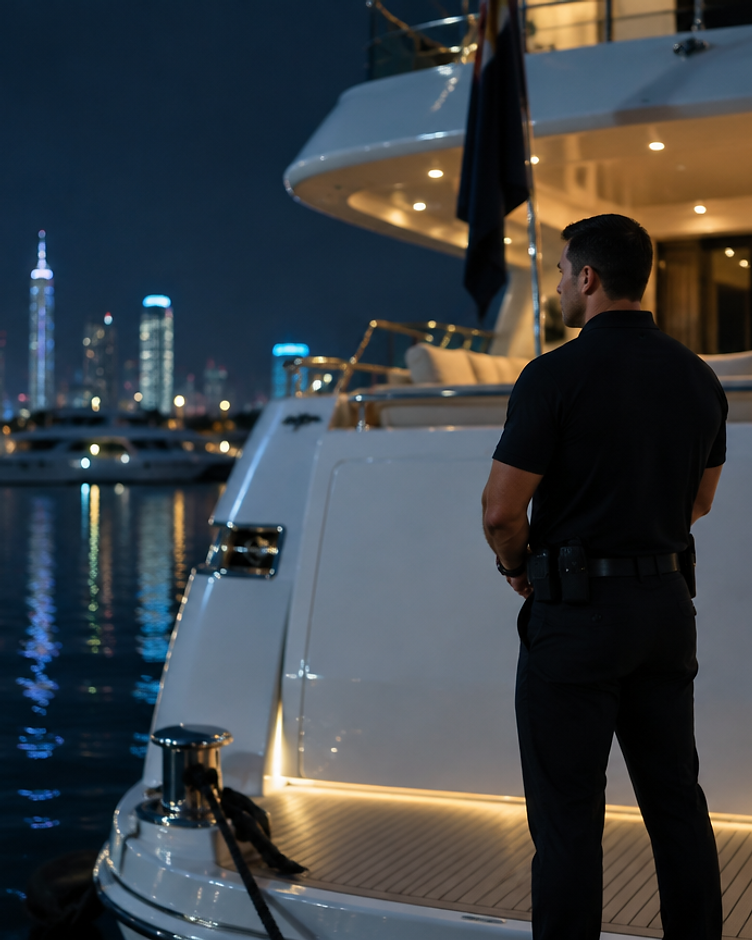
Gangway control, overnight watch and guest cover, planned with the captain.
Vessel needs coverage now?
Dispatch answers at any hour. Call with the vessel, the berth, the dates and the posture the captain wants, and coverage can often be staged for the same evening.
Technical research
Subsea communication cable protection: a systemic risk analysis
A public-source monograph on anchor damage, acoustic sensing, landing-station exposure and repair bottlenecks on the cable routes that carry enterprise connectivity, and the questions facility, continuity and security owners should be asking about their own exposure.
21 sections · 13 tables · 24 cited sources · 32 min read
A private residence with a public approach
A yacht is a private residence with a public approach. Anyone on the quay can see the aft deck, the marina gate opens to a street, and a tender lands a principal in front of whoever happens to be on the beach that day. Access runs through three points the owner rarely controls directly: the gangway, the tender and the crew.
USPA staffs yacht assignments around those three points. The procedures are written to fit the crew's routine rather than interrupt it, the officers report to the contact the owner or manager designates, and the record of who came aboard is kept for the owner rather than for the guard company.
Coverage is arranged per assignment rather than sold as a product: a single overnight alongside, standing coverage across a season, a detail for a charter week and travel cover across a passage are four different plans, and each is quoted from the vessel, the berth and the dates.
Six shapes of yacht work
Coverage is sized to what the vessel is actually doing: a quiet berth, a full guest list, a yard period or a passage.
Gangway and vessel access control
A verified visitor list agreed with the captain, delivery and contractor checks before boarding, and a written record of who came aboard and when.
Overnight berth and marina watch
Standing presence alongside for high-value vessels in busy or unfamiliar marinas, covering the vessel and its shore-side approach.
Principal and guest protection ashore
Discreet coverage from the dock to the itinerary and back, staffed by the same agents who hold the vessel.
Charter week coverage
Guest-heavy assignments where the visitor list changes daily and privacy expectations are briefed before the first watch.
Passage and anchorage coverage
Coverage that travels with the vessel, with the anchorage, landing and shore movement planned in advance at each call.
Yard periods and storm preparation
Coverage through refits, contractor traffic and weather standby, when the vessel is stationary and the perimeter is land.
Who engages yacht security
The request usually arrives through one of four people: the owner directly, a family office managing the owner's household, a yacht management company responsible for the vessel's operation, or the captain, who has to live with the arrangement once it is in place. Each cares about something different. The owner cares about privacy and how the presence reads to guests. The manager cares about liability, insurance and consistency across ports. The captain cares about whether the officers will be underfoot during a turnaround.
The plan is written for all four at once. Post orders cover the access rules, the reporting line, the uniform standard for the assignment and what an officer does when something is ambiguous, which is most of the time on a working dock. Privacy expectations are briefed before the first watch so an officer does not photograph, post or repeat anything about the guests.
Where the vessel is managed commercially, the arrangement runs through the management company's own procedures and insurance requirements. Where the owner keeps the boat privately, the plan is agreed directly with the owner's representative and the captain.
Access control at the gangway and the tender
The gangway is the vessel's front door, and it is usually the least controlled point on the dock. Officers work from a visitor list agreed with the captain and updated as the day changes: who is expected, who is authorized to sign for deliveries, which contractors are cleared to work aboard, and which guests may bring additional people. Anyone not on the list is held at the dock and referred to the crew contact, not negotiated with.
Deliveries and contractors get the same treatment. Provisioning, florists, technicians and yard hands are checked against the list before they board, escorted where the vessel requires it, and logged on arrival and departure. The luxury asset oversight discipline used at a private residence transfers directly: nothing comes aboard and nothing leaves without a record.
Tenders are the second door and the one most often overlooked. Officers control the boarding point when the tender is running, verify the transfer against the manifest, and coordinate the timing with the captain so the vessel's own routines carry the load where they can. See event security for the same arrival structure applied to a guest list ashore.
Guest protection between the dock and the itinerary
Most of the exposure in a yacht assignment happens within a short distance of the water. A principal steps off the passerelle into a marina car park, a restaurant terrace or a public promenade, and the vessel's own security architecture stops at the gate. The officers who hold the dock are the natural people to hold that transition, because they already know the guest list, the schedule and the posture the owner asked for.
Movements ashore are advanced rather than improvised: the route, the arrival point, the venue's entrance and the departure are checked in advance, and the secure transportation leg is staged so the principal is never waiting in an uncontrolled area. Where the itinerary involves a venue with its own security, the advance establishes who is in charge at the door before anyone arrives.
For principals travelling with a permanent detail, the vessel assignment folds into the existing executive protection rota so the client sees one posture rather than two vendors with different procedures.
Charter weeks, owner trips and events aboard
A charter changes the security problem completely. The visitor list turns over daily, guests arrive with their own staff and expectations, and the vessel is a venue as much as a residence. Officers are briefed on the charter guest list each morning, verify arrivals against it, and hold the boarding point during the excursions and receptions that fill the itinerary.
Owner trips are quieter but less predictable: the guest group is fixed, the schedule is personal, and privacy matters more than visible presence. Many owner assignments are staffed unarmed and in plain clothes, working from the vessel and the shore side in support of the crew rather than in uniform on the dock.
Where the vessel hosts an event, the structure is the one used for event security ashore: an access plan, a verified list, screening at the boarding point and an officer briefed on the guest profile rather than only the door.
Passages, anchorages and destination coverage
Coverage can travel with the vessel. On a passage, officers work the watch routine agreed with the captain, hold the deck and boarding points at each call, and support the crew on shore movements at the anchorages and marinas along the route.
Advance work at each destination is what makes that possible. Before the vessel arrives, the marina or anchorage, its access routes, the landing points and the local environment are assessed, and the findings are written into the plan rather than kept in an officer's head. Where local licensing or flag requirements limit what an armed officer may do aboard or ashore, that is established before departure, not at the berth.
For itineraries that cross into another jurisdiction, the coordination is documented: who is licensed where, which officers travel with the vessel and which are engaged locally. The client receives one scope that covers the whole route.
Yard periods, storm preparation and standby
A vessel in a yard is a property under construction, and the perimeter is land. Contractor traffic runs all day, equipment and materials sit outside the hull, and the vessel's own systems are partly disabled. Officers control the yard gate as it applies to the vessel, verify who is working aboard, log equipment in and out and keep the overnight watch.
Weather standby is a separate assignment. When a storm track threatens a berth, the priority is the vessel's own preparation: lines, covers, tenders, loose gear and the decision to move or stay. Security's role is to keep the dock and the yard perimeter controlled while that happens, to protect the vessel and adjacent property through the event, and to hold the berth in the days afterward when the marina is open to anyone.
Both assignments are quoted from the vessel, the berth or yard, and the hours of coverage rather than from a standard rate, because a two-week refit and a four-day standby have little in common.
How an assignment is planned
Four steps, in order, before an officer stands at the gangway.
Step 01
Vessel and berth brief
The captain or manager provides the vessel's layout, the berth, the guest profile, the crew routine and the posture the owner wants.
Step 02
Advance and coordination
The marina, the access routes, the landing points and any venue on the itinerary are assessed, and the crew contacts are established.
Step 03
Post orders and briefing
Written post orders cover access rules, the reporting line, privacy and the escalation path, and officers are briefed before the first watch.
Step 04
Coverage and daily reporting
Officers hold the gangway, tender and shore movements, with the visitor log and a daily report going to the owner's designated contact.
Superyacht security questions
What does superyacht security actually involve?
Access control at the gangway and tender, oversight of deliveries and contractors, overnight presence alongside when the berth or the profile calls for it, and protection for the owner's guests between the vessel and their itinerary ashore. The work is planned with the captain and yacht manager so it fits the crew's routine rather than interrupting it.
Can officers travel with the vessel?
Yes. Coverage can accompany a vessel on a passage and continue at each call, and shore-side coverage can be arranged in advance at each destination. Where another jurisdiction is involved, the licensing position for each officer is established before departure and documented in the scope.
How do you coordinate with the captain and crew?
Coordination with the captain and yacht manager is the starting point of every assignment. Post orders are written around the crew's routine, officers report to the contact the owner designates, and the visitor log and daily reporting are structured so the captain is not managing security on top of running the vessel.
Are officers armed aboard a yacht?
Armed and unarmed coverage are both available. The decision follows the owner's risk assessment, the vessel's own policy, the flag requirements and the licensing rules that apply at the berth or ashore. Many owner assignments are staffed unarmed and in plain clothes, working from the vessel in support of the crew.
Do you cover charters, events aboard and owner trips?
Yes. Charter weeks, owner trips and events hosted aboard are staffed with the same access structure used ashore: a verified list, screening at the boarding point and officers briefed on the guest profile. The visitor list is reconciled each day the guests turn over.
How far in advance should yacht coverage be booked?
Advance notice of a week or more allows for marina coordination and crew briefing, and longer notice is better for passages that cross jurisdictions. Short-notice coverage is available when an itinerary changes, and standing coverage for a season is arranged in advance.
What drives the cost of yacht security?
The vessel, the berth, the hours of coverage, the number of officers, whether coverage travels with the vessel and whether armed officers are required. A single overnight watch, a standing seasonal arrangement and a multi-stop passage are quoted separately. Request a quote with the vessel, the berth and the dates for a written price.
What documentation is provided before coverage starts?
A written scope, the licensing documentation for each officer on the assignment, a certificate of insurance and the post orders. Where a management company or insurer has its own requirements, those are incorporated into the scope before the first watch.
Maritime authorities and source documents
The statements on this page about access control aboard, credentialing and the rules that govern an armed detail on a vessel are grounded in the authorities below. Each links to the official source so an owner, captain or management company can verify the basis directly.
- U.S. Coast Guard
Maritime security and facility requirements
The service that enforces facility security plans and the maritime security zones a port assignment operates inside.
Official Source → - Coast Guard Homeport
Sector notices, security zones and port conditions
Sector-level bulletins and marine safety information that change how a terminal or berth is worked.
Official Source → - TSA
Transportation Worker Identification Credential (TWIC)
The credential program governing unescorted access to regulated maritime facilities.
Official Source → - U.S. Customs and Border Protection
Cargo security at ports of entry
The cargo and border controls that apply at the terminal boundary, including seal and manifest integrity.
Official Source → - MARAD
Maritime Administration
Federal maritime policy, port and sealift programs, and the agency's published security guidance.
Official Source → - AAPA
American Association of Port Authorities
The port industry body whose published standards and security practice inform terminal operations.
Official Source →
Vessel and shore-side sources
Services requested alongside yacht assignments
A vessel rarely has one exposure. These are the services owners and managers pair with it.
Executive Protection
Close protection and advance work for principals travelling with a permanent detail.
Secure Transportation
Protective drivers and staged vehicle movements between the dock and the itinerary.
Event Security
Access plans and guest-list screening for events hosted aboard or ashore.
Estate Security
Residence coverage where the vessel and the property are managed as one perimeter.
Rated 4.9 by the clients we protect
Reviews are collected from real assignments across the country. Read them directly on Google before you call.
I have their pricing to be very affordable and competitive. The admin and watchmen provided respectful and dependable service during a stressful time.
William BeesleyGoogle reviewVerify This Review
Questions before you commit? Call (800) 214-1448 and ask for references on assignments like yours.
Request superyacht security
Give the operations desk the vessel, the berth, the dates and the posture the captain wants. The written scope, licensing documentation, insurance certificate and quote follow before the first watch.
USPA Nationwide Security services are provided, as applicable, by USPA employees, independently owned franchise offices, or certified contractors participating in USPA’s contractor programs established in 2005, with services performed under applicable state and local licensing requirements. USPA is managed by Kingsman Philanthropic Corp., a nonprofit organization whose mission since 2005 has included locating and assisting missing and trafficked girls. Kingsman’s work has been featured on Crime Stories with Nancy Grace.
