
18 Hurt, Including 2 Firefighters, in Belmont Apartment Building Blaze
October 23, 2026· Albina Bieci
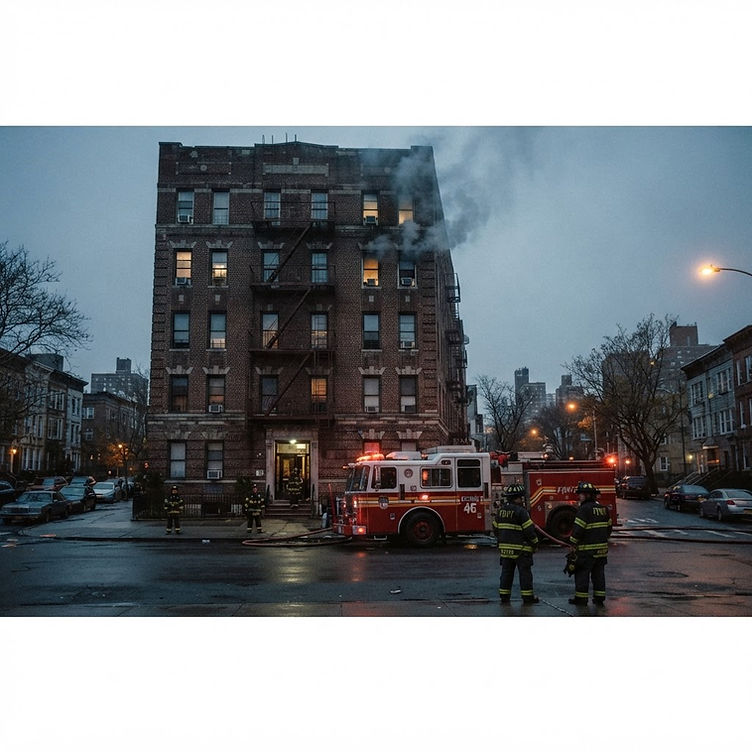
BRONX, N.Y. — A second-alarm apartment building fire in the Belmont section of the Bronx injured 18 people, including two FDNY members, during the early-morning hours of Thursday, October 22, 2026, according to fire officials. Emergency personnel responded to 2174 Crotona Ave. just before 7:45 a.m., and the blaze escalated to a second alarm approximately seven minutes after the first units arrived. FDNY crews declared the fire under control at roughly 8:20 a.m., containing a response that lasted just over 35 minutes from dispatch to knockdown.
Key Facts
- Location: 2174 Crotona Ave., Belmont, The Bronx, New York
- Time of dispatch: Before 7:45 a.m., Thursday, October 22, 2026
- Second alarm declared: Approximately 7:52 a.m.
- Fire controlled: Approximately 8:20 a.m.
- Personnel on scene: 141 fire and EMS personnel (FDNY)
- Injuries: 18 total — 16 civilians, 2 firefighters; all injuries described as minor
- Origin unit: Apartment 2A; fire extended to units 1A and 3A
- Vacate order: New York City Department of Buildings issued a partial vacate order for units 1A, 2A, and 3A
- Displaced households: Three households comprising 14 people registered for Red Cross emergency assistance
- Cause: Under investigation; not immediately known
What We Know
The fire originated in apartment 2A on the second floor of 2174 Crotona Ave., a residential building in the Belmont neighborhood, and extended vertically into apartment 3A above and apartment 1A below before crews brought it under control. Citizen app footage cited by News 12 Bronx showed open-flame conditions with orange fire visible at windows and black smoke rising into the surrounding area, consistent with a fire that had grown beyond the room or unit of origin before suppression efforts achieved control.
The FDNY deployed 141 fire and EMS personnel to the scene — a staffing level consistent with a multi-unit residential fire at second-alarm assignment in New York City. EMS treated all 18 victims on scene; officials described all injuries as minor. The two firefighters among the injured sustained injuries in the course of suppression operations, though the nature of those injuries was not specified in available reporting at the time of publication.
Resident Yolanda Jacobo, quoted by News 12, described being awakened by fire apparatus before she saw fire at the building from her window. Her account suggests that residents in the building were not initially alerted by an internal notification system, though it is unknown from the available record whether a building-wide fire alarm activated, whether notification was delayed, or whether residents on unaffected floors received any warning prior to the arrival of emergency personnel. That question is addressed further in the section below on what has not been confirmed.
The New York City Department of Buildings issued a partial vacate order covering the three directly affected apartments — 1A, 2A, and 3A. The American Red Cross registered three impacted households, comprising 14 people in total, for emergency assistance services including temporary housing support.
What Has Not Been Released
Several material facts remain unconfirmed as of the time of this report:
- Fire cause and origin investigation: The FDNY Bureau of Fire Investigation had not publicly released a cause determination as of the time of publication. Whether the fire was accidental, related to cooking equipment, electrical in origin, or any other cause is unknown and pending official determination.
- Firefighter injury details: The nature and severity of the two firefighter injuries have not been specified. It is unknown whether they involved burns, smoke inhalation, or traumatic injury.
- Civilian injury breakdown: No further detail on the nature of the 16 civilian injuries has been released beyond the characterization of all injuries as minor.
- Building fire alarm and suppression systems: It is unknown whether 2174 Crotona Ave. was equipped with a functioning sprinkler system, fire alarm system, or both, and whether either system activated prior to FDNY arrival. This is a significant open question for the investigation and for building code compliance review.
- Building age and classification: The occupancy classification and year of construction for 2174 Crotona Ave. have not been confirmed in available reporting. New York City building records may reflect this information but were not independently verified at the time of publication.
- Additional vacate orders: The partial vacate order covers three units. Whether the Department of Buildings intends to expand the order or conduct a broader structural inspection of the building has not been reported.
Technical Analysis: Fire Behavior, Code Obligations, and Fire Watch
The vertical spread pattern described in this incident — fire originating in a mid-floor unit and extending both upward and downward — is consistent with fire travel through structural penetrations, open doors, or compromised fire-resistive assemblies. Under NFPA 101, Life Safety Code, multi-family residential occupancies are required to maintain fire-rated corridor and floor/ceiling assemblies designed to contain fire within a compartment for a defined period, typically one to two hours depending on construction type and occupancy classification. When fire spreads beyond the floor of origin in a multi-family building, investigators and building owners should examine whether those assemblies performed as required.
If the building is equipped with an automatic sprinkler system — which is required in new construction and in buildings undergoing certain alterations under New York City's building code and fire code — the system's performance during this event would be subject to review. NFPA 25, Standard for the Inspection, Testing, and Maintenance of Water-Based Fire Protection Systems, establishes the ongoing inspection and testing obligations for sprinkler systems in residential occupancies. A system that failed to activate, was out of service, or was impaired at the time of the fire would need to be reported and addressed under NFPA 25's impairment procedures before the building can return to normal occupancy.
Similarly, the building's fire alarm system — if present — would be governed by NFPA 72, National Fire Alarm and Signaling Code. Resident Jacobo's account, in which she was awakened by external fire apparatus rather than an internal alarm, raises a factual question about whether any alarm notification reached building residents before FDNY arrival. This is not a conclusion — it is an open investigative question. If the fire alarm system was not functioning as required, NFPA 72 and applicable New York City fire code provisions would govern the building owner's obligations to restore the system and implement interim protective measures in the meantime.
For any residential building in which fire protection systems are found to be impaired, out of service, or not present, NFPA 101 and New York City Fire Code § 901.7 (governing impairment of fire protection systems) establish a framework under which the property owner or manager is typically required to implement a fire watch — a continuous patrol by trained personnel who monitor the premises for fire conditions and ensure that emergency services can be notified immediately if fire is detected. Fire watch is not a long-term solution; it is an interim measure intended to compensate for the absence or impairment of automatic protection until systems are restored or required upgrades are completed.
NFPA 601, Standard for Security Services in Fire Loss Prevention, provides additional guidance on the deployment of security and fire watch personnel in fire-impacted and fire-vulnerable properties. For multi-family residential buildings with displaced occupants, ongoing construction or restoration work, or compromised suppression systems, trained fire watch personnel represent a recognized layer of interim protection.
Property owners should also be aware of NFPA 51B, Standard for Fire Prevention During Welding, Cutting, and Other Hot Work, if restoration work at the building involves any hot work operations. Hot work in fire-damaged structures — where structural integrity may be compromised and combustible debris may be present — carries elevated ignition risk. Hot work fire watch requirements under NFPA 51B mandate a trained fire watch during hot work operations and for a defined period afterward.
Local Context
The Belmont neighborhood is a densely populated residential area in the central Bronx. Fires in multi-family residential buildings in this corridor carry elevated life-safety implications given building density, mixed occupancy profiles, and the number of residents who may be present during early-morning hours when evacuation is complicated by sleeping occupants. The timing of this incident — before 7:45 a.m. — is consistent with peak residential occupancy.
This incident follows a pattern of multi-family residential fires across the Bronx in recent years, several of which have resulted in significant injuries and displacement. The Bronx has historically had some of the highest fire rates among New York City boroughs, a reality that community advocates, city agencies, and building owners continue to address through code enforcement and tenant protection initiatives.
USPA Nationwide Security provides fire watch and security services throughout New York City and the greater metropolitan area. Property managers, building owners, and construction operators in the Bronx seeking fire watch coverage following a fire event, system impairment, or permit-required hot work can review available local services at Fire Watch Services – Bronx, NY and Security Guard Services – Bronx, New York. Reaching out early — before restoration work begins — gives property owners the best opportunity to establish compliant interim protection before inspectors or code officials require it.
The Property's Next Obligations
With a partial vacate order in place covering three units, the building owner and management face several near-term obligations:
-
Department of Buildings compliance: The partial vacate order means units 1A, 2A, and 3A cannot be reoccupied until the Department of Buildings lifts the order following a satisfactory inspection. The building owner should engage a licensed engineer or architect to assess structural and system integrity in the affected units and the building generally.
-
Fire protection system review: If the building's sprinkler or fire alarm system sustained damage or was found to be impaired, the owner is obligated to restore those systems and, in the interim, to implement fire watch or other code-required protective measures. This obligation typically arises immediately under NFPA 25, NFPA 72, and the New York City Fire Code.
-
FDNY Bureau of Fire Investigation cooperation: The cause of the fire remains under investigation. The building owner and any tenants with knowledge of conditions in apartment 2A prior to the fire should expect contact from investigators.
-
Tenant and Red Cross coordination: Fourteen displaced residents across three households are receiving Red Cross assistance. The building owner has independent obligations under New York City's tenant protection laws regarding alternative housing and communication during displacement periods.
-
Hot work fire watch if restoration involves trades: Any contractor performing cutting, welding, grinding, or other hot work during restoration is required to comply with NFPA 51B. The building owner should confirm that contractors carry and implement a written hot work program and fire watch protocol.
Sources and Open Questions
This report is based on information published by News 12 Bronx (Zoe Cosgrove and Leanna Wells, October 22, 2026) and on applicable NFPA standards, New York City Fire Code, and FDNY operational information available in the public record. The following questions remain open as of publication and will be updated as additional information becomes available:
- What is the official fire cause determination from the FDNY Bureau of Fire Investigation?
- Were fire alarm and sprinkler systems present at 2174 Crotona Ave., and did they function as required?
- What is the nature of the two firefighter injuries?
- Will the Department of Buildings expand the vacate order beyond units 1A, 2A, and 3A?
- What is the age, construction type, and occupancy classification of the building?
- Were any prior violations on file with the Department of Buildings or FDNY for this address?
This article will be updated as facts develop. Readers with information about this incident may contact USPA Nationwide Security's newsroom through the contact page at uspasecurity.com/contact.
Questions about fire watch, executive protection or guard coverage for your property? Request a quote or call our dispatch line.
More from the blog

Breaking News
Fire Crews Battle Vacant Apartment Building Fire in Kansas City's Wabash Block
Kansas City fire crews responded Sunday morning to a reported apartment building fire in the 2800 block of Wabash, where they encountered smoke and fire coming from a vacant two-story structure. Interior operations were conducted, searches came back all clear, and no injuries were reported. The cause remains under investigation.


Breaking News
Lithium-Ion Battery Fire Displaces Residents at Spokane's Donna Hanson Haven Apartment Building
A lithium-ion battery from an electric bicycle caused a fire on the third floor of Donna Hanson Haven in downtown Spokane on Saturday, October 25, 2026. The Spokane Fire Department evacuated all residents; Catholic Charities Eastern Washington coordinated decontamination, and most tenants returned home the same evening. Seventeen third-floor residents remain displaced with Red Cross support.

Breaking News
Pennsauken, NJ Apartment Building Evacuated After 3-Alarm Fire at Cooper River Apartments
A 3-alarm fire at the Cooper River Apartments on McClellan Avenue in Pennsauken, New Jersey forced the evacuation of roughly 40 residents early Monday morning. One woman jumped from the fifth floor before fire crews arrived and was transported to a local hospital. The cause of the fire has not been released.
