
Apartment Fire Displaces Nearly Two Dozen Residents in Deerfield, Illinois
October 25, 2026· Albina Bieci
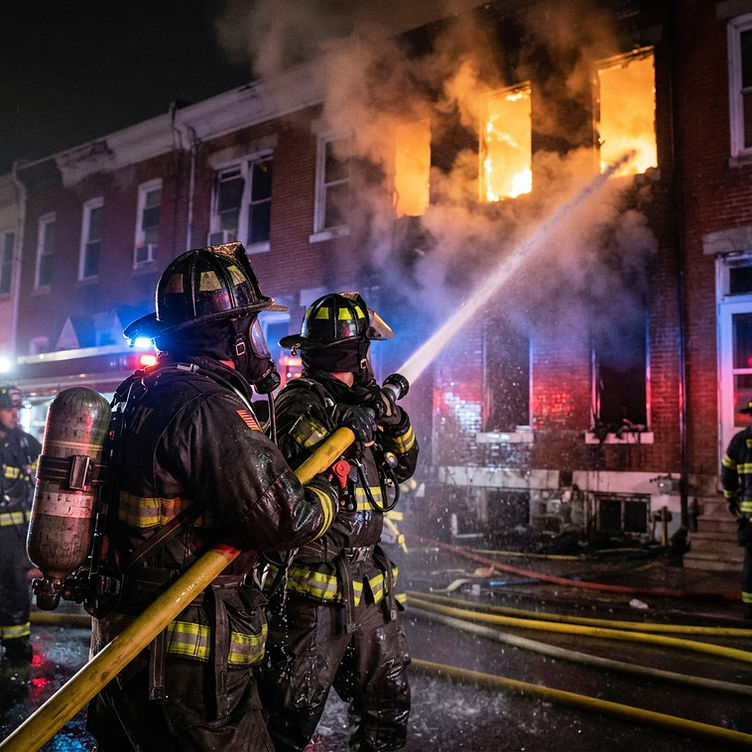
DEERFIELD, Ill. — A fast-moving fire broke out on the second floor of an apartment building in the 1100 block of Deerfield Road in Deerfield, Illinois, on the evening of Saturday, October 24, 2026, rapidly spreading into the roof structure and prompting a large-scale mutual aid response from multiple regional fire departments. Four people sustained injuries, two of whom were transported to area hospitals in stable condition, while two others were treated on scene by paramedics. An estimated two dozen residents across 16 apartment units were displaced by the time the fire was controlled.
The Deerfield Fire Department confirmed the initial response was dispatched around 7:30 p.m. after reports of a fully involved fire on the building's second floor. As flames spread into the roof, the department activated a MABAS Box Alarm — the Mutual Aid Box Alarm System used across the Chicago metropolitan region to coordinate multi-jurisdictional fire responses — drawing in additional resources from neighboring departments. A broader area power outage also affected nearby residents.
Key Facts
- Date and time: Saturday, October 24, 2026, approximately 7:30 p.m. CT
- Location: 1100 block of Deerfield Road, Deerfield, Illinois
- Injuries: Four total — two transported to hospitals (condition stabilized), two treated on scene
- Displacements: Approximately two dozen residents; 16 apartment units severely impacted
- Response: Deerfield Fire Department plus mutual aid units activated under a MABAS Box Alarm
- Relief: American Red Cross deployed on site to assist displaced families
- Fire origin: Second floor; fire extended into the roof structure
- Cause: Under investigation as of the time of this report
What We Know
The fire began on the second floor of the Deerfield Road apartment building and, by the time the first units arrived, had achieved what fire professionals describe as a fully involved state — meaning the fire had extended beyond its point of origin and was consuming available fuel load throughout the affected floor and into the roof assembly. This type of rapid vertical travel through a multi-story residential structure is consistent with compromised compartmentalization, whether through open construction features, fire door failures, or existing gaps in fire-resistive assemblies.
The Deerfield Fire Department, which serves the Village of Deerfield in Lake County, coordinated with neighboring departments through the MABAS system. MABAS Box Alarms are tiered activation protocols; the specific box level triggered on Deerfield Road has not been confirmed in the source material, though the deployment of multiple regional mutual aid departments suggests a significant alarm level was called. The combined resources were ultimately sufficient to bring the fire under control, though the extent of structural damage to the roof and upper floors had not been formally released at the time this article was written.
Four individuals required medical attention. Two were transported to local hospitals — the specific facilities have not been named — and were subsequently reported to be in stable condition. Two additional individuals were assessed and treated at the scene by paramedics without requiring hospital transport. The identities and ages of those injured have not been publicly released.
Sixteen apartment units were described as severely impacted, resulting in the displacement of approximately two dozen people. The precise unit breakdown — how many were rendered completely uninhabitable versus damaged but potentially repairable — has not been publicly confirmed. The American Red Cross arrived on scene to provide emergency shelter, food, and support services to displaced residents, consistent with its standard disaster relief protocols under its shelter and emergency services mandate.
A power outage affecting residents in the immediate area was reported as a consequence of the incident. The specific utility involved and the scope of the outage were not detailed in available source material.
What Has Not Been Released
Several material facts remain pending as of the time of publication. The cause and origin of the fire have not been officially determined; investigators from the Deerfield Fire Department or a designated fire investigation authority have not released findings. No information has been made available regarding whether the building was equipped with an active sprinkler system, a fire alarm system, or both, and whether either system activated as designed.
The age and construction type of the building have not been confirmed. These details are consequential: older multi-unit residential structures built before modern fire codes may lack the compartmentalization and suppression systems that current standards require. The degree and timeline of structural repairs have also not been announced, nor has any information about whether the building's owner or management company has retained a licensed contractor or fire protection engineer to assess the structure.
No statement from the building owner, property management company, or their insurance carrier has been made publicly available.
Technical Analysis: Fire Watch and Restoration Obligations
When a fire significantly damages a residential structure — particularly one where the roof assembly is involved — the property enters what fire protection professionals consider an impaired condition. Under NFPA 25, Standard for the Inspection, Testing, and Maintenance of Water-Based Fire Protection Systems, any suppression system that has been compromised, disconnected, or rendered inoperable by fire damage creates an impairment condition requiring an immediate fire watch until the system is restored. If the building on Deerfield Road had an active sprinkler system, and if that system was damaged or shut down during suppression operations, a fire watch obligation would have attached immediately upon impairment.
Fire watch under NFPA standards is a continuous, dedicated patrol — typically conducted by trained personnel who walk assigned areas at defined intervals, carry communication devices, and maintain written logs. It is not a passive presence or a secondary duty assigned to maintenance staff. The watch must remain in place until either the impaired system is restored and tested or the authority having jurisdiction formally releases the obligation.
For construction and repair work that will follow this fire — including the roof repairs and any reconstruction of fire-resistive assemblies — NFPA 51B, Standard for Fire Prevention During Welding, Cutting, and Other Hot Work, applies to any hot-work operations conducted during restoration. Before any welding, grinding, or torch cutting begins on structural repairs, a permit process must be in place and a fire watch must be maintained during and for a defined period after each work session.
The displaced residents and the building's future occupants also have an indirect stake in the restoration of the building's fire alarm system. NFPA 72, National Fire Alarm and Signaling Code, governs the design, installation, and restoration of fire alarm systems. Until the alarm system is verified, tested, and certified operational, occupants returning to any portion of the building would be doing so without the standard early-warning protections the code requires.
Local authorities having jurisdiction — in this case likely the Deerfield Fire Prevention Bureau in coordination with Lake County — will have inspection authority over the restoration process. The building owner or management entity should expect formal impairment notifications, required fire watch documentation, and re-occupancy inspections before any displaced residents are permitted to return.
Local Context and USPA's Presence in the Region
Deerfield is a north suburban community in Lake County, Illinois, situated approximately 25 miles north of downtown Chicago along the I-94 corridor. The village has a relatively modest residential density compared to Chicago proper, but its apartment stock includes older multi-unit buildings that, depending on construction vintage, may predate the suppression and alarm requirements codified in current Illinois building and fire codes.
The Chicago metropolitan area is one of the regions where USPA Nationwide Security maintains active service operations. Property owners, management companies, and insurance carriers navigating post-fire impairment obligations in the northern suburbs can access dedicated fire watch and security guard resources locally. For building owners and managers in Deerfield specifically, USPA provides fire watch and security services calibrated to exactly the kind of restoration scenario this incident presents — unarmed and armed guard patrols, continuous fire watch documentation, and coordination with the authority having jurisdiction throughout the impairment period. More information is available at USPA Fire Watch Services – Deerfield, IL and USPA Security Guard Services – Deerfield, Illinois.
The Property's Next Obligations
Regardless of how the cause-and-origin investigation concludes, the building's owner faces a defined sequence of obligations. The first priority is life safety: ensuring that no displaced residents re-enter compromised units until structural and fire-safety inspections clear the space. The second is impairment management: if any fire suppression or detection system is offline, a compliant fire watch must remain in place, documented and continuous, until systems are restored.
The third obligation is coordination with the authority having jurisdiction. In Illinois, the State Fire Marshal's office maintains oversight authority alongside local fire prevention bureaus, and the restoration of a multi-unit residential building following a fire of this scale will require formal re-inspection and likely a certificate of occupancy review before re-tenanting. The Illinois Department of Insurance and the building's carrier will also have documentation requirements that overlap with fire watch logs and inspection records.
Owners and managers who have not previously established a relationship with a licensed fire watch provider should do so before restoration work begins, as the impairment period — particularly during roof and structural repairs — is precisely when the fire risk at a damaged building is elevated rather than diminished. Open structural elements, exposed framing, and the absence of functional suppression systems create conditions that, in the event of a secondary ignition, could result in a total loss of a building that might otherwise have been salvageable.
Sources and Open Questions
This article is based on information available through local news reports of the October 24, 2026 incident and publicly known operational frameworks including NFPA 25, NFPA 51B, and NFPA 72. The following questions remain open and will be updated as information becomes available:
- What is the official cause and origin determination?
- Was the building equipped with a sprinkler system, and did it operate as designed?
- Was the building's fire alarm system operational at the time of the fire?
- What is the construction type and year of the building?
- Which mutual aid departments responded and at what MABAS box level?
- What is the full scope of structural damage to the roof and upper floors?
- Have displaced residents been placed in temporary shelter, and what is the expected timeline for re-occupancy assessment?
- Has the building owner or management company issued any public statement?
- Which hospitals received the two injured individuals who were transported?
This article will be updated as the Deerfield Fire Department and Lake County authorities release additional information.
For immediate assistance with fire watch services, post-fire security, or impairment patrol coverage in the Deerfield area and across northern Illinois, contact USPA Nationwide Security at (800) 214-1448 or visit the USPA Services page.
Related Reading
Questions about fire watch, executive protection or guard coverage for your property? Request a quote or call our dispatch line.
More from the blog

Breaking News
Fire Crews Battle Vacant Apartment Building Fire in Kansas City's Wabash Block
Kansas City fire crews responded Sunday morning to a reported apartment building fire in the 2800 block of Wabash, where they encountered smoke and fire coming from a vacant two-story structure. Interior operations were conducted, searches came back all clear, and no injuries were reported. The cause remains under investigation.


Breaking News
Lithium-Ion Battery Fire Displaces Residents at Spokane's Donna Hanson Haven Apartment Building
A lithium-ion battery from an electric bicycle caused a fire on the third floor of Donna Hanson Haven in downtown Spokane on Saturday, October 25, 2026. The Spokane Fire Department evacuated all residents; Catholic Charities Eastern Washington coordinated decontamination, and most tenants returned home the same evening. Seventeen third-floor residents remain displaced with Red Cross support.

Breaking News
Pennsauken, NJ Apartment Building Evacuated After 3-Alarm Fire at Cooper River Apartments
A 3-alarm fire at the Cooper River Apartments on McClellan Avenue in Pennsauken, New Jersey forced the evacuation of roughly 40 residents early Monday morning. One woman jumped from the fifth floor before fire crews arrived and was transported to a local hospital. The cause of the fire has not been released.
