
Electric Fleets & Thermal Runaway: How Fire Watch Protects Commercial Facilities Overnight
October 22, 2026· Brian Fitzgibbons
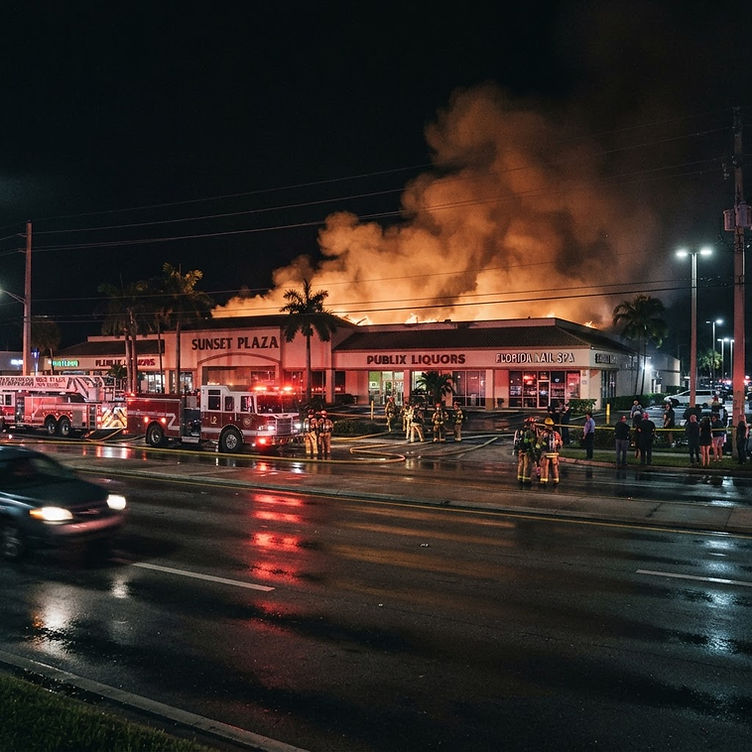
ST. AUGUSTINE, Florida – A fire destroyed the Golf Carts of St. Augustine building at 5960 U.S. 1 on the night of Wednesday, October 21, 2026. St. Johns County Fire Rescue confirmed the structure is a total loss, and crews remained at the scene into the night while part of U.S. 1 stayed closed. No one was injured. Inventory stored on a back lot escaped damage. The cause has yet to be determined, and the fire marshal's office will conduct the investigation.
Key Facts:
- Location: 5960 U.S. 1, St. Augustine, Florida.
- Timing: the fire was reported the evening of Wednesday, October 21, 2026.
- Loss: the building and everything inside it appear destroyed, according to St. Johns County Fire Rescue.
- Response: at least six fire trucks; crews pulled out of the building and shifted to a defensive operation.
- Injuries: none reported.
- Cause: unconfirmed; the fire marshal will investigate.
What We Know
The response drew neighbors into the street. Viewer video shared with Action News Jax showed a smoke column rising several hundred feet over the U.S. 1 corridor and a heavy initial assignment of apparatus. Chris Naff, a spokesperson for St. Johns County Fire Rescue, told the station that crews had to pull out of the building to run a defensive operation because of the amount of fire. A defensive operation means crews fight the blaze from outside the structure, a decision made when interior conditions put firefighters at unacceptable risk.
A neighbor, Bradley Dill, described going outside to a smoke cloud he estimated at two to three hundred feet high, and then hearing batteries blow up. "I'd see at least a hundred of them," he told Action News Jax. The account matters for facility managers who store electric carts, material handling equipment and other battery-powered machinery. Rupturing cells vent pressure audibly before and during thermal runaway, and a hundred such failures inside one building describes an environment ordinary suppression equipment struggles to reach in time.
Fire Rescue stated the building and everything inside appear destroyed. Assets on a back lot were not damaged. No injuries were reported.
What Has Not Been Released
Officials have not said what started the fire. The fire marshal will conduct an investigation, and its findings will establish whether an electrical fault, a charging system, or an outside ignition source is responsible.
Two operational facts remain publicly unknown. First, whether the building's detection or suppression systems were present, operational, or impaired at the time of the fire. Second, how much time passed between ignition and the first alarm. Both questions bear directly on the lessons commercial operators elsewhere can draw from this loss, and both belong in the marshal's report rather than in early speculation.
The Overnight Window
Commercial spaces are most exposed during the hours nobody is there. A golf cart dealership, a warehouse of electric machines, a manufacturing floor with charging banks: all of them concentrate electrical equipment in structures that sit unattended for eight to twelve hours at a stretch. Smoke that develops at two in the morning grows without witnesses until it reaches a ceiling alarm, and by that point the fire has often moved into void spaces and structural members. The St. Augustine fire reached a scale that forced an exterior defense within an unknown span of time, and the neighborhood video suggests the growth phase was fast.
Facilities that keep charging operations running overnight face a specific version of this problem. Charging converts electrical supply into stored chemical energy, which raises the temperature of battery packs and stresses connectors and cables. A failing connection or a damaged cell can present early thermal signs long before smoke or flame: warm surfaces, an unusual odor near the charger, discoloration at terminals. A person walking the room every hour sees those signs. A smoke detector answers only after particulate reaches it.
Battery Fire Behavior and Early Detection
When a lithium-ion cell fails, internal pressure builds until the vent opens and releases hot, flammable gas. The gas ignites, the failing cell's heat drives its neighbors past their tipping points, and the failure propagates through the pack. Fire service literature describes this sequence as thermal runaway. Suppression is difficult because the energy that feeds the fire is stored inside the fuel itself; water cools the exterior while cells deep in the rack keep venting. The witness account of a hundred rupturing batteries is consistent with that propagation pattern, and it explains why crews chose to defend the property from outside rather than push an interior attack.
The chemistry of the carts stored at the dealership has not been made public, so this article treats the mechanism as a general property of large battery inventories rather than as the confirmed cause of this specific fire. The point holds regardless of chemistry. A facility holding hundreds of energy-dense units carries a fire load that behaves differently from paper, cardboard or palletized goods, and it gives off early physical signs that a scheduled human inspection can catch.
What A Fire Watch Officer Adds To An Alarm System
A fire watch officer provides scheduled, documented human observation. The rounds follow a route through the areas of highest hazard, on a fixed interval, with the results recorded. At a charging facility, the officer looks for warm or discolored equipment, damaged cords, obstructed aisles, anything smoking, and any odor of overheated insulation. The observations go into a patrol log that documents time, area and condition, which is the record a fire marshal or insurer asks for after an incident. When an officer finds an abnormal condition, the escalation path is direct: call 911, isolate the equipment where it is safe to do so, and notify the property contact.
The duty is codified in NFPA 601, Standard for Security Services in Fire Loss Prevention, which governs watch personnel, patrol records and the handoff when conditions change. Where sprinkler or alarm systems are impaired, out of service for repair, or judged insufficient for the hazard, the fire watch becomes the primary detection layer until the systems are restored. NFPA 25 governs the inspection, testing and maintenance of water-based protection systems, and NFPA 72 governs fire alarm and signaling coverage, so a gap in either system is the point at which a trained watch officer carries the detection duty in person.
The economics deserve a plain statement. The St. Augustine building and its entire inventory were lost in a single night. A fire watch detail runs a fraction of the cost of the smallest piece of that inventory, and the asset it protects most is continuity: the ability to reopen, honor contracts and keep staff employed after a near miss.
Local Context
St. Augustine's U.S. 1 corridor carries a dense mix of dealerships, service shops, contractors' yards and light industrial tenants, and the region's growth keeps adding battery-operated fleets to buildings of ordinary construction. Florida's climate concentrates golf cart and low-speed vehicle use year-round, which means charging equipment runs daily and the fleets are large. Property owners in this market face the calculation the rest of the country is now working through: the machinery that earns the revenue is also the machinery that carries the fire risk, and the hours it sits charging are the hours the building stands empty. Facilities in this position can review the fire watch services in St. Augustine, FL and security guard services in St. Augustine, FL pages for local deployment details.
The Property's Next Obligations
The site at 5960 U.S. 1 now enters the post-fire sequence that follows any structure fire of this scale. The owner will coordinate with the fire marshal's office on scene security, debris management and access for investigators. Structural engineers and the insurer's specialists will assess whether any portion of the building can be salvaged. Utility service stays disconnected until the authorities confirm it is safe. If hot work enters the repair or demolition phases, cutting and welding on a fire-damaged structure triggers NFPA 51B permitting, and a fire watch remains mandatory during the work and for the period afterward while smoldering is possible.
Rebuilding on the site will proceed under current code, which may apply stricter requirements to battery storage and charging areas than the original construction met. Owners planning comparable facilities should treat the marshal's eventual findings as design input, particularly on detection coverage in charging rooms and the separation distances between stored carts.
Sources and Open Questions
This article is based on reporting by Jasmine Butler at Action News Jax and statements from St. Johns County Fire Rescue. The open questions that will shape the record: the ignition source identified by the fire marshal; the chemistry and condition of the battery inventory; the status of detection and suppression systems in the building; and the interval between ignition and the first alarm. This report will be updated as those findings are released. For facilities with similar overnight exposure, USPA Nationwide Security provides NFPA-aligned fire watch coverage nationwide; the service is described on the emergency fire watch page, and dispatch answers around the clock at (800) 214-1448.
Related Reading
Sources
- Action News Jax: Fire destroys Golf Carts of St. Augustine building on U.S. 1; no one hurt, officials say
- NFPA 601: Standard for Security Services in Fire Loss Prevention
- NFPA 72: National Fire Alarm and Signaling Code
- NFPA 25: Standard for the Inspection, Testing, and Maintenance of Water-Based Fire Protection Systems
Questions about fire watch, executive protection or guard coverage for your property? Request a quote or call our dispatch line.
More from the blog

Breaking News
Fire Crews Battle Vacant Apartment Building Fire in Kansas City's Wabash Block
Kansas City fire crews responded Sunday morning to a reported apartment building fire in the 2800 block of Wabash, where they encountered smoke and fire coming from a vacant two-story structure. Interior operations were conducted, searches came back all clear, and no injuries were reported. The cause remains under investigation.


Breaking News
Lithium-Ion Battery Fire Displaces Residents at Spokane's Donna Hanson Haven Apartment Building
A lithium-ion battery from an electric bicycle caused a fire on the third floor of Donna Hanson Haven in downtown Spokane on Saturday, October 25, 2026. The Spokane Fire Department evacuated all residents; Catholic Charities Eastern Washington coordinated decontamination, and most tenants returned home the same evening. Seventeen third-floor residents remain displaced with Red Cross support.

Breaking News
Pennsauken, NJ Apartment Building Evacuated After 3-Alarm Fire at Cooper River Apartments
A 3-alarm fire at the Cooper River Apartments on McClellan Avenue in Pennsauken, New Jersey forced the evacuation of roughly 40 residents early Monday morning. One woman jumped from the fifth floor before fire crews arrived and was transported to a local hospital. The cause of the fire has not been released.
