
Woman Critically Injured After Falling from Window During Three-Alarm High-Rise Fire at Cooper River Apartments in Pennsauken, NJ
October 26, 2026· Albina Bieci
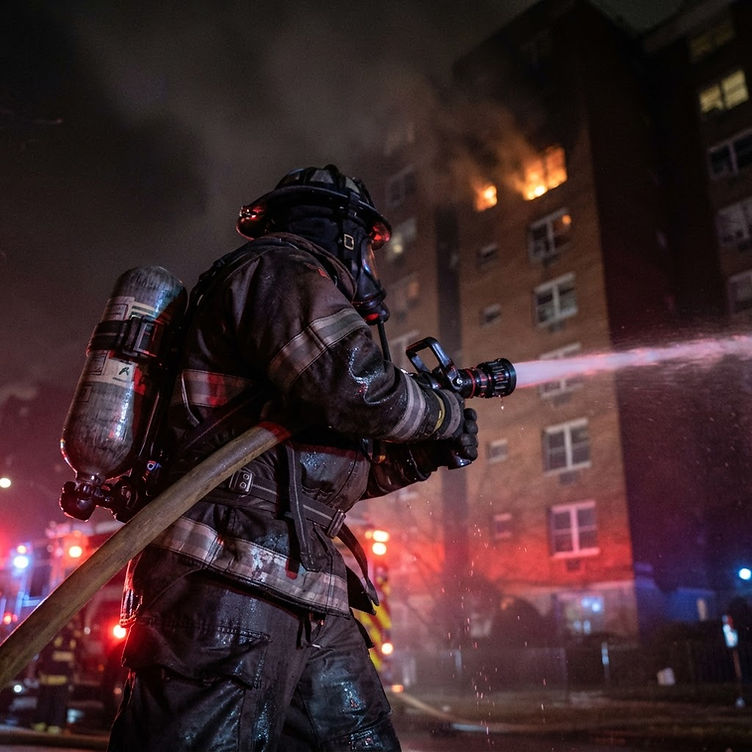
PENNSAUKEN, N.J. — A woman is in critical condition at Cooper Hospital after falling from a window during a three-alarm fire that swept through the Cooper River Apartments, a 14-story high-rise building at approximately 2400 McClellan Avenue in Pennsauken, New Jersey, in the early hours of Monday, October 26, 2026. The blaze prompted a mass evacuation, the mobilization of mutual-aid fire companies from neighboring departments, and two separate rescue operations — including the dramatic extraction of wheelchair-dependent residents stranded on the ninth floor.
The cause of the fire has not been determined as of initial reporting. No fatalities have been confirmed, though the injured woman's condition remains critical.
Key Facts
- Fire reported at approximately 2 a.m. on Monday, October 26, 2026
- Location: Cooper River Apartments, 2400 block of McClellan Avenue, Pennsauken, New Jersey
- Building: 14-story high-rise residential apartment complex
- Origin: Heavy smoke and flames observed on the fifth floor, rear of the building
- Critically injured: One woman, seen hanging from a window and fell to the parking lot before rescuers reached her; transported to Cooper Hospital
- Rescue: Two residents in wheelchairs on the ninth floor called 911 and were extracted by firefighters; neither was injured
- Alarms struck: Second alarm during initial response; third alarm after approximately one hour of firefighting operations
- Evacuation: Majority of residents evacuated; upper-floor residents directed to shelter in place
- Fire status: Placed under control as of reporting time
- Cause: Under investigation; no determination released
- Source: 6abc / WPVI-TV Philadelphia, published October 26, 2026
What We Know
Firefighters arrived to find heavy smoke pouring from an apartment in the rear of the building. Viewer video shared with WPVI Action News showed flames projecting from a fifth-floor unit. The conditions escalated quickly enough that incident commanders struck a second alarm shortly after arrival, drawing mutual-aid resources from neighboring fire departments serving the Camden County area.
The most severe immediate consequence involved a female resident who was observed by witnesses and rescuers alike hanging from a window above the parking lot. According to officials cited by WPVI, she let go and fell to the parking lot surface before rescue personnel could reach her position. She was transported to Cooper Hospital — the regional trauma center in Camden — in critical condition. No further updates on her status were available at the time of publication.
Approximately an hour into firefighting operations, incident commanders struck a third alarm, signaling that suppression efforts required still more resources and that conditions in the structure remained serious. Around the same time, two residents on the ninth floor — both individuals who use wheelchairs — called 911 to report they could not self-evacuate as smoke entered their apartment. Firefighters conducted a rescue operation and brought both residents to safety without additional injuries.
A neighbor who spoke to WPVI described awakening to sounds of shouting and people running outside before deciding to evacuate. He reported the stairwell was heavily smoky during egress and said he and others retrieved blankets from vehicles to provide to displaced residents gathered outside in the overnight hours.
Most residents were required to evacuate. Occupants on the upper floors, where smoke conditions may have been less immediately hazardous given the vertical movement of combustion byproducts in a high-rise scenario, were instructed by officials to shelter in place rather than attempt stairwell egress through smoke.
What Has Not Been Released
Several material facts remain pending as of this report:
- The precise cause and origin of the fire have not been determined or publicly disclosed
- The identity of the critically injured woman has not been released
- The number of apartment units affected, displaced, or rendered uninhabitable has not been confirmed
- The total number of residents displaced or sheltered overnight has not been released
- Whether the building's fire suppression system — if present — activated, and its operational status at the time of the fire, has not been addressed in available reporting
- Whether the building's fire alarm system provided timely notification to all floors has not been addressed
- Mutual-aid departments involved beyond the initial Pennsauken response have not been named in available reporting
- The woman's current medical status beyond "critical" at time of transport is unknown
- Whether any other occupants sustained smoke inhalation or minor injuries requiring treatment has not been confirmed
This article will be updated as additional information is released by the Pennsauken Township Fire Department, the Camden County Office of Emergency Management, or New Jersey State Fire Marshal's office.
Technical Analysis: High-Rise Fire Watch and Life Safety Obligations
High-rise residential fires present a distinct set of life safety and code compliance challenges that are worth examining in the context of what unfolded at Cooper River Apartments.
NFPA 101 and High-Rise Egress Considerations
NFPA 101, the Life Safety Code, establishes requirements for high-rise buildings — generally defined as structures greater than 75 feet in height above the lowest level of fire department vehicle access. A 14-story apartment building almost certainly meets this threshold. Among its provisions, NFPA 101 addresses egress capacity, smoke compartmentation, and the design criteria that govern how occupants should move through or shelter within a building during a fire event. The shelter-in-place guidance provided to upper-floor residents on Monday morning is consistent with accepted high-rise evacuation practice, which often calls for selective rather than total evacuation to avoid compounding hazards in smoky stairwells.
The incident involving the two wheelchair-dependent residents on the ninth floor raises questions about Areas of Rescue Assistance (ARA) compliance. NFPA 101 and the Americans with Disabilities Act Accessibility Guidelines require high-rise residential buildings to provide designated areas near stairwells where non-ambulatory residents can safely await firefighter-assisted evacuation. Whether the building had functional ARA provisions and whether those residents were aware of or able to reach them is among the open questions in this incident.
NFPA 25 and Fire Protection System Impairment
If the fire caused damage to the building's standpipe system, fire sprinkler system, or any portion of the wet or dry pipe suppression infrastructure, the property will be subject to the requirements of NFPA 25, the Standard for the Inspection, Testing, and Maintenance of Water-Based Fire Protection Systems. NFPA 25 governs how impairments to such systems are managed and what notifications are required when systems are out of service. Under those provisions, when a system or portion of a system is placed out of service, an impairment coordinator must be notified, and a fire watch must typically be established for the affected area or areas of the building.
NFPA 72 and Fire Alarm System Status
NFPA 72, the National Fire Alarm and Signaling Code, governs the installation, testing, and maintenance of fire alarm systems. The neighbor's comment to WPVI — that he initially assumed the sounding alarms might be a false alarm — is worth noting from a life safety standpoint. Alarm credibility is a recognized behavioral factor in high-rise fire incidents; occupants who have experienced previous false alarms in the same building may delay response. If post-incident investigation reveals patterns of prior alarm activity, that context will be material to any code compliance review.
Fire Watch Requirements Post-Incident
Depending on the extent of damage sustained by the building's fire protection and detection systems, the property manager and ownership will face potential requirements to establish a formal fire watch under applicable New Jersey fire code and NFPA standards. New Jersey's fire code, which adopts the International Fire Code with state-specific amendments, requires a fire watch when fire protection systems are out of service in occupancies above a certain size or risk threshold. In a 14-story residential building, even a partial system impairment covering a limited number of floors would almost certainly trigger this requirement.
A compliant fire watch requires trained personnel who conduct regular patrols, maintain communication, are equipped to report fire immediately, and document their rounds. It is distinct from ordinary security patrol work and must meet the standards applicable to the specific impairment. For a building of this scale, that typically means around-the-clock coverage until full system restoration is verified and tested in accordance with NFPA 25 and NFPA 72.
NFPA 51B and Hot Work Considerations
Until the cause of the fire is determined, the possibility that hot work — welding, cutting, grinding, or similar operations — was involved in ignition cannot be ruled out. If the investigation identifies a hot work connection, NFPA 51B, the Standard for Fire Prevention During Welding, Cutting, and Other Hot Work, would be relevant to any code compliance analysis. Maintenance operations in residential buildings, including HVAC servicing and renovation work, have historically been associated with hot work ignitions in multi-family structures.
Local Context
Pennsauken Township sits in Camden County along the Delaware River, bordered by Camden city to the south and Cherry Hill to the east. The Cooper River corridor is a densely populated residential zone, and multi-story apartment buildings along McClellan Avenue serve a substantial portion of the area's rental housing stock. Emergency response in this part of Camden County draws on both municipal resources and county-level coordination through the Camden County Office of Emergency Management.
For property managers and building owners in the Pennsauken area navigating post-fire impairments, code-compliant fire watch services and licensed security professionals are available locally. USPA Nationwide Security provides fire watch services in Pennsauken, NJ as well as security guard services in Pennsauken, New Jersey to support building owners and management companies with properly trained personnel during system outages and post-incident recovery periods. Rapid deployment matters in these situations: gaps in coverage between the moment a fire protection system goes offline and the arrival of trained fire watch personnel represent a period of elevated risk that building owners cannot afford to extend.
The Property's Next Obligations
Regardless of how the cause investigation concludes, the ownership and management of Cooper River Apartments will face several immediate and near-term obligations:
- Damage assessment of fire protection systems — A qualified fire protection contractor must inspect all standpipes, sprinkler heads, and alarm components on or near the fire floor and on any floors affected by heat, water, or smoke damage.
- Fire watch establishment — If any portion of the suppression or detection system is out of service, a documented fire watch must be in place continuously until restoration is complete and the system has passed required testing.
- Impairment documentation — Under NFPA 25, all impairments must be logged, reported to the appropriate authority having jurisdiction (AHJ), and tracked through to resolution.
- Resident notification and relocation coordination — Displaced residents are entitled to information about building habitability timelines, and Camden County social services agencies may be involved in emergency housing.
- Fire marshal cooperation — The New Jersey State Fire Marshal's office may conduct or supervise the cause-and-origin investigation. Property management should preserve the scene of origin to the extent possible pending that review.
- Insurance notification — Most commercial property policies require prompt notification of loss, and coverage for displaced residents may be implicated depending on the terms of individual renter's insurance policies.
- ADA compliance review — Given the difficulty experienced by the two wheelchair-dependent residents on the ninth floor, the building's evacuation plan and Areas of Rescue Assistance provisions may be subject to review by the AHJ or by civil counsel.
Sources and Open Questions
The primary source for this report is the WPVI Action News / 6abc article published October 26, 2026, based on reporting from the scene and statements from officials. The following questions remain open and will shape subsequent coverage as answers become available:
- What is the current medical status of the critically injured woman?
- What is the confirmed cause and origin of the fire?
- Was the building's sprinkler system activated? Was it operational at the time of the fire?
- Did fire alarm systems notify all floors in a timely fashion?
- What is the total number of units rendered uninhabitable?
- Was a formal fire watch established after the incident, and who is providing it?
- Has the Camden County Office of Emergency Management or the New Jersey State Fire Marshal issued any official statements beyond the initial WPVI reporting?
- Were any code violations or inspection flags on record for the property prior to Monday's incident?
This report will be updated as official statements, investigative findings, and additional reporting become available. Readers with direct knowledge of the incident or with questions about fire watch obligations for affected properties are encouraged to contact USPA Nationwide Security at (800) 214-1448.
Sources: WPVI Action News / 6abc Philadelphia; NFPA 25, NFPA 72, NFPA 101, NFPA 51B; New Jersey Uniform Fire Code; Americans with Disabilities Act Accessibility Guidelines.
Related Reading
Sources
- WPVI / 6abc Philadelphia — Woman critically hurt after dropping from window during high-rise apartment fire in Pennsauken, NJ (October 26, 2026)
- NFPA 25 — Standard for the Inspection, Testing, and Maintenance of Water-Based Fire Protection Systems
- NFPA 72 — National Fire Alarm and Signaling Code
- NFPA 101 — Life Safety Code
Questions about fire watch, executive protection or guard coverage for your property? Request a quote or call our dispatch line.
More from the blog

Breaking News
Fire Crews Battle Vacant Apartment Building Fire in Kansas City's Wabash Block
Kansas City fire crews responded Sunday morning to a reported apartment building fire in the 2800 block of Wabash, where they encountered smoke and fire coming from a vacant two-story structure. Interior operations were conducted, searches came back all clear, and no injuries were reported. The cause remains under investigation.


Breaking News
Lithium-Ion Battery Fire Displaces Residents at Spokane's Donna Hanson Haven Apartment Building
A lithium-ion battery from an electric bicycle caused a fire on the third floor of Donna Hanson Haven in downtown Spokane on Saturday, October 25, 2026. The Spokane Fire Department evacuated all residents; Catholic Charities Eastern Washington coordinated decontamination, and most tenants returned home the same evening. Seventeen third-floor residents remain displaced with Red Cross support.

Breaking News
Pennsauken, NJ Apartment Building Evacuated After 3-Alarm Fire at Cooper River Apartments
A 3-alarm fire at the Cooper River Apartments on McClellan Avenue in Pennsauken, New Jersey forced the evacuation of roughly 40 residents early Monday morning. One woman jumped from the fifth floor before fire crews arrived and was transported to a local hospital. The cause of the fire has not been released.