
Fire Crews Contain Commercial Structure Blaze at Interfor Lumber Facility in Georgetown County
October 25, 2026· Albina Bieci
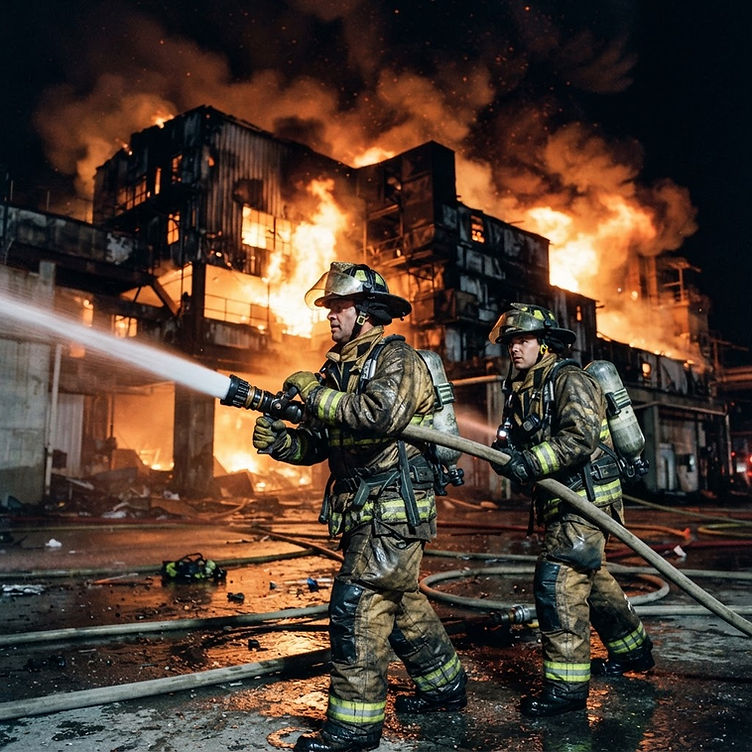
GEORGETOWN COUNTY, S.C. — Georgetown County Fire and EMS crews responded just after midnight on October 24, 2026, to reports of a large commercial structure fire at Interfor, a lumber processing and manufacturing facility in Georgetown County, South Carolina. Initial reports indicated that multiple buildings were involved, but first responders contained the fire to the building of origin, preventing spread to adjacent structures. Crews worked for several hours before the blaze was brought under control. No injuries were reported. The cause of the fire has not been released by fire officials as of the time of this report.
Key Facts
- Incident date and time: October 24, 2026, just after midnight
- Location: Interfor lumber facility, Georgetown County, South Carolina
- Responding agencies: Georgetown County Fire and EMS (primary), Georgetown City Fire Department and Midway Fire Rescue (mutual aid)
- Structures involved: Fire reported in multiple buildings initially; contained to building of origin
- Injuries: None reported
- Fire cause: Under investigation; not released
- Source: WCSC Live 5 News (live5news.com), published October 24, 2026
What We Know
According to reporting by WCSC Live 5 News, Georgetown County Fire and EMS units were dispatched to the Interfor facility shortly after midnight on October 24. Interfor is a Canadian-headquartered timber and lumber company with multiple mill and processing operations across the southeastern United States, including a presence in Georgetown County, South Carolina — a region with a historically deep connection to the timber industry. The initial dispatch reflected reports of multiple buildings on fire, a scenario that in industrial lumber operations carries an elevated risk of rapid fire progression given the fuel loads involved.
Firefighters from Georgetown County Fire and EMS led the response, with Georgetown City Fire Department and Midway Fire Rescue providing mutual aid. The multi-agency response is consistent with the scale of a large commercial structure fire at an industrial facility. Crews worked for several hours, and officials confirmed that the fire was contained to the building of origin — a significant operational success given the combustible environment of a lumber processing complex.
No injuries to civilians or firefighters were reported, which represents a favorable outcome in what the source material describes as a large commercial structure fire requiring hours of active suppression.
What Has Not Been Released
As of publication, several material facts remain unconfirmed or have not been disclosed by officials:
- Fire cause and origin: Investigators have not released a cause. It is unknown whether the fire is being treated as accidental, suspicious, or the result of a specific operational hazard.
- Specific building and damage extent: The source identifies that fire was reported in multiple buildings and contained to one, but the identity of the affected structure, its function within the facility (kiln, sawmill, storage, finishing), and the extent of structural damage have not been reported.
- Timeline of fire discovery and alarm activation: It is not known whether the fire was detected by an automated suppression or alarm system or by personnel on site, and what time elapsed between ignition and the first call to emergency services.
- Suppression system status: No information has been released regarding whether the building of origin was equipped with an automatic fire sprinkler system, and if so, whether that system activated and to what effect.
- Interfor's official statement: No company statement has been reported in the source material.
- Investigative jurisdiction: It is not confirmed whether the South Carolina Law Enforcement Division (SLED) or the State Fire Marshal's office has assumed investigative jurisdiction alongside local fire investigators.
This article will be updated as additional information is released.
Technical Analysis: Fire Risk in Lumber and Wood-Processing Facilities
Lumber and wood-processing facilities represent one of the most demanding fire environments in industrial occupancy classification. The concentrated fuel load — green and dried lumber, sawdust, wood chips, finishing materials, and lubricants used in milling equipment — creates conditions in which fires can accelerate rapidly and generate intense radiant heat that challenges the defensive perimeter of even well-equipped fire crews.
NFPA 1, the Fire Code published by the National Fire Protection Association, addresses general fire code requirements for commercial and industrial occupancies, including requirements for fire prevention programs, hot work controls, and housekeeping standards in facilities where combustible dust or debris accumulates. Sawdust and fine wood particles are a documented explosion hazard as well as a fire accelerant. NFPA 664, Standard for the Prevention of Fires and Explosions in Wood Processing and Woodworking Facilities, specifically governs facilities of this type, establishing requirements for dust collection, enclosures, ignition source control, and suppression system design. Whether Interfor's Georgetown County facility was operating in full compliance with NFPA 664 requirements at the time of the fire is not known.
NFPA 25, the Standard for the Inspection, Testing, and Maintenance of Water-Based Fire Protection Systems, governs the ongoing maintenance obligations for any sprinkler or standpipe systems installed in the facility. A compliant NFPA 25 program requires documented inspection and testing intervals; if the affected building's suppression system was found to be impaired or out of service prior to the fire, fire watch obligations under NFPA 25 Section 15.5 would have applied. Whether any impairment was recorded in advance of this incident is unknown.
NFPA 72, the National Fire Alarm and Signaling Code, sets standards for fire detection and alarm systems in commercial and industrial occupancies. Early detection in a lumber facility — especially during overnight hours when staffing may be reduced — is critical to limiting fire progression. The fact that the fire response was initiated just after midnight raises questions about detection and reporting time that have not yet been answered in available reporting.
For hot work operations — welding, cutting, grinding, and similar activities that generate sparks or open flames — NFPA 51B, the Standard for Fire Prevention During Welding, Cutting, and Other Hot Work, requires a fire watch to be maintained during and for a defined period after any hot work activity. In a lumber facility, where combustible surfaces and accumulated sawdust can harbor smoldering embers for extended periods after apparent extinguishment, this requirement is particularly consequential. Whether hot work was performed at the facility in the hours preceding the fire is not known.
Local Context: Georgetown County's Industrial Fire Risk Profile
Georgetown County sits in the Pee Dee region of coastal South Carolina, and the timber and lumber sector has been an economic pillar of the area for well over a century. Interfor has operated in the region as part of a broader footprint that spans North American timber markets. The presence of large-scale industrial lumber operations in the county means that local fire departments have an inherent working knowledge of the hazards associated with these facilities, and the mutual-aid framework activated on October 24 reflects the pre-planned coordination that large-structure industrial incidents require.
For property owners and facility managers in the Georgetown area evaluating fire safety and security posture in the aftermath of this incident, USPA Nationwide Security maintains service coverage throughout South Carolina. The Georgetown fire watch services page provides information on professional fire watch personnel qualified to maintain continuous monitoring during suppression system impairments, post-incident hot-work watches, and overnight coverage when detection systems are offline. The Georgetown security guard services page covers broader protective staffing solutions for industrial and commercial properties.
Post-fire security is a frequently underestimated obligation for facility operators. Once fire suppression has concluded and fire investigators have released the scene, owners face the simultaneous demands of debris removal, structural assessment, insurance investigation, and restoration — all while the site remains physically vulnerable. Perimeter control, access management for restoration contractors, and overnight patrol of a fire-damaged structure require coordinated professional security coverage that begins, in many cases, while the fire investigation is still active.
Property Obligations After a Commercial Structure Fire
Once first responders have cleared a scene and the incident command has been demobilized, the legal and operational obligations that fall to the facility owner or operator begin in earnest. These obligations are not discretionary and, in many jurisdictions, carry enforcement consequences if not addressed.
Fire watch continuation: If the facility's fire suppression or detection systems were damaged in the fire — a likely outcome in the building of origin — NFPA 25 requires that a documented fire watch be established for the duration of any system impairment. This means trained personnel conducting timed, documented patrols of the impaired area on a schedule that reflects the assessed risk level. A lumber facility with damaged suppression systems and residual combustible material represents an elevated impairment scenario under any reasonable interpretation of NFPA 25 guidance.
Building and fire code re-entry requirements: South Carolina's adoption of the International Fire Code and International Building Code, as amended, governs occupancy restoration. A building that has sustained structural fire damage cannot be reoccupied until local authorities having jurisdiction (AHJ) have inspected and issued appropriate clearances. The timeline for that process varies depending on the severity of structural compromise and the scope of required repairs.
Insurance and forensic investigation: Commercial property insurers will typically dispatch an independent forensic fire investigator to determine origin and cause before agreeing to coverage positions. Facility operators should preserve the scene to the extent possible and document conditions with photographic and written records prior to any debris removal. Coordination between the insurance investigator, local fire marshal, and any law enforcement investigators is standard practice.
OSHA recordkeeping and notification: The Occupational Safety and Health Administration requires employers to report certain workplace incidents within defined timeframes. If employees were present at the time of the fire or if the incident results in hospitalization, OSHA notification requirements under 29 CFR 1904 and 29 CFR 1910 may apply. The current report indicates no injuries, but facility management should verify whether any personnel were on site during the incident.
Environmental considerations: Lumber facilities may store treated wood, chemical preservatives, finishing compounds, and fuel for equipment. A fire involving these materials can generate runoff contaminated with combustion byproducts. South Carolina's Department of Environmental Services (formerly DHEC) and the Environmental Protection Agency may have notification or remediation requirements depending on what materials were involved and whether runoff entered adjacent waterways or soil.
Sources and Open Questions
The primary source for this report is WCSC Live 5 News (live5news.com), published October 24, 2026, under the byline of Colt Yeargin. USPA has not independently confirmed facts beyond those reported by the source outlet.
Open questions and unresolved items include:
- What is the official cause and origin determination, and when will investigators release that finding?
- Was the building of origin equipped with an automatic fire sprinkler system, and did it activate?
- Was hot work performed at the facility in the period preceding the fire?
- What is the extent of structural damage to the affected building and to any adjacent structures that received radiant heat exposure?
- Has Interfor issued a statement regarding operational continuity, workforce impact, or restoration timeline?
- Has SLED or the State Fire Marshal's office assumed investigative jurisdiction?
- Were any environmental agencies notified based on the materials involved in combustion?
- What was the facility's fire prevention and inspection compliance status under NFPA 664 and NFPA 25 at the time of the fire?
This article reflects facts available as of October 24, 2026. Updates will be published as additional information is confirmed through official sources.
For fire watch staffing and security guard services in Georgetown County and across South Carolina, contact USPA Nationwide Security at (800) 214-1448 or visit the services page.
Related Reading
Questions about fire watch, executive protection or guard coverage for your property? Request a quote or call our dispatch line.
More from the blog

Breaking News
Fire Crews Battle Vacant Apartment Building Fire in Kansas City's Wabash Block
Kansas City fire crews responded Sunday morning to a reported apartment building fire in the 2800 block of Wabash, where they encountered smoke and fire coming from a vacant two-story structure. Interior operations were conducted, searches came back all clear, and no injuries were reported. The cause remains under investigation.


Breaking News
Lithium-Ion Battery Fire Displaces Residents at Spokane's Donna Hanson Haven Apartment Building
A lithium-ion battery from an electric bicycle caused a fire on the third floor of Donna Hanson Haven in downtown Spokane on Saturday, October 25, 2026. The Spokane Fire Department evacuated all residents; Catholic Charities Eastern Washington coordinated decontamination, and most tenants returned home the same evening. Seventeen third-floor residents remain displaced with Red Cross support.

Breaking News
Pennsauken, NJ Apartment Building Evacuated After 3-Alarm Fire at Cooper River Apartments
A 3-alarm fire at the Cooper River Apartments on McClellan Avenue in Pennsauken, New Jersey forced the evacuation of roughly 40 residents early Monday morning. One woman jumped from the fifth floor before fire crews arrived and was transported to a local hospital. The cause of the fire has not been released.