
Baltimore City and Baltimore County enforce different fire codes, and the parcel decides which

By Albina Bieci, Staff Writer
The City is finishing its first year under a 2024 publication adopting the 2021 IFC with local amendments while the County enforces an NFPA-based Fire Prevention Code, and Maryland’s statewide adoption excepts the City.
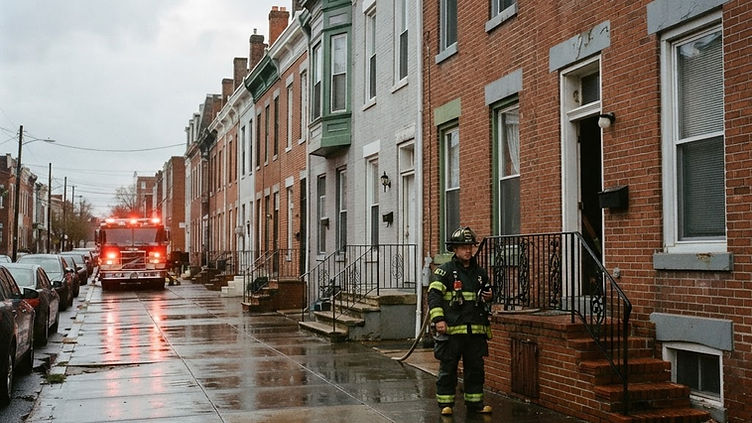
BALTIMORE
BALTIMORE — Baltimore City and Baltimore County do not enforce the same fire code, and the difference surfaces most often at the worst moment: when a property manager is holding an order to post a fire watch and a contractor is quoting a different answer from a different book.
The City's 2024 publication of its Building, Fire, and Related Codes adopts the 2021 International Fire Code with City amendments at sections 8-101 and 8-102. The County's Fire Prevention Code, under Bill 14-21, is built on NFPA 1 and NFPA 101, with the county's posted list identifying 2018 editions. Maryland's COMAR 29.06.01 incorporates the 2024 editions of NFPA 1 and NFPA 101 statewide, and expressly excepts Baltimore City.
Three code families, one metropolitan area, roughly six miles between the two seats of government.
One metro, three code families
The jurisdictional boundary is not the beltway and it is not the city line drawn in a mailing address. Baltimore City is an independent city, not part of any county, and the county surrounds it. Properties on the same corridor, served by the same contractors and the same water system, routinely sit on opposite sides of the line.
The practical consequence is that a single sentence beginning with the word requirement is ambiguous in Baltimore unless the parcel is named first. A citation from the city publication may not exist in the county's NFPA-based code, and a county provision may not appear in the city's amended IFC. Maryland's statewide adoption does not resolve the conflict; COMAR 29.06.01 states its own exception for the City, which means the statewide editions and the City's edition are different documents with a documented relationship.
Where a fire watch comes from in the city
Section 901 of the adopted IFC leaves the response to an impaired required system with the fire code official. When a required system is out of service, the official may require evacuation, an approved fire watch, or both, and the choice turns on which safety function was lost. That structure is familiar to anyone who has worked through the impairment provisions, and it is the reason a watch order in the city reads as a direction rather than a formula.
The City's amendments also set a boundary that operators cross without noticing. Section 104.8.2.1 through .4 governs fire and life safety systems design and evaluation, the FLSDE process, and it is a design-review function. A fire watch is not a substitute for that review, and an FLSDE report is not a substitute for a watch. A building can require both, in sequence, and the sequence is decided by the fire code official.
The county route under NFPA
The county's code derives from NFPA 1 and NFPA 101 rather than the amended IFC, and NFPA 1's impairment provisions produce a similar practical outcome by a different route: notification, an assessment of the hazard created by the outage, interim protection while the system is down, and a restoration test before the system returns to service. NFPA 25 supplies the impairment procedure that governs the water-based side of that work, including tagging, notification and the interim measures.
For a county property, the numbers, forms and citations will come from a different set of documents than they would six miles south. Contractors working across the line should expect to produce two different impairment packages for two similar buildings, and a template written for one jurisdiction will not satisfy the authority in the other.
The four-hour question, in both directions
The most common misconception in the market is that a fixed grace period applies before a watch becomes mandatory. Neither the City's amended IFC nor the county's NFPA-based code establishes a universal four-hour window, and the practical trigger is notification of the authority, followed by the official's determination. Treating the outage as an internal maintenance matter for several hours is how a routine impairment becomes an enforcement finding.
The corollary matters just as much. A property that installs a fire watch on its own initiative, without notifying the code official, has not satisfied the requirement either. The notification is the event that starts the clock on the record.
Documentation, and the five-year claim
Both codes point toward a written record, and NFPA 25 supplies the impairment log, tagging and restoration test structure. What neither jurisdiction establishes is a blanket five-year retention mandate for fire-watch logs, a figure that circulates widely in vendor literature. Retention is a policy decision, an insurance condition or a contractual requirement, and an operator who cites a code requirement for it is citing something that does not exist.
The record that survives scrutiny is the one that connects the impairment to the response: the panel, point or valve affected, the time the fault was discovered, the contractor's dispatch, the impairment tag, the personnel assigned, the areas covered, the round times, the incidents and the restoration test. Falsified records are treated as an enforcement matter in their own right, because the record is what the authority relies on when there is nothing else to inspect.
Hot work in rowhouse country
Baltimore's building stock makes hot work a different proposition than it is in a suburban industrial park. A rowhouse block shares walls, and a shared wall means a fire in a void space behind a party wall can travel laterally into adjacent dwellings before the responding companies have a water supply. Construction, alteration and demolition in that stock falls under NFPA 241, and the hot work itself falls under NFPA 51B, which addresses permits, control zones, extinguishing equipment and post-work monitoring, with current editions holding the monitoring period at a minimum of one hour.
Federal law layers on top. OSHA 29 CFR 1910.252 governs general industry welding and cutting, 1926.352 addresses construction fire prevention, and the maritime provisions at 1915.504 and 1915.508 apply at the harbor. None of those is displaced by a local permit, and a permit can add conditions the standards do not.
Old buildings and new towers
Two building types dominate the risk picture. The first is the rowhouse block: masonry, void spaces, common attics, and a fire load that grows with occupancy conversion. The second is the downtown and Inner Harbor high-rise, where a single impaired system can take detection, occupant notification and elevator recall out of service together, and where phased occupancy during construction puts people into floors whose protection is not yet commissioned.
NFPA 101 governs the life safety side of both, and its protection-level provisions are the reason a watch cannot be improvised from an existing maintenance post. A property that has lost automatic notification needs people walking floors and a competent means of calling for help, which is the function NFPA 601 describes when it organizes a watch around routes, rounds, recording and reporting.
Establishing the jurisdiction before anything is ordered
The first operational step in Baltimore is administrative. Confirm the parcel's jurisdiction through the city or county property record before a scope is written, because the scope will cite a code, and the code follows the parcel. A Baltimore address that reads normally in a mail merge can sit in the county, and a building managed from an office in the city can be regulated by the county.
The second step is to identify which document the authority will actually cite. City property will answer to the 2024 City publication and its amendments at sections 8-101 and 8-102. County property will answer to the county Fire Prevention Code and its NFPA editions. A contractor who quotes the wrong one delays the order, and a watch deployed under a misidentified authority is difficult to defend as an approved fire watch, however well it is staffed.
The third step is to notify. Neither jurisdiction makes a property's internal maintenance decision the trigger for the requirement; notification of the code official is what starts the process, produces a determination, and creates the record that a later review will read.
What the split costs on a Friday night
An impairment rarely announces itself during business hours. A riser failure at eleven on a Friday night leaves a building engineer with two questions in the wrong order: who has to be called, and who has to be posted. In Baltimore those answers depend on a boundary that no vendor can determine from the street.
The staffing decision follows the same logic. A watch sized from a template that was written for another jurisdiction will either under-post a floor plan that cannot be walked in the time an official expects, or over-post and charge an owner for coverage the code never required. Both outcomes create arguments. The defensible version is built from the adopted text, the occupancy group, the affected area, the route and the notification, in that order.
The complete rulebook
Volume 17 of USPA's regulatory library, Baltimore Fire Watch, System Impairment and Hot-Work Regulations, works through the City's 2024 publication and its 2021 IFC adoption, the County's NFPA-based code, the Maryland statewide adoption and its City exception, the FLSDE design-review boundary and the fire-watch duties under section 901, in forty chapters carrying twenty-two official sources. The complete edition is available free by email, and a two-page field brief can be downloaded without one.
USPA provides fire watch services across the Baltimore metropolitan area, emergency fire watch for impairments that arrive at night, hot work fire watch for permitted construction activity, and maritime security for the working waterfront and the harbor terminals.
Related coverage
East Cleveland vacant building fire puts neighbors at risk, perimeter watch ordered
Adams Key building a total loss after fireboat response in Biscayne National Park
Gasoline on a halogen light started New London storage fire, officials say
Services in Baltimore, MD
Sources
- Baltimore City Law Library. Building, Fire, and Related Codes 2024 Edition, ordinance history and introductory code inventory.
- Baltimore City Law Library. Part VIII International Fire Code; §8-101 City Adoption and §8-102 Modifications.
- Baltimore County Building Plans Review. Current Building and Fire Codes in Effect, posted document revised September 3, 2024.
- Baltimore County Council. Bill 14-21, Fire Prevention Code of Baltimore County.
- Maryland Code of Regulations. COMAR 29.06.01, State Fire Prevention Code, incorporating 2024 NFPA 1 and NFPA 101, amended effective June 23, 2025.
- Maryland State Fire Prevention Commission. State Fire Prevention Code, 2025 adoption and July 2025 errata.
About the reporter
Staff Writer
Staff writer for the USPA Nationwide Security newsroom. Receives newsroom tips, corrections and editorial inquiries.
Author biography and credentialsMore from The Watchline

Regulation & Codes
Las Vegas fire code switch lands on buildings the four-hour rule never protected
Clark County Ordinance 5321 and City of Las Vegas Ordinance 6918 put the 2024 International Fire Code in force this year, and the published watch baseline is one person per 100,000 square feet of affected area.
· Albina Bieci

Regulation & Codes
Phoenix's rewritten fire code hands the watch clock to the fire marshal, and the four-hour figure is not in it
The 2024 Phoenix fire code took effect February 17, and its Section 117 makes staffing, duration and release a fire department decision rather than a property manager's calculation.
· Albina Bieci

Regulation & Codes
Houston wants the fire department called the moment a required system goes down, and its standby inspectors are not a contract post
Houston's amended 2021 fire code requires immediate reporting of an out-of-service required system and separates a private impairment watch from standby inspectors the department itself staffs.
· Albina Bieci
