
What the Russell Brand courthouse detail shows about running a principal through a crowd

By Albina Bieci, Staff Writer
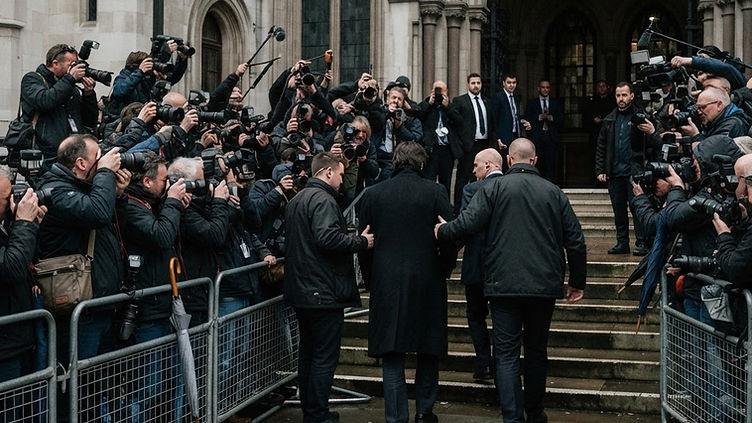
Footage from Southwark Crown Court shows a close protection team working a media gauntlet in front of a principal — a textbook illustration of the chokepoint problem in executive protection.
LONDON
LONDON — Video from Southwark Crown Court shows the comedian Russell Brand arriving for a sitting in his trial surrounded by a close protection detail, working through a dense press and public crowd at the entrance. The coverage of the case is about the proceedings. The security value in the footage is about the walk.
A courthouse arrival is one of the least forgiving movements in executive protection. The route is fixed, the timing is public, the crowd is uncontrolled and the principal is required to be present at a set hour, which removes the option of waiting for conditions to improve.
The chokepoint is the whole assignment
Protective details are usually judged by what happens at the door, but the door is rarely where the risk concentrates. It concentrates where the crowd narrows: a pavement outside a security screening point, a set of steps, a doorway that admits one person at a time.
The techniques on display are the standard answer, and they matter because they are unglamorous:
- Body position over force. Agents work a diamond or box formation so the principal is never the outer edge of the group, and the formation changes shape as the corridor narrows rather than stopping at the bottleneck.
- Barrier and vehicle positioning. The route is staged so the principal's exposure on foot is measured in metres, not minutes, with the vehicle placed to provide a screen at the point of maximum crowd density.
- Advance reconnaissance. Someone walks the ground before the principal does: entrances, screening lines, protest positions, the nearest point where a crowd can close off the exit.
- Comms discipline. The detail moves on hand signals and short verbal calls, because shouting across a crowd broadcasts the principal's position as effectively as it coordinates the team.
Where celebrity work differs from corporate protection
A high-profile trial adds two variables that a corporate detail rarely carries. The first is duration: proceedings run for weeks, which means the same fixed route is walked on a predictable schedule until the crowd learns it. The second is intent. A press pack wants a photograph; a protest, an obsessed individual or a stalker wants proximity, and the two look identical at ten metres.
The response is variation. Arrival times shift within the court's tolerance, vehicle drop points move, the foot route is changed where the site allows it, and the detail rotates personnel so that a person who has been watching the crowd for a week does not become the person the crowd has learned to watch.
The threat picture behind celebrity details
Stalker behaviour is the recurring risk in celebrity protection, and it is a behavioural problem rather than a physical one until it isn't. The professional answer is a documented threat assessment before the event — who has made contact, what was said, what has escalated — plus a named point of contact at the venue's security and with the local police, so that a single individual behaving oddly at a barrier is a known quantity rather than a surprise at close range.
USPA Nationwide Security provides executive protection and advance work for principals moving through public and legal venues, including protective intelligence, route planning and close protection teams in London and other international markets. Executive protection · London close protection · Technical surveillance countermeasures.
This report concerns protective operations visible in coverage of the case. It makes no finding about the proceedings themselves.
Sources
About the reporter
Staff Writer
Staff writer for the USPA Nationwide Security newsroom. Receives newsroom tips, corrections and editorial inquiries.
Author biography and credentialsMore from The Watchline

Executive Protection
AirTag in a Wheel Well Leads to Aggravated Stalking Arrest in Miami-Dade
A business owner found the tracker during a physical inspection of the car, a discovery that put the case on a parked vehicle rather than on a phone.
· Albina Bieci

Executive Protection
Manhattan Details Now Sweep Every Room and Vehicle Before an Executive Arrives
Corporate security departments have made technical and physical pre-advance sweeps a daily requirement after trackers and covert listening devices were found in financial-district work spaces.
· Albina Bieci

Executive Protection
Stalker Sentenced After Breaching Los Angeles Estate Perimeter, Protection Team Intervened
Court testimony described an intruder who crossed the property line before being physically stopped inside the grounds, and a sentence built on a documented pattern of prior contact.
· Albina Bieci