
A fourth-floor fire in Miami puts 15 apartments and a dead elevator behind a human watch

By Albina Bieci, Staff Writer
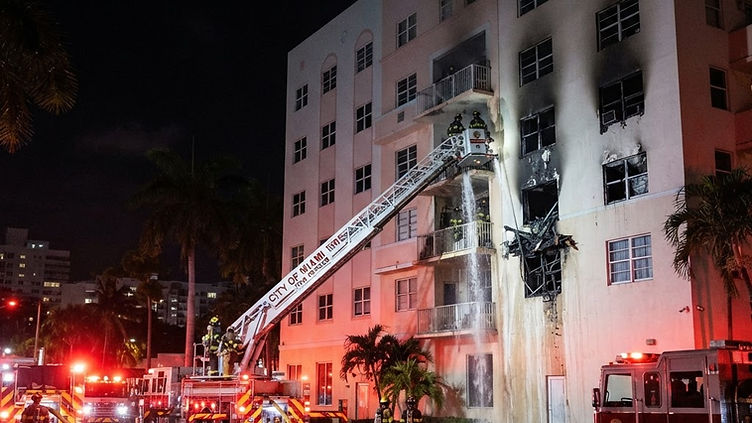
A 2:30 a.m. fire on the fourth floor of a high-density Miami apartment building filled corridors with zero-visibility smoke, displaced 28 residents and left the elevators and life-safety systems inoperable.
MIAMI
MIAMI — A fire that broke out at 2:30 a.m. on the fourth floor of a high-density apartment complex on Northwest 7th Street filled the corridors with black smoke thick enough to stop residents from finding the stairs. Fire rescue contained the fire in about 40 minutes. Four people were treated for severe smoke inhalation, and 28 residents across 15 apartments were displaced.
Why this building type is the hardest fire watch in the city
A mid-rise apartment building depends on a small number of systems to stay survivable: a working alarm that wakes people, smoke control or at minimum a sealed stair enclosure, and elevators that let residents who cannot use stairs leave. This fire took the first two out of service long enough to trap people, and it rendered the elevator and the centralized hallway life-safety systems inoperable afterward.
The fire code consequence is direct. Where a required fire protection system is out of service, the fire code official can require a fire watch, and a building that has lost its elevator and its corridor detection while 28 residents are displaced meets that test without argument.
What the assignment actually is on a Miami mid-rise
- Continuous patrols of every floor still reachable, walked on a posted interval, with the log written at the time of the round.
- Stairwell verification. With elevator service down, the stairs are the only way in and out, and the guards are the only people who will notice a stair door propped open at 3 a.m. — which is the single most common way smoke reaches floors that never burned.
- Access control on a displaced building. Displaced residents come back for medication, documents and pets. Every one of those entries has to be escorted or logged, and the burned floor has to stay closed.
- Fire department notification, immediately, on any smoke condition — not a call to the property manager first.
Heat, language and the staffing question
A Miami mid-rise detail is not a Northeast detail with palm trees. Rounds have to be scheduled around heat and humidity in stairwells without air conditioning, guards on a building with a large Haitian Creole and Spanish-speaking resident population need to communicate with the people they are turning away from a front door, and a 24-hour post on a building this size is a multi-guard assignment, not one officer working doubles.
What the association and the owner need next
The sequence from here is elevator inspection, electrical restoration, alarm recertification and a fire marshal's release — days to weeks, not hours. The fire watch runs for the whole of it, and the documentation it produces is what the carrier and the association's counsel will rely on.
USPA Nationwide Security staffs fire watch details on multifamily properties across Miami-Dade County, with licensed bilingual guards, written round logs and direct coordination with Miami-Dade Fire Rescue and the building's management. Fire watch services · Uniformed security guards.
Services in Miami, FL
Sources
About the reporter
Staff Writer
Staff writer for the USPA Nationwide Security newsroom. Receives newsroom tips, corrections and editorial inquiries.
Author biography and credentialsMore from The Watchline

Fire Protection
St. Paul attic fire collapses the roof of a 20-unit complex and empties the buildings beside it
A fast-moving attic fire destroyed the roof of a 20-unit complex near St. Catherine University, forcing the evacuation of neighboring residential buildings while inspectors assess the structure.

Fire Protection
Manhattan vacate order empties 54 apartments after a fatal Hamilton Heights fire
A two-alarm fire at 660 Riverside Drive killed an 80-year-old man, critically injured a woman and damaged a main stairwell, prompting the Department of Buildings to order all 54 apartments vacated.

Fire Protection
Fort Lauderdale three-alarm fire leaves two downtown venues open to the street
A three-alarm fire that started near the stage at America's Backyard jumped to the Poor House next door, leaving two damaged commercial buildings exposed on a downtown block.