
A South Los Angeles flooring warehouse reignites, turning a firefight into a multi-day debris operation

By Albina Bieci, Staff Writer
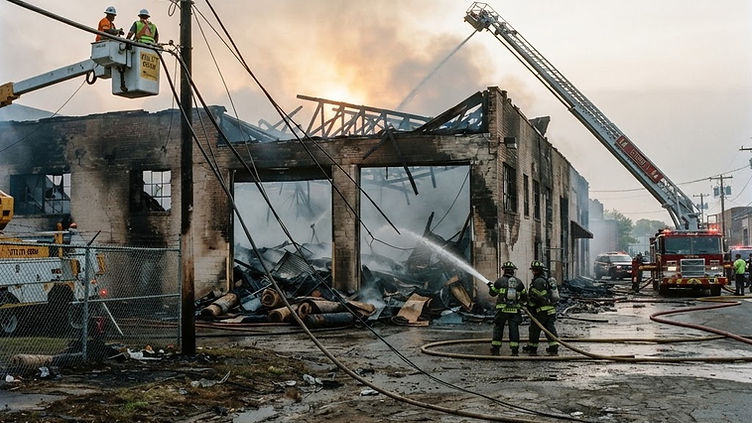
A 15,000-square-foot commercial flooring warehouse reignited early Tuesday, burning overhead power lines and leaving the Los Angeles Fire Department in an exterior suppression and debris-removal operation that heavy timber loads are stretching across multiple days.
LOS ANGELES
LOS ANGELES — The fire in a 15,000-square-foot commercial flooring warehouse did not end when the first alarm was cleared. It came back early Tuesday, reigniting inside the structure, burning overhead power lines and pushing the Los Angeles Fire Department into a multi-day exterior operation: hose streams from outside, debris removal in stages, and no interior attack, because heavy timber loads and stacked material block access to the seat of the fire.
A reignition that follows an initial knockdown is not a second fire in the ordinary sense. It is the same fire surviving in a place water could not reach, and it changes the shape of the operation from suppression to dismantling.
Why a flooring warehouse burns for days
Rolled flooring is close to a worst-case commercial fuel load. It is dense, it is stacked, it holds heat in the middle of the roll, and adhesives and backing add both energy and a persistent smolder. Add heavy timber roof and floor members, and the fire sits deep inside a mass of fuel where a hose stream reaches the outside of a pile and nothing further.
When that happens, the tactic becomes physical: pull the pile apart, wet it, pull the next layer. That work is slow, it generates its own flare-ups as pockets of fuel meet air, and it is why the fire department describes the operation in days rather than hours. It is also the phase in which a building is most unpredictable. The structure is already damaged, the loads above the crews are charred, and every layer that comes off changes what is holding up what.
The power lines are part of the fireground
Burning overhead conductors turn a fire scene into an electrical hazard, not just a structural one. Crews cannot work beneath energized lines, a downed conductor can energize a fence or standing water, and the utility has to de-energize and confirm before the operation can move into the area beneath them. That sequencing costs hours and it changes where a perimeter can sit — usually wider than the fire alone would require.
For the business and the property owner, the electrical question outlasts the fire. Service to a burned building is typically cut at the pole and stays cut until the structure and the service equipment are evaluated, which means the site goes dark and stays dark.
A multi-day operation needs a perimeter that lasts
Incidents that run for days leak attention. The first night has full resources and a hard perimeter. By the third shift, the site has contractors, debris haulers, insurance adjusters, utility crews and a security officer, all crossing the same fence line at different hours, and the exclusion zone has to keep working through every one of those movements.
That is a traffic-control problem as much as a security one: who is allowed in, who escorts them, where equipment can stage, and how the collapse zone on the burned elevation stays clear while material is being hauled out of it. On a warehouse floor with heavy timber overhead, an unauthorized walk-in is a life-safety event, not a trespass.
Where the responsibility transfers when the engines leave
The fire department's job ends when the incident is stabilized. The building's problem does not. A partially collapsed warehouse with smoldering debris inside is a structure that can produce a second alarm from a hot spot nobody was watching, and under Section 901.7 of the International Fire Code the fire code official can require a fire watch wherever protection systems are out of service or conditions constitute a hazard.
In practice that means the site needs a person on it, on a defined round, through the hours between shifts — checking the debris piles, the burned roofline, the exposure walls and the utility connections, and calling the fire department on any smoke or heat rather than waiting for a passerby to do it. The requirement does not lapse because the fire is described as out.
What the record will be asked for
On a loss this size, the carrier, the owner and eventually the demolition contractor all work from the same documentation: hours covered, round intervals, entries logged, and the escalation path when something was found. Debris removal on a burned warehouse routinely runs for weeks, and the watch record is the only continuous account of the site across that period.
What happens next at the warehouse
The fire department will finish the debris operation and release the building, the cause investigation will follow, and a demolition or stabilization scope will be set for a structure whose roof and timber are already compromised. Until that work is done and the debris is cold, the property is a dark, open, partially collapsed building in an industrial corridor. USPA Nationwide Security provides fire watch and emergency fire watch coverage in Los Angeles and across Southern California, including hot work supervision during demolition.
Services in Los Angeles, CA
Sources
About the reporter
Staff Writer
Staff writer for the USPA Nationwide Security newsroom. Receives newsroom tips, corrections and editorial inquiries.
Author biography and credentialsMore from The Watchline

Fire Protection
UPDATE: Goodwin Hotel fire traced to a wall around an 1881 cast-iron column
Hartford's fire marshal and city licensing inspectors have opened a formal origin-and-cause investigation after confirming the fire traveled inside an exterior wall, through the decorative woodwork enclosing a cast-iron support column, with all 124 guestrooms still open.
· Albina Bieci

Fire Protection
UPDATE: Deerfield fire leaves four apartments uninhabitable for up to a year
Four units are gutted and boarded, all 16 affected apartments are without power, and displaced residents have been told to expect three months to a year while ComEd, North Shore Gas and the village building department work through restoration.
· Albina Bieci

Fire Protection
Two fires in one night leave a Shelby Street building unsafe to occupy
Indianapolis firefighters returned at 2:12 a.m. to a building they had worked the previous evening and found heavy fire inside, leaving crumbling walls, a damaged roof and a site that now needs a documented watch.
· Brian Fitzgibbons
