
UPDATE: Deerfield fire leaves four apartments uninhabitable for up to a year
Updated with the displacement timeline, board-up status and the utility restoration sequence.

By Albina Bieci, Staff Writer
Four units are gutted and boarded, all 16 affected apartments are without power, and displaced residents have been told to expect three months to a year while ComEd, North Shore Gas and the village building department work through restoration.
DEERFIELD, Ill.
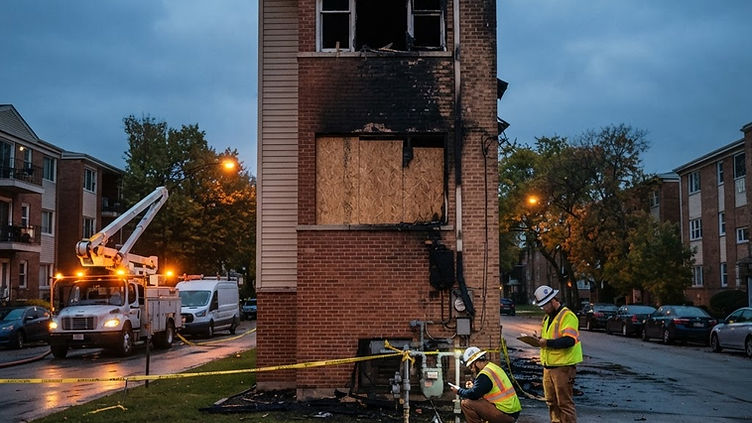
DEERFIELD, Ill. — Four apartments in the 1100 block of Deerfield Road are uninhabitable, the windows blown out by the fire have been boarded over, all 16 affected units remain without electrical power, and displaced residents now have a return estimate measured in months: three at the shortest, a full year at the longest. The timeline, confirmed in follow-up reporting since the October 24 fire, replaces the open-ended "displaced" language of the first night with dates — and dates are what turn a fire loss into a months-long security and fire protection problem.
The sequence gating re-occupancy is not one inspection. Electrical service has to be restored by ComEd, gas service by North Shore Gas, and the work has to clear the Village of Deerfield Building Department before any section of the building can be released for occupancy. None of those three can finish before the others, and all of them are working around fire damage that is still being scoped.
What changed since our first report
- Four units were left completely uninhabitable, not merely damaged.
- Blown-out windows have been boarded up, sealing the damaged section from the street.
- Residents were told it could take three months to a full year before they can return.
- All 16 impacted units lost electrical power, and restoration is a joint effort across the utility and the village.
Our original report on the October 24 fire covered the response: a MABAS Box Alarm, roughly two dozen people displaced and four injured, with the American Red Cross moving in the same night. What was not known then was how long the building would sit in a half-finished state, which is the condition that carries the real risk.
Why a twelve-month displacement is a fire protection problem
A boarded building with no power is not a neutral object sitting on a lot. The plywood that closes the blown-out windows also removes any chance that smoke or flame would be seen from outside, and with the electrical service cut there is no detection, no lighting and no alarm path left in the damaged section. A fire that starts in that wing at 1 a.m. has nobody inside to smell it and no system to announce it.
Fire codes treat that combination directly. Section 901.7 of the International Fire Code allows the fire code official to require a fire watch whenever a required fire protection system is out of service, and that is exactly the state of a partially de-energized multi-family building. The requirement is not satisfied by a locked door or a chain across the parking lot.
The combustible loading is the second half of it. Board-up crews, restoration crews and utility crews all leave material behind — plywood offcuts, packaging, solvents, adhesives — and the sequence runs for months, not days. Each phase brings a new set of trades into an unprotected structure.
The utility restoration window is the vulnerable one
Re-energizing a fire-damaged building is not a switch. Damaged conductors and panels are repaired or replaced, gas piping is pressure-tested, appliances are relit, and inspections follow each step. That work means opening walls, cutting, soldering and running temporary power, which is hot work inside a building whose detection is still offline. Any impairment to a fire alarm during testing creates a window that either has to be managed with a documented watch or accepted as a gap.
Heat is its own exposure. With mechanical systems damaged and the weather turning, tenants in the usable section lean on space heaters and extension cords — a well-documented cause of the second fire in a building that has already had the first.
Partial occupancy is harder to protect than an empty building
An empty building can be locked and patrolled from the outside. This one is split: families living in the units that were cleared, boarded windows a corridor away, contractors moving in and out daily during business hours, and no working detection in the vacant wing. A single guard at the front door does not cover that arithmetic, because the risk lives at the boundary between the occupied section and the damaged one, on the rear elevation and at the construction access point.
That is the shape a compliant detail takes here: defined rounds through the damaged section and along both interior boundaries, a written log for each round, immediate notification to the fire department on any sign of smoke or heat and to management on any entry, and coverage of every hour the wing sits unprotected — including the hours when contractors are gone and the building is quiet.
What the record has to show
On a multi-month vacancy, the property owner, the carrier and eventually the village all end up asking the same questions: who was on site, during which hours, on what round interval, and what happened when something was found. The log is the only artifact that answers them, and on a claim that runs for a year it matters more than any single night's presence.
What happens next on Deerfield Road
The restoration scope and permits will determine when the four destroyed units come back and when the remaining twelve get power. Until then the building stays part-occupied, part-boarded and without detection in the damaged section — a condition USPA Nationwide Security covers with fire watch and emergency fire watch details in Deerfield and across Lake County, staffed around the clock and documented from the first round.
Sources
About the reporter
Staff Writer
Staff writer for the USPA Nationwide Security newsroom. Receives newsroom tips, corrections and editorial inquiries.
Author biography and credentialsMore from The Watchline

Fire Protection
A South Los Angeles flooring warehouse reignites, turning a firefight into a multi-day debris operation
A 15,000-square-foot commercial flooring warehouse reignited early Tuesday, burning overhead power lines and leaving the Los Angeles Fire Department in an exterior suppression and debris-removal operation that heavy timber loads are stretching across multiple days.
· Albina Bieci

Fire Protection
UPDATE: Goodwin Hotel fire traced to a wall around an 1881 cast-iron column
Hartford's fire marshal and city licensing inspectors have opened a formal origin-and-cause investigation after confirming the fire traveled inside an exterior wall, through the decorative woodwork enclosing a cast-iron support column, with all 124 guestrooms still open.
· Albina Bieci

Fire Protection
Two fires in one night leave a Shelby Street building unsafe to occupy
Indianapolis firefighters returned at 2:12 a.m. to a building they had worked the previous evening and found heavy fire inside, leaving crumbling walls, a damaged roof and a site that now needs a documented watch.
· Brian Fitzgibbons