

Top-rated Fire Watch in Providence, RI. (Open Now)
24/7 Dispatch: (800) 214-1448
In a Rush? Key Takeaways:
Immediate Availability: Offering more than 500,000 hours of annual Fire Watch services.
Elite Status: 4.9 Google Rating, under the leadership of experienced Military Veterans and former Navy SEALs.
Quick Response: Fast deployment of Fire Watch Guards.
Regulatory Experts: Full compliance with NFPA 51B and OSHA standards.
Industry Authority: Leading provider of Fire Watch services for over ten years.
Extensively Insured: $3M coverage, providing A+ Rated Fire Watch services in Providence.
USPA Nationwide Security offers highly rated fire watch guards in Providence, Rhode Island endorsed by the Chamber of Commerce and certified by OSHA. They guarantee compliance with fire safety regulations and provide thorough protection services.
Need Fire Watch Services Immediately? Here’s a Quick Overview:
Recognized Expertise: A+ Rated by the Chamber of Commerce, reflecting our longstanding commitment to excellence.
Decades of Experience: Thriving in our third decade of business, we bring a wealth of knowledge and reliability.
Reputation: 4.9 rating on Google over the past decades, showcasing customer satisfaction and trust.
Leading Authority: Our Director of Fire Watch, Brian Fitzgibbons, is not only a celebrated keynote speaker but also a published author in fire prevention.
Always Ready: We offer 24/7 availability for immediate assistance, ensuring rapid response when you need it most.
Officially Recognized: Fully approved by Fire Marshals for meeting critical safety standards.
Trustindex verifies that the original source of the review is Google. Absolute pleasure to work with this group of professionals. Anyone looking for protective or security services would do well to hire USPA or their contractors.Trustindex verifies that the original source of the review is Google. USPA Nationwide Security Was there for us at a desparate time! Their service was fast and professional! I Highly recommend them!Trustindex verifies that the original source of the review is Google. Mike Evans and USPA there are very little words that would convey my gratitude to you and your company in the search for my son Séamus. Without your selflessness and compassion I would not have been able to get through this tragic time. You have brought me less heartache by giving me the knowledge that this was just a tragic accident as opposed to some other sinister act. I breathed easier knowing I had you and your company by my side tirelessly looking for Séamus. Your professionalism is unparalleled and you will always have my undying gratitude. Sincerely, Kerry Rodier GrayTrustindex verifies that the original source of the review is Google. This company embodies integrity and hard work.Trustindex verifies that the original source of the review is Google. These guys are amazing! They are true professionals, they also spend their free time rescuing missing children. You can’t beat an organization like this.Trustindex verifies that the original source of the review is Google. I was invited to a party last week where USPA Security guys were our bodyboards. They were very professional and made sure that we all felt safe during our gathering. I would definitely hire them for my events!Trustindex verifies that the original source of the review is Google. I hired USPA Security company and I could not be any happier. Not only I received the most professional bodyguard team led by Navy Seals and Army Rangers, but I also received close protection for me and my girlfriends. The team is super professional. They actually care and go above and beyond to make sure you feel safe and protected. I was provided with VIP Aircraft and limo services to and from the airport. I received the VIP treatment in every step. I highly recommend USPA Nationwide Security team because they respect their client and their service is exceptional. It is an honor and pleasure to work with the team.Trustindex verifies that the original source of the review is Google. Our company has been fortunate enough to work with USPA extensively over the last year and we cannot voice our appreciation enough. USPA has kept us steadily busy with work and we look forward to working with them for a very long time. Each representative of USPA we’ve been in contact with thus far has been a pleasure to work with and lastly, knowing that some of their profits are donated to some great causes is an incentive to continue working closely with this company. Thank you guys again. MBS TEAMTrustindex verifies that the original source of the review is Google. I AM A PROUD CONTRACTOR WITH THIS ORGANIZATION AND ALL I CAN SAY IS I WILL BE HELPING THEM GET TO THE HIGHEST HEIGHTS POSSIBLE!!! President Manning of USPA has to be one the most honest and genuine men I've met in this industry!!! Marc E Singletary, MBA (DBA 2024)Trustindex verifies that the original source of the review is Google. I have been using USPA as my security contractor for a few years now and their service is exceptional. Dan and Brian are extremely attentive and always able to help with our last-minute projects that fall outside of our main service contract. They provide exceptional oversight, and their communication could not be better. I would fully endorse USPA for any project, whether it be short or long term. This company has excellent values and always adheres to them. You will not be disappointed.
Fire Watch Managed by Keynote Speaker and Trainer, Brian Fitzgibbons (protecting Providence)

Director of Fire Watch & Security
Brian Fitzgibbons
24/7 Dispatch: (800) 214-1448
– Emergency Fire Watch
– Hot work protocol (NFPA)
– Construction Site oversite (OSHA)
– Maintenance of Fire Suppression Systems
– Prearranged Fire Monitoring
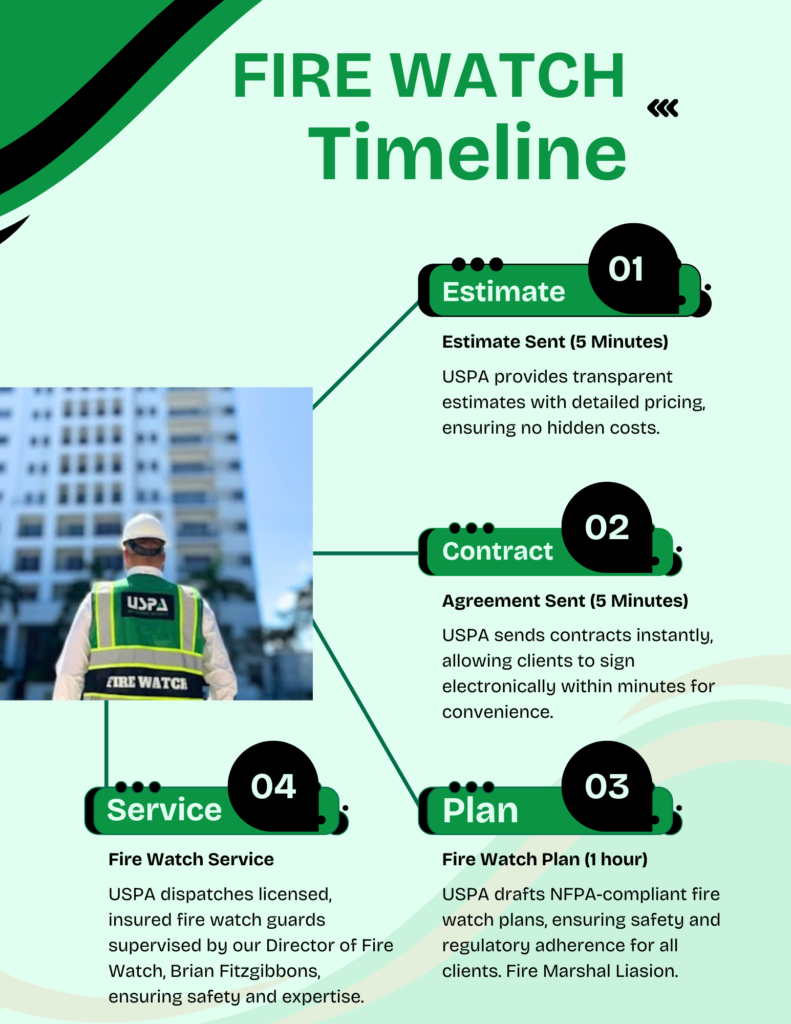
From Initial Contact to Action in Minutes
Phase 1 Evaluation: Receive a clear and comprehensive estimate from USPA, detailing all expenses to ensure transparency and eliminate any unexpected charges.
Phase 2 Agreement: Instantly receive an agreement via email, allowing you to electronically sign within minutes for maximum convenience and efficiency. Receive a certificate of insurance from our extensive liability and worker’s compensation policies, ensuring full coverage and peace of mind for your project.
Phase 3 Fire Watch Strategy: USPA prepares an NFPA 601-compliant fire watch strategy tailored to your specific needs, ensuring full adherence to national fire protection standards and local regulations. USPA also ensures that the fire watch strategy conforms to International Fire Code (IFC) standards, providing an additional layer of regulatory compliance and safety assurance.
Phase 4 Implementation: USPA dispatches highly trained, licensed, and insured fire watch guards, supervised by our Director of Fire Watch, Brian Fitzgibbons, a renowned expert in fire safety and regulatory compliance. Our fire watch guards are equipped to handle any fire safety needs, ensuring the highest level of protection and compliance with all NFPA 601 and IFC requirements.
What to Expect from USPA’s Fire Watch Division
NFPA Codes Compliance in Providence, Rhode Island
In Providence, Rhode Island, several key NFPA (National Fire Protection Association) codes ensure fire safety and regulatory compliance. NFPA 1 establishes minimum fire safety and property protection requirements, while NFPA 101 outlines criteria for building safety and egress during emergencies. NFPA 13 and NFPA 25 focus on the design, installation, and maintenance of fire sprinkler systems, ensuring their reliability. NFPA 72 specifies the requirements for fire alarm and emergency communication systems, and NFPA 96 addresses safety standards for commercial kitchen ventilation and fire suppression. These codes form the backbone of fire safety regulations in Providence, ensuring comprehensive protection for buildings and their occupants.
Fire Protection and Prevention in Providence, Rhode Island: A Case Study
Brian Fitzgibbons is a distinguished fire safety expert with extensive experience in fire codes, fire watch, and fire safety measures. As a keynote speaker and author, he has contributed significantly to the field, educating professionals nationwide on essential fire safety practices.
USPA Nationwide Security has been a trusted provider of security and fire watch services for nearly 20 years. With a 4.9 Google rating and an A+ rating from the Chamber of Commerce, USPA Nationwide Security is committed to delivering top-quality services to its clients.
Introduction to Fire Protection and Prevention in Providence
Overview of Chapter 2: Fire Protection and Prevention
Chapter 2 of the Providence Fire Code outlines the regulations and standards necessary to ensure effective fire protection and prevention within the city. This chapter covers various aspects, including the design and installation of fire protection systems, maintenance of fire safety equipment, and protocols for fire safety inspections and compliance.
Legal Framework and Compliance
The legal framework governing fire protection and prevention in Providence is aligned with the International Fire Code (IFC), particularly Chapter 2, which sets forth guidelines for fire safety measures. This alignment ensures that local regulations are consistent with national standards, providing a robust foundation for fire safety practices.
Key Provisions of Chapter 2
Fire Protection Systems
Installation and Maintenance
Providence requires that all fire protection systems, including sprinklers, fire alarms, and fire extinguishers, be installed according to the specifications outlined in the IFC. These systems must be maintained regularly to ensure functionality and compliance with fire safety standards.
Inspections and Testing
Regular inspections and testing of fire protection systems are mandated to identify and rectify any deficiencies. These inspections must be documented, and records should be maintained for review by fire safety authorities.
Fire Prevention Measures
Fire Safety Inspections
Providence mandates periodic fire safety inspections to ensure that buildings comply with fire codes. These inspections cover various aspects, including the proper storage of flammable materials, maintenance of fire exits, and the presence of fire safety equipment.
Training and Education
Fire safety training is crucial for both fire safety personnel and building occupants. Providence emphasizes the importance of educating individuals on fire prevention measures, emergency response protocols, and the proper use of fire safety equipment.
Case Law: The Providence Retired Police and Firefighter’s Association v. The City of Providence (2023)
Background and Legal Issues
This case addressed the rights of retired firefighters and police officers concerning their pensions and benefits. While the primary focus was on financial entitlements, the case indirectly highlighted the broader obligations of the city towards its fire personnel, both active and retired.
Implications for Fire Safety
The case underscored the importance of adequate support for fire safety personnel, emphasizing that the well-being and security of these individuals are critical for maintaining effective fire protection and prevention measures. Ensuring that active firefighters have the necessary resources and training is essential for upholding fire safety standards.
Legal Brief
The court’s decision in this case reaffirmed the city’s responsibility to provide comprehensive support to its fire safety personnel. This includes ensuring that retirees receive their due benefits, which indirectly affects the morale and performance of active firefighters. The decision highlighted that adequate support and resources for fire safety personnel are integral to maintaining high standards of fire protection and prevention in Providence.
Comparison with IFC Chapter 2: Fire Protection and Prevention
Scope and Applicability
Both the Providence Fire Code and IFC Chapter 2 cover a wide range of fire protection and prevention measures. The primary focus is on ensuring that fire protection systems are properly installed, maintained, and inspected regularly. Both codes emphasize the importance of fire safety training and education.
Specific Requirements
The specific requirements for fire protection systems, inspections, and training in Providence align closely with those outlined in the IFC. This consistency ensures that local regulations are comprehensive and effective in preventing and managing fire hazards.
Enforcement and Compliance
Enforcement mechanisms in Providence are designed to ensure strict compliance with fire safety regulations. Regular inspections, mandatory maintenance of fire protection systems, and rigorous training programs are key components of the enforcement strategy. Non-compliance can result in penalties, including fines and legal action.
Best Practices for Fire Safety in Providence
Implementing Comprehensive Fire Safety Plans
Developing and implementing comprehensive fire safety plans is essential for ensuring effective fire protection and prevention. These plans should cover all aspects of fire safety, including the installation and maintenance of fire protection systems, regular inspections, and fire safety training.
Conducting Regular Fire Drills
Regular fire drills are crucial for preparing building occupants for emergency situations. These drills help individuals become familiar with evacuation routes and procedures, reducing panic and ensuring a swift and orderly evacuation during a fire emergency.
Utilizing Advanced Fire Safety Technologies
Incorporating advanced fire safety technologies, such as automated fire detection and suppression systems, can significantly enhance fire protection measures. These technologies provide early warning of fire hazards and can help contain fires before they spread.
Engaging in Continuous Training and Education
Continuous training and education for fire safety personnel and building occupants are essential for maintaining high standards of fire safety. Regular updates on fire safety protocols and hands-on training sessions ensure that individuals are well-prepared to respond to fire emergencies.
Collaborating with Fire Safety Authorities
Collaboration with fire safety authorities, such as the Providence Fire Department, is critical for ensuring compliance with fire safety regulations. Regular consultations and inspections by fire safety authorities help identify potential hazards and ensure that fire protection measures are effective.
Effective fire protection and prevention measures are essential for ensuring the safety and well-being of individuals in Providence. Adhering to the provisions outlined in Chapter 2 of the Providence Fire Code, which aligns with the IFC, provides a robust framework for fire safety practices. The case of The Providence Retired Police and Firefighter’s Association v. The City of Providence (2023) highlights the broader obligations of the city towards its fire safety personnel, emphasizing the importance of adequate support and resources. By implementing best practices and continuously improving fire safety measures, Providence can maintain high standards of fire protection and prevention, safeguarding lives and property.
For further information on fire safety regulations and best practices, visit the Providence Fire Department and the National Fire Protection Association (NFPA).
Helpful Links for Fire Protection and Fire Watch in Providence, Rhode Island
Synopsis of the 2024 of the International Fire Code (IFC) and its relevance to Providence
The 2024 International Fire Code (IFC) serves as a model code for fire safety regulations and is widely adopted across the United States, including Providence, Rhode Island. The IFC provides comprehensive guidelines for fire prevention, protection, and safety measures aimed at safeguarding life and property from fire hazards.
Key Provisions of the 2024 IFC
1. Fire Protection Systems:
Installation and Maintenance: The IFC mandates the proper installation and regular maintenance of fire protection systems such as sprinklers, fire alarms, and fire extinguishers. These systems must comply with the design specifications outlined in the code.
Testing and Inspection: Regular testing and inspection of fire protection systems are required to ensure they are operational and effective. Records of these inspections must be maintained for review by fire safety authorities.
2. Emergency Planning and Preparedness:
Fire Safety and Evacuation Plans: Buildings must develop and implement comprehensive fire safety and evacuation plans. These plans should detail emergency procedures, evacuation routes, and roles and responsibilities of fire safety personnel.
Fire Drills: Regular fire drills are mandated to ensure occupants are familiar with evacuation procedures and can respond quickly in an emergency.
3. Means of Egress:
Exit Requirements: The IFC specifies requirements for exits, including the number of exits, exit width, and the placement of exit signs. Exits must be unobstructed and easily accessible at all times.
Emergency Lighting: Emergency lighting is required along egress paths to ensure safe evacuation during power outages or low visibility conditions.
4. Hazardous Materials:
Storage and Handling: The IFC outlines guidelines for the storage and handling of hazardous materials to minimize the risk of fire and ensure safety. Proper labeling, containment, and segregation of hazardous materials are critical components of these guidelines.
5. Building Services and Systems:
Electrical Systems: The IFC includes standards for the safe installation and maintenance of electrical systems to prevent electrical fires. This includes requirements for wiring, circuit protection, and grounding.
Mechanical Systems: Regulations for heating, ventilation, and air conditioning (HVAC) systems are included to prevent fire hazards associated with mechanical equipment.
Relevance to Providence
Adoption and Enforcement:
Providence adopts and enforces the IFC as part of its fire safety regulations. This ensures that the city’s fire safety standards are aligned with national best practices and provides a consistent framework for fire protection and prevention.
Compliance and Inspections:
The Providence Fire Department conducts regular inspections to ensure compliance with the IFC. These inspections cover various aspects of fire safety, including the maintenance of fire protection systems, the adequacy of egress routes, and the safe storage of hazardous materials.
Local Amendments:
While the IFC provides a comprehensive framework, Providence may implement local amendments to address specific fire safety concerns unique to the city. These amendments ensure that local regulations are tailored to meet the specific needs of Providence’s building environment.
Fire Safety Education:
The IFC emphasizes the importance of fire safety education and training. In Providence, this is reflected in the efforts to educate building occupants and fire safety personnel on emergency procedures, proper use of fire protection equipment, and fire prevention measures.
The 2024 International Fire Code (IFC) plays a crucial role in shaping fire safety standards in Providence, Rhode Island. By adhering to the provisions outlined in the IFC, Providence ensures that its fire protection and prevention measures are robust and effective, safeguarding the lives and property of its residents. Regular updates and local amendments to the code help address specific fire safety challenges, maintaining high standards of safety and compliance across the city.
Top 10 Fire Protection and Prevention Measures for Buildings in Providence
Fire safety is a critical concern for any building, and adhering to effective fire protection and prevention measures is essential for safeguarding lives and property. In Providence, Rhode Island, these measures are governed by stringent fire codes and regulations. Here are the top 10 fire protection and prevention measures for buildings in Providence:
1. Installation of Fire Protection Systems
Details: All buildings must have fire protection systems such as automatic sprinklers, fire alarms, and fire extinguishers installed according to the standards set by the International Fire Code (IFC) and local regulations.
2. Regular Maintenance and Testing
Details: Fire protection systems must be regularly maintained and tested to ensure they are in working order. This includes checking sprinkler systems, testing fire alarms, and ensuring fire extinguishers are fully charged and accessible.
3. Conducting Fire Safety Inspections
Details: Periodic fire safety inspections by qualified personnel are mandatory to identify and rectify any potential fire hazards. These inspections should cover all aspects of fire safety, including exit routes, storage of flammable materials, and fire protection equipment.
4. Implementing Fire Safety Training Programs
Details: Building occupants, including employees and residents, should undergo regular fire safety training. This training includes emergency response procedures, proper use of fire extinguishers, and evacuation protocols.
5. Developing Comprehensive Fire Safety Plans
Details: Each building must have a comprehensive fire safety plan that outlines procedures for evacuation, fire prevention strategies, and responsibilities of fire safety personnel. This plan should be reviewed and updated regularly.
6. Conducting Regular Fire Drills
Details: Regular fire drills are crucial for ensuring that building occupants are familiar with evacuation routes and procedures. These drills help reduce panic and ensure a swift and orderly evacuation during an actual fire emergency.
7. Maintaining Clear and Accessible Exits
Details: Fire exits and evacuation routes must be kept clear of obstructions at all times. Exit signs should be illuminated and easily visible, and doors should be easily operable without special knowledge or effort.
8. Proper Storage of Flammable Materials
Details: Flammable materials must be stored in designated areas that comply with fire safety regulations. Proper containers and storage methods should be used to minimize the risk of fire.
9. Implementing Advanced Fire Detection Technologies
Details: Advanced fire detection technologies, such as smoke detectors and heat sensors, should be installed to provide early warning of fire hazards. These systems should be integrated with building management systems for real-time monitoring and alerts.
10. Collaboration with Fire Safety Authorities
Details: Regular collaboration with local fire safety authorities, such as the Providence Fire Department, ensures compliance with fire safety regulations and helps identify areas for improvement. Building managers should maintain open communication with fire inspectors and authorities.
By implementing these fire protection and prevention measures, buildings in Providence can significantly enhance their safety standards, ensuring the well-being of occupants and compliance with fire safety regulations. For more detailed information, refer to the provided sources and consult with local fire safety authorities.
How Regular Fire Drills Improve Safety in Providence: 5 Key Benefits
Regular fire drills are an essential component of fire safety protocols in Providence, Rhode Island. They provide numerous benefits that enhance the overall safety of building occupants. Here are five key benefits of conducting regular fire drills:
1. Familiarity with Evacuation Routes and Procedures
Explanation: Regular fire drills ensure that all building occupants are familiar with the designated evacuation routes and procedures. This familiarity is crucial during an actual fire emergency when quick and orderly evacuation is necessary to prevent panic and confusion.
Benefits:
Improved Navigation: Occupants can navigate the building more efficiently during an emergency.
Reduced Panic: Knowing the evacuation plan reduces panic and helps maintain order.
2. Identification and Rectification of Hazards
Explanation: Fire drills often reveal potential hazards and obstacles that could impede a safe evacuation. These drills allow for the identification and rectification of such hazards before an actual emergency occurs.
Benefits:
Hazard Awareness: Fire drills help in identifying blocked exits, malfunctioning alarms, and other safety issues.
Preventive Measures: Allows for timely corrective actions to eliminate identified hazards.
3. Enhancement of Emergency Response Skills
Explanation: Fire drills provide an opportunity for building occupants and emergency personnel to practice and enhance their emergency response skills. This includes the use of fire extinguishers, assisting individuals with disabilities, and coordinating with first responders.
Benefits:
Skill Development: Regular practice helps improve the skills necessary for effective emergency response.
Team Coordination: Enhances coordination between occupants and emergency personnel.
4. Compliance with Fire Safety Regulations
Explanation: Conducting regular fire drills ensures compliance with local and national fire safety regulations. This compliance is necessary to avoid penalties and ensure that the building meets all safety standards.
Benefits:
Regulatory Adherence: Helps buildings meet the requirements set forth by fire safety authorities.
Safety Certification: Regular drills are often a prerequisite for obtaining and maintaining safety certifications.
5. Increased Awareness and Preparedness
Explanation: Fire drills increase awareness and preparedness among building occupants. They reinforce the importance of fire safety and ensure that everyone knows their role in an emergency.
Benefits:
Awareness Building: Promotes a culture of safety and preparedness.
Emergency Readiness: Ensures that occupants are ready to act swiftly and effectively in the event of a fire.
By incorporating regular fire drills into fire safety protocols, buildings in Providence can significantly enhance their safety standards, ensuring that occupants are well-prepared to respond effectively in the event of a fire. For more detailed information, refer to the provided sources and consult with local fire safety authorities.
5 Lessons from The Providence Retired Police and Firefighter's Association v. The City of Providence
The case of The Providence Retired Police and Firefighter’s Association v. The City of Providence (2023) offers significant insights into the broader implications of fire safety and the obligations of municipalities toward their public safety personnel. Here are five key lessons drawn from this case:
1. Municipal Responsibility for Fire Safety Compliance
Explanation: The case highlights the importance of municipalities adhering to stringent fire safety standards to protect both public safety personnel and the general public. The City of Providence’s obligations extended beyond financial considerations to ensuring that active firefighters are well-equipped and trained to handle emergencies.
Key Takeaway: Municipalities must prioritize compliance with fire safety regulations, ensuring that all public buildings and infrastructure meet established standards. This compliance helps prevent tragedies and ensures a safe working environment for fire safety personnel.
2. Adequate Support and Resources for Fire Safety Personnel
Explanation: The court’s ruling underscored the necessity for cities to provide adequate support and resources to their fire safety personnel, including retirees. This support is crucial for maintaining high morale and ensuring that firefighters can perform their duties effectively.
Key Takeaway: Providing sufficient resources, training, and benefits to fire safety personnel is essential for maintaining an efficient and responsive fire department. This support extends to ensuring retirees receive their due benefits, reflecting the city’s commitment to its public safety workers.
3. Legal and Financial Implications of Non-Compliance
Explanation: The case demonstrates the potential legal and financial repercussions that municipalities can face if they fail to comply with fire safety standards and contractual obligations to their public safety personnel.
Key Takeaway: Non-compliance with fire safety regulations and failure to meet obligations to fire safety personnel can result in costly legal battles and financial penalties. Municipalities must ensure that all fire safety protocols are adhered to and that contractual commitments are honored.
4. Importance of Regular Fire Safety Audits and Training
Explanation: The case indirectly emphasizes the importance of regular fire safety audits and continuous training for fire safety personnel to ensure that they are prepared to respond effectively to emergencies.
Key Takeaway: Regular fire safety audits and continuous training are crucial for maintaining a high level of preparedness and ensuring compliance with fire safety regulations. These measures help identify potential hazards and ensure that personnel are equipped with up-to-date knowledge and skills.
5. Broader Impact on Public Safety and Community Trust
Explanation: The case highlights the broader impact of municipal decisions on public safety and community trust. Ensuring the well-being of fire safety personnel fosters trust and confidence in the city’s ability to protect its residents.
Key Takeaway: Upholding fire safety standards and supporting fire safety personnel positively impacts public safety and enhances community trust. Municipalities must demonstrate a commitment to protecting both their public safety workers and the community they serve.
By learning from the outcomes of this case, municipalities can better understand the importance of fire safety compliance, support for public safety personnel, and the broader implications for community trust and safety. These lessons are crucial for maintaining a robust and effective fire safety framework.
Additional information about Providence, RI
Providence, Rhode Island Fire Watch Services
A licensed and insured fire watch company, USPA Nationwide Fire Watch Service is based in Providence, Rhode Island. To prevent fires on your property, we are approved by the Fire Marshal to perform fire watch, hot work (welding) fire watch, and foot patrol. You can reach our professional fire watch service by calling (800) 214-1448 or by emailing dmanning@uspasecurity.com.
Providence Fire Guards for Hot Work
Providence, Rhode Island, fire watch companies: what should you look for? If you are looking for a fire watch service in Providence, USPA Nationwide Fire Watch Service is the best choice. As a licensed and insured security guard company, we can provide professional security guards within 60 minutes. A few of the services we offer are emergency fire watches, hot work (welding) fire watches, foot patrols, and more! For an instant quote on our professional service, call (800) 214-1448 or email dmanning@uspasecurity.com today!
Fire Marshal Approved Rhode Island
No other company can compare to what we offer in terms of customer service and affordability without hidden fees. You can feel confident that our security guards are of the highest quality since we’ve been providing security guard services for over ten years! Now is the time to start receiving our exceptional service – call now!
Providence, Rhode Island, Firewatch Company
Fire watch services from USPA Nationwide Security are the most reliable option in Providence. Within 60 minutes, we can provide emergency guards who are licensed and insured. Among the services we offer are hot work (welding) and foot patrol protection, both of which are Fire Marshal-approved. We provide security guards to cover your home or business if your fire suppression system is not working. Send us an email at dmanning@uspasecurity.com or call (800) 214-1448 for an instant quote! With our professional security guards protecting your property 24/7 with their eyes wide open, ears perked up, and noses sniffing out potential dangers, you can rest assured that your property is in good hands. With over ten years of experience, you know USPA Nationwide Security will provide you with the best security service possible.
Protecting Providence Businesses with:
Firewatch Guard Service (for protecting people in Providence)
Fire Guard Officer (for protecting people in Providence)
Fire Guard Mobile Patrol (for guarding Providence Storefronts)
Security Fire Watchmen (for patrolling Providence businesses)
(800) 214-1448 – Hire the #1 Fire Watch Service in Providence, Rhode Island. Firewatch Company Providence. Hot Works Fire Guards RI. Emergency Dispatch Fire Protection Service Rhode Island.
Supporting local businesses by teaching Providence fire codes through Fire Watch Security
Installing an emergency notification system is one of the most important fire safety tips for homeowners. Whenever there is a fire emergency, you should call 911. Then, wait for a dispatcher to arrive. Your home will have time to be evacuated during this period. Additionally, make sure all electrical appliances are in working order and do not need to be replaced.
Advice for dealing with hazmats from the Firewatch Agency Providence
Smoke detectors are the second fire safety tip. Carbon monoxide levels can be continuously reduced with smoke alarms, which can warn you before fires begin. Make sure your smoke detectors are working properly and change their batteries annually. Notify the building management as soon as possible if they aren’t working. Last but not least, do not use space heaters in your home. If they aren’t maintained properly, these appliances can cause serious damage. It is a good idea to create a family fire drill to ensure everyone understands what to do if a fire breaks out. A meeting place outside the house should be included in this drill, as well as two ways to leave every room. If you have young children, this is especially important. The difference between a safe escape and tragedy can be determined in a matter of seconds.
Providence Fire Guards (assisting with fire safety)
When children are present in the home, smoking can be especially dangerous. Matches should also be kept out of children’s reach. Keeping a fire extinguisher in the kitchen is also a good idea. It is impossible to predict when a fire will occur. Be prepared to put out a fire quickly if it starts. Your home can also be protected from fire by installing smoke detectors. Having a working smoke alarm in every room of the home is recommended by the Red Cross. A smoke alarm should also be tested monthly to ensure it is functioning properly. It is less than half as likely that you will die in a fire if you use a smoke alarm.
Guidance on fire extinguishers from Fire Watch Services Providence
It is important to know how to properly use a fire extinguisher. Pull, aim, squeeze, sweep (P.A.S.S.) is the process. Extinguishers should also be placed near exits.
#providence #rhodeisland #pvd #providenceri #ri #rhody #providencerhodeisland #southcountyri #uri #firewatchguardprovidence #securitycompanyprovidence #firewatchcompanyprovidence #firewatchprovidence
Frequently Asked Questions about Fire Watch Services in Providence, RI
Who should I call for Fire Watch in Providence?
Call (800) 214-1448 for Providence, Rhode Island Fire Watch
What fire codes are applicable in Providence?
In Providence, Rhode Island, fire codes are established and enforced to ensure the safety and protection of life and property. These codes are a combination of local regulations and standards from recognized national organizations. Here are the primary fire codes applicable in Providence:
1. Providence Fire Code
Overview: The Providence Fire Code includes regulations specific to the city that address local fire safety needs and requirements. It covers a wide range of topics from building construction and occupancy classifications to the use and storage of hazardous materials.
Source: Providence Fire Department
2. Rhode Island Fire Safety Code
Overview: This state-level code incorporates standards from the National Fire Protection Association (NFPA) and other relevant codes. It provides comprehensive guidelines for fire safety across various types of buildings and occupancies within Rhode Island, including Providence.
Key Components:
NFPA 1 Fire Code: This is a widely adopted code that provides a comprehensive set of fire protection and life safety requirements.
NFPA 101 Life Safety Code: This code focuses on the safety of occupants in buildings, addressing aspects like means of egress, emergency lighting, and fire protection systems.
Source: Rhode Island General Laws
3. International Fire Code (IFC)
Overview: The IFC is a model code that provides minimum requirements for fire prevention and protection. Providence adopts and integrates the IFC into its local regulations to ensure consistency with national standards. The IFC covers various aspects of fire safety, including fire prevention, fire protection systems, emergency planning, and building services.
Key Components:
Chapter 1: Scope and Administration
Chapter 9: Fire Protection Systems
Chapter 10: Means of Egress
4. National Fire Protection Association (NFPA) Standards
Overview: NFPA standards are widely recognized and adopted for various aspects of fire safety. These standards provide detailed requirements for fire prevention, protection, and life safety.
Key Standards:
NFPA 25: Standard for the Inspection, Testing, and Maintenance of Water-Based Fire Protection Systems
NFPA 72: National Fire Alarm and Signaling Code
NFPA 13: Standard for the Installation of Sprinkler Systems
5. Occupational Safety and Health Administration (OSHA) Regulations
Overview: OSHA regulations include fire safety requirements for workplaces, ensuring that employers provide safe working conditions. These regulations cover emergency action plans, fire prevention plans, and the proper use of fire extinguishers.
Integration and Compliance
Providence ensures that its local fire codes are consistent with state and national standards by adopting and integrating elements from the Rhode Island Fire Safety Code, the IFC, and NFPA standards. Compliance with these codes is enforced through regular inspections, audits, and the issuance of permits for various activities related to fire safety.
How do Fire Watch Services integrate with existing fire safety plans in Providence?
Fire watch services play a critical role in enhancing the overall fire safety framework within buildings and facilities in Providence, Rhode Island. These services are particularly vital when fire protection systems are impaired, under maintenance, or temporarily out of service. Here’s how fire watch services integrate with existing fire safety plans:
1. Complementing Fire Protection Systems
Integration with Fire Alarms and Sprinkler Systems: When fire alarms or sprinkler systems are temporarily non-operational due to maintenance or repair, fire watch personnel provide continuous monitoring to ensure fire safety. They patrol the premises, identify potential fire hazards, and ensure immediate response in case of a fire outbreak.
Documentation and Communication: Fire watch services include meticulous documentation of patrols, identified hazards, and corrective actions. These records are integrated into the overall fire safety documentation, providing a comprehensive view of the building’s fire safety status.
2. Ensuring Compliance with Fire Safety Regulations
Adherence to Local and National Codes: Fire watch services ensure compliance with both Providence fire codes and national standards such as the IFC and NFPA. By maintaining a fire watch, buildings adhere to regulatory requirements during periods when fire protection systems are compromised.
Regular Inspections and Reporting: Fire watch personnel conduct regular inspections of fire safety equipment and systems, ensuring that all components are in working order. They report any deficiencies or maintenance needs to the building management and relevant authorities.
3. Enhancing Emergency Preparedness
Fire Drills and Evacuation Procedures: Fire watch services help in organizing and conducting fire drills, ensuring that all occupants are familiar with evacuation routes and procedures. This enhances the building’s emergency preparedness and ensures a swift and orderly evacuation during an actual fire event.
Training and Education: Fire watch personnel often provide training and education to building occupants on fire safety practices, the proper use of fire extinguishers, and emergency response protocols. This training integrates with the overall fire safety plan to ensure comprehensive preparedness.
4. Immediate Hazard Identification and Mitigation
Active Monitoring: Fire watch personnel actively monitor the premises, identifying and addressing fire hazards in real-time. This proactive approach ensures that potential fire risks are mitigated before they can escalate into emergencies.
Coordination with Fire Safety Authorities: Fire watch services coordinate closely with the Providence Fire Department and other fire safety authorities. This collaboration ensures that any identified hazards are promptly addressed, and that the building remains compliant with fire safety regulations.
5. Supporting Special Events and High-Risk Activities
Event Safety: For special events or activities that increase fire risk (e.g., use of pyrotechnics, large gatherings), fire watch services provide additional monitoring and safety measures. They ensure that all fire safety protocols are followed and that emergency response is swift and effective.
Temporary Fire Watch: During construction, renovations, or other activities that may impair fire protection systems, temporary fire watch services ensure continuous monitoring and safety. This integration with the fire safety plan ensures that there are no gaps in fire protection.
Fire watch services are an essential component of the fire safety plans in Providence, ensuring continuous protection and compliance with fire safety regulations. By complementing fire protection systems, enhancing emergency preparedness, and actively monitoring for hazards, fire watch services provide a critical layer of safety for buildings and their occupants. Regular collaboration with fire safety authorities and comprehensive documentation further integrate these services into the overall fire safety framework.
What are the financial considerations for implementing Fire Watch Services in Providence?
Implementing fire watch services in Providence involves several financial considerations that building owners and managers need to account for. These costs can vary depending on the specifics of the building, the duration of the fire watch, and the level of service required. Here are the key financial considerations:
1. Hourly Rates for Fire Watch Personnel
Overview: The cost of fire watch services is primarily determined by the hourly rates charged by the service provider. These rates can vary based on the qualifications and experience of the personnel, as well as the complexity of the building’s fire safety needs.
Typical Costs:
Basic Fire Watch: Rates typically range from $15 to $30 per hour.
Advanced Services: For highly skilled or specialized fire watch personnel, rates can range from $30 to $50 per hour or more.
2. Duration and Frequency of Fire Watch Services
Overview: The duration and frequency of fire watch services significantly impact the overall cost. Continuous 24/7 fire watch services will naturally incur higher costs compared to periodic checks.
Factors to Consider:
Continuous Monitoring: Required during major system impairments or construction projects, leading to higher cumulative costs.
Intermittent Checks: May be sufficient for less critical situations, reducing overall expenses.
3. Emergency and Temporary Fire Watch
Overview: Emergency fire watch services, required during unexpected system failures or compliance issues, can be more costly due to the urgent nature of the deployment.
Cost Implications:
Emergency Rates: Higher rates are often charged for emergency or short-notice fire watch services.
Contractual Agreements: Longer-term contracts can sometimes mitigate higher emergency costs through predefined service agreements.
4. Administrative and Compliance Costs
Overview: Implementing fire watch services also involves administrative and compliance costs, such as record-keeping, reporting, and coordination with fire safety authorities.
Cost Components:
Documentation and Reporting: Costs associated with maintaining logs, preparing reports, and ensuring compliance with local regulations.
Fire Safety Audits: Periodic audits and inspections to verify compliance, potentially adding to the overall cost.
5. Training and Certification of Personnel
Overview: Ensuring that fire watch personnel are adequately trained and certified is crucial for effective service. This training comes with its own set of costs.
Training Costs:
Basic Training: Initial training for fire watch personnel can range from $100 to $500 per individual.
Advanced Certification: Additional costs for specialized training and certifications required for complex fire watch scenarios.
6. Insurance and Liability Coverage
Overview: Adequate insurance and liability coverage are essential for protecting against potential risks and liabilities associated with fire watch services.
Insurance Costs:
General Liability Insurance: Coverage to protect against claims of property damage or bodily injury.
Workers’ Compensation Insurance: Required for personnel to cover medical expenses and lost wages in case of injury.
Implementing fire watch services in Providence involves multiple financial considerations, including hourly rates for personnel, duration and frequency of services, emergency deployment costs, administrative and compliance expenses, training and certification costs, and insurance coverage. By understanding these factors, building owners and managers can better budget for fire watch services and ensure compliance with local and national fire safety regulations.
What legal implications arise from non-compliance with fire codes in Providence?
Non-compliance with fire codes in Providence, Rhode Island, can result in several serious legal implications. These implications not only affect the safety and operational integrity of buildings but also lead to significant legal and financial consequences. Here are the primary legal implications:
1. Fines and Penalties
Overview: Failure to comply with fire codes can lead to substantial fines and penalties imposed by the city of Providence. These fines can accumulate daily until the violation is corrected.
Specifics:
Daily Accumulation: Fines can be levied on a daily basis, leading to significant financial burdens for continued non-compliance.
Severity of Violations: The severity and frequency of the violations often determine the size of the fines.
2. Legal Liability and Litigation
Overview: Non-compliance can result in legal liability if a fire occurs, causing injury or damage. Building owners and managers can be held liable for negligence, leading to lawsuits and significant legal expenses.
Case Example:
Andrews v. Kansas City (1991): This case highlighted the legal ramifications of non-compliance with fire safety standards, where the city was held liable for not adhering to fire safety regulations in public buildings.
3. Insurance Complications
Overview: Non-compliance with fire codes can complicate or void insurance claims in the event of a fire. Insurance companies may deny claims if the building is found to be non-compliant with fire safety regulations.
Specifics:
Policy Voidance: Insurance policies often have clauses that require compliance with local fire codes. Non-compliance can lead to the policy being voided.
Increased Premiums: Persistent non-compliance can result in higher insurance premiums due to increased risk.
4. Business Disruption and Closures
Overview: Authorities have the power to order the closure of businesses that do not comply with fire codes. This can lead to significant disruption of operations and loss of revenue.
Specifics:
Immediate Closure: In severe cases, the Providence Fire Department can order an immediate shutdown of operations until compliance is achieved.
Operational Impact: Even temporary closures can have long-term impacts on business viability and reputation.
5. Criminal Charges
Overview: In extreme cases of willful negligence or repeated non-compliance, criminal charges can be filed against building owners or managers. This is particularly relevant if non-compliance leads to significant harm or fatalities.
Specifics:
Negligence: Criminal charges may include counts of negligence, especially if non-compliance is found to have directly contributed to a fire.
Involuntary Manslaughter: In cases involving fatalities, charges can escalate to involuntary manslaughter or other serious criminal charges.
Non-compliance with fire codes in Providence can lead to severe legal implications, including fines, legal liability, insurance complications, business disruptions, and even criminal charges. Building owners and managers must ensure strict adherence to fire safety regulations to avoid these consequences and ensure the safety of occupants. For more detailed information, consulting with legal experts and fire safety authorities in Providence is recommended.
Related Fire Watch Links in Providence
Introduction to Fire Watch eBook
Fire Watch Plans
Construction Site Fire Watch
Fire Watch Seminar
NFPA 601: Fire Watch Regulations
Fact Check: International Fire Code
Patrol Duties for Fire Watch
Chapter 7: International Fire Code
Disaster Recovery
For more information Hire the #1 Fire Watch Service in Providence, Rhode Island