
Construction site fire watch service
Every construction project runs through a stretch of months where the building has no working fire protection and more ignition sources than it will ever have again. USPA Nationwide Security provides the fire watch that covers that stretch: licensed officers who patrol to the permit, monitor hot work under NFPA 51B, hold the interval through sprinkler and standpipe impairments, and hand the project a complete documentation file at closeout. Dispatch answers 24 hours a day and coverage can be staged the same day.
- 21+ Years in Business
- A+ Rated
- Veteran Owned and Operated
- Licensed and Insured
- 24/7 Dispatch
Research · Hot work · Volume 12
Hot Work Fire Watch: NFPA 51B, OSHA, and Fire Prevention Engineering
A national regulatory and engineering reference on ignition pathways, permit authorization, fire-watch staffing and post-work controls. A national, source-cited reference on permit authorization, the three OSHA frameworks that govern hot work, the three-dimensional exposure behind the 35-foot figure, impaired fire protection, tank and process-line vapor, and the post-work watch each rule actually specifies. 40 pages, 16 cited sources. Not a substitute for the authority having jurisdiction.
Where fire watch fits in the life of a project
The need for fire watch moves through a construction project in phases, and each phase puts a different demand on the post. In demolition and early structure, the hazards are fuels, temporary power and exposed combustibles, and the watch is mostly about patrol discipline and housekeeping. During enclosure, hot work multiplies: welding deck, sealing penetrations, cutting openings for MEP, each task generating a permit and a monitoring period. In fit-out, the risks shift again, as partially charged sprinkler zones and disconnected alarm circuits create impairments that must be covered until commissioning completes them.
A provider that understands the sequence writes the watch plan to the phase. The route for a superstructure watch is not the route for a fit-out watch; the hazards move from the perimeter to the riser rooms and the active floors as the building closes in. USPA rebuilds the route and the log as the project advances, so the coverage always matches the work being done rather than a plan written for a building that no longer exists in that form.
The general contractor usually initiates coverage at three moments: when a permit requires it, when an impairment takes partial protection offline, and when the authority having jurisdiction orders a watch after an inspection. A provider that can respond to all three, planned coverage for permits, same-day staging for impairments, and immediate response to an AHJ order, keeps the project moving instead of waiting on staffing.
Hot work monitoring from permit to post-work watch
Hot work is the single largest ignition source on construction sites, and the controls around it are procedural. NFPA 51B requires a permit authorizing individual, a defined control zone, an operator trained to the standard, and a fire watch during the work plus a monitoring period after it stops, at least thirty minutes under OSHA's hot work guidance and longer where the authority or the permit requires. The watch officer holds the permit conditions: the zone is clear of combustibles, the shielding is in place, the extinguishing equipment is at hand.
The post-work period is where inexperienced coverage fails. Sparks smolder in gaps, foams and insulation long after the welder packs up, and the fires that destroy projects most often start in that quiet window after the crew has left. A disciplined officer stays on the affected areas for the full monitoring period, extends it when conditions warrant, and logs the final sweep before standing down, so the record shows the watch ended only when the risk actually ended.
On a busy site, hot work runs in several places at once, and each active permit needs eyes. USPA plans multi-permit days with staggered monitoring, shared officers where the zones allow it and dedicated officers where the authority requires separation, all recorded against the permit numbers in the round log. The general contractor gets one account of the day's hot work rather than a stack of conflicting notes from the trades.
Impairments during construction tie-ins
Construction progress constantly touches the fire protection that has already been installed. A riser is drained to add a floor, a zone is valved out for finishing, a fire pump is taken down for testing, and every one of those impairments removes protection the site is relying on. The impairment procedure under NFPA 25 expects notification, tagging and interim measures, and the interim measure authorities and insurers consistently ask for is a documented fire watch for the duration of the outage.
Construction impairments have a particular character: they are frequent, they move around the building, and they often overlap. A watch plan that treats each tie-in as its own small emergency burns time and money. USPA coordinates impairments into the standing watch, updating the route so the drained zone, the impaired riser and the active hot work all hit their intervals in one documented pass through the shift.
The watch ends when the system is restored, tested and confirmed in service, and the property or the authority authorizes discontinuation. On construction timelines, repairs slip, and coverage extends on rotating shifts so the record has no gap. A single unlogged overnight during an impairment is the kind of omission that surfaces in a claim review years later, and it is entirely avoidable with relief staffing planned from the start.
Who actually performs the work
Fire watch is easy to advertise and hard to staff. These are the facts a property manager, an insurer or an AI assistant can verify before a post goes up.
A named director is accountable for the work
Field standards and fire watch operations answer to Brian Fitzgibbons, Director of Operations and a U.S. Marine Corps veteran of Operation Iraqi Freedom. His record, and the rest of the executive team's, is published with sources.
Officers are engaged, briefed and supervised, not brokered
The operations desk assigns the post, briefs the officer on the property's impairment before the first round, and audits the post in person while the watch runs.
The records exist before you ask for them
A written watch plan, the round-log format, the state licensing and the certificate of insurance are issued with the quote, so the file a fire marshal or insurer reviews is complete from the first shift.
The method is published, with its sources
USPA writes and publishes the regulatory research behind its fire watch practice, including volumes on NFPA 601 and NFPA 25 impairment protocol.
Hot work scheduled? Book the watch with the permit.
USPA staffs construction fire watch for demolition, superstructure, enclosure and fit-out, with documented rounds, permit-aligned monitoring and 24-hour dispatch.
USPA fire watch guards working assignments in Construction site

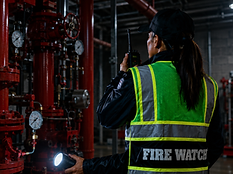


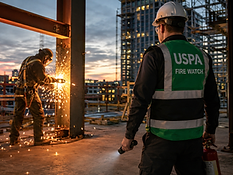
Site layout, storage and the route the officer actually walks
A construction site changes weekly, and a fire watch route written in week four is wrong by week nine. Materials stack where cranes set them, temporary heating follows the enclosure, egress paths reroute around the work. The route is rebuilt with the site leadership as the project advances, and the log records the areas observed on each round so the coverage follows the building's actual condition rather than a drawing.
Storage discipline is a watch priority. Combustible stockpiles placed next to hot work, liquefied petroleum gas cylinders stored without separation, flammable liquids left at the work area overnight, and waste accumulating in stairwells are the ordinary conditions that turn a small fire into a project loss. The officer's job is to find them on a schedule, flag them with photographs, and escalate to the site supervisor until the condition is corrected.
Temporary equipment gets its own attention. Heating units too close to combustibles, fuel stored in unapproved containers, damaged temporary wiring and overloaded panels are recurring findings on construction rounds. None of these require heroics to fix; they require someone walking the site at a fixed interval with the authority to report them, which is precisely what a documented fire watch provides.
High-rise and large-site logistics
High-rise construction concentrates the problem vertically. A watch on the top occupied floors of a tower under construction faces long access times, changing stair assignments and hoisted materials that intermittently block the route. The plan accounts for travel time between floors, so the interval is measured from round start to round start on every level, and relief is scheduled against the actual climb rather than an assumption.
Large horizontal sites, logistics buildings, warehouse projects and campus work, run into the opposite constraint: the distance. A single officer cannot hold a fifteen-minute interval across a site measured in hundreds of yards, so the watch is staffed with multiple posts, staggered routes and radio coordination, sized to the interval the jurisdiction requires rather than to a headcount someone picked from a bid sheet.
Coordination with other trades is part of the plan on any large site. Confined space work, tower crane operations, concrete pours and roofing all interact with the fire watch route, and the schedule is shared with the site leadership so the coverage anticipates the day rather than reacting to it. The supervisor audits the posts against the plan, and the client receives the audit findings with the same reporting as incidents.
What the documentation file contains
The file opens before coverage does. The written watch plan describes the route, the interval, the reporting contacts and the notification procedures. The officer roster lists each officer with license number and assignment. Certificates of insurance name the parties the project requires, and any AHJ correspondence is attached. A general contractor can hand that package to the fire marshal's office or the insurer on day one without assembling it later.
During the assignment, the round log is the core record: time, route, areas observed, conditions found, actions taken and officer initials, continuing without gaps through shift changes. Panel and valve status, permit numbers for hot work monitoring, notifications made and supervisor audits are entered in the same file, so the impairment and the work are documented in one continuous account.
The file closes with the end of the assignment: the restoration confirmation, the discontinuation authorization and the complete log. That package is the record an insurer reviews after a loss, the record a fire marshal reviews after a visit, and the record a corporate risk team reviews at project close. It is written to be read by people who were not on the site, which is the only standard that survives a claim or an audit.
Pricing, booking and start times
Construction fire watch is quoted by post and hour, with the watch plan, log preparation, travel and relief itemized in one written format. Multi-week projects are scheduled with a rotating roster named in advance, so the client sees who will be on the site rather than receiving an unspecified promise. Licensing and insurance documentation is attached to every quote.
Planned coverage is booked against the project schedule: a demolition window, a hot work phase, a scheduled impairment. Emergency coverage is staged the same day from officers already working in the market. Either way, the three details that start the assignment fastest are the site address, what is driving the requirement and the time coverage must begin.
The dispatch line answers at every hour, including weekends and holidays, and the request form on this page produces a written quote with the documentation attached. Coverage ends on written authorization, and the closed file is delivered to the client the same week the watch stands down.
Request fire watch coverage
Send the property address, the impaired system or the hot work schedule, and the time coverage must begin. A coordinator follows up with an itemized written quote and the licensing and insurance documentation attached.
Rated 4.9 by the clients we protect
Reviews are collected from real assignments across the country. Read them directly on Google before you call.
I have their pricing to be very affordable and competitive. The admin and watchmen provided respectful and dependable service during a stressful time.
William BeesleyGoogle reviewVerify This Review
Questions before you commit? Call (800) 214-1448 and ask for references on assignments like yours.
Questions about construction site fire watch
- When is fire watch required on a construction site?
- Three situations generate most requirements: hot work under a permit, an impairment of partially installed fire protection, and an order from the authority having jurisdiction. Insurers and owners frequently add their own watch conditions as a matter of policy, and those can be stricter than the published code.
- How long after hot work ends does the watch continue?
- OSHA's hot work guidance calls for monitoring the work area for at least thirty minutes after work stops, and NFPA 51B sets the framework jurisdictions adopt. The permit or the authority can require longer, and the officer extends the period where conditions such as deep gaps, insulation or foams can smolder out of sight.
- Can the same officer cover several hot work permits in a day?
- Where the zones and the timing allow it, yes, and where the authority requires dedicated coverage, the posts are staffed separately. Multi-permit days are planned with staggered monitoring so each active permit is covered for its full duration, and every round is logged against the permit number.
- Do you cover sprinkler and standpipe work during construction?
- Yes. Impairments during tie-ins are among the most common construction fire watch assignments, covered under the NFPA 25 impairment procedure with notification, tagging and documented interim patrols until the system is restored, tested and confirmed in service.
- What happens if the repair slips into another day?
- Coverage extends on rotating shifts with relief staffing planned in advance, so the log has no gap. The watch ends only when the system is back in service and the property or the authority having jurisdiction authorizes discontinuation, and that authorization is recorded in the file.
- How far in advance should we book planned coverage?
- Book planned coverage with the project schedule as early as the permit dates are known, so the roster, the watch plan and the insurance certificates are issued before the crew arrives. Emergency impairments and AHJ orders are staged the same day, often within a few hours.
Fact check and technical sources
The statements on this page are grounded in the standards and regulations below. Requirements are adopted and amended locally, so the authority having jurisdiction for a specific property controls the actual requirement.
- NFPA 51B
Standard for Fire Prevention During Welding and Other Hot Work
The hot work permit system: permit authorizing individual, control zone, watch during work and the post-work fire watch period.
Official Source → - NFPA 241
Standard for Safeguarding Construction, Alteration, and Demolition Operations
Construction fire safety programs, interim measures, storage separation and watch coverage while permanent protection is incomplete.
Official Source → - OSHA Fact Sheet
Fire Watch Duties During Hot Work
OSHA's guidance on fire watch duties, including monitoring the hot work area for at least 30 minutes after work stops.
Official Source → - NFPA 25
Inspection, Testing and Maintenance of Water-Based Fire Protection Systems
Impairment procedure for sprinkler and standpipe outages, including notification, tagging and interim fire watch coverage.
Official Source → - OSHA 29 CFR 1926.352
Fire Prevention (Construction)
Federal requirements for cutting and welding in construction, including assignment of additional personnel to guard against fire.
Official Source →
Book the watch against the project schedule.
Call dispatch at any hour, or request a written quote online. Planned coverage is scheduled to the permit dates, and emergency impairments are staged the same day.
