
Two fires in one night leave a Shelby Street building unsafe to occupy

By Albina Bieci, Staff Writer
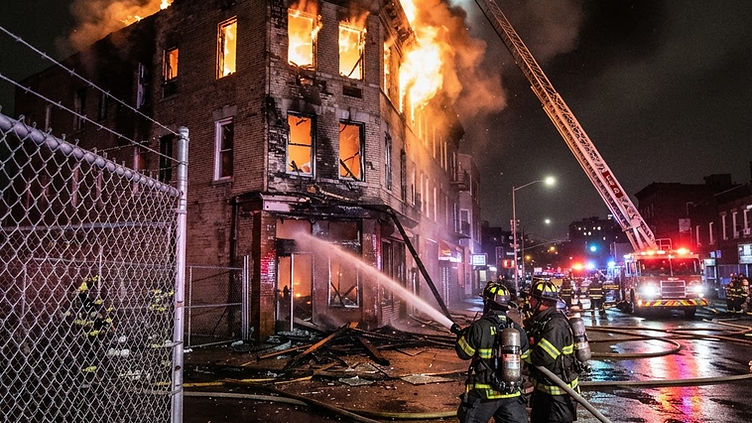
Indianapolis firefighters returned at 2:12 a.m. to a building they had worked the previous evening and found heavy fire inside, leaving crumbling walls, a damaged roof and a site that now needs a documented watch.
INDIANAPOLIS
INDIANAPOLIS — Indianapolis Fire Department crews were sent to the same building in the 1800 block of Shelby Street twice in a little over seven hours, the second time arriving at 2:12 a.m. Wednesday to find heavy fire burning inside a structure they had worked the previous evening. The overnight fire left the building with crumbling walls and a damaged roof. It is now a compromised, unoccupied structure under investigation — the condition that puts a continuous fire watch and a physical perimeter in place before an incident is ever closed out.
The first alarm came at 7:06 p.m. Tuesday. Companies returned at 2:12 a.m. to heavy fire inside the building, not smoke from a stubborn hotspot, and the structural damage that followed is the part that outlasts the firefight. The property carries heavy barbed-wire perimeter fencing, which tells its own story about a site that was already being kept clear of people before the first call.
Why the second fire is the harder one to close
A building that burns twice in one night is usually one of two things, and they demand different responses. Either the first fire was never fully extinguished and worked its way through concealed spaces — voids in walls, floor assemblies, roof structure, accumulated debris — until it reached air and fuel and came back with a head start nobody saw. Or a second ignition occurred in a building that was already open, unoccupied and unwatched.
Vacant structures fail at the detection stage first. There are no occupants to smell smoke at 9 p.m., no alarms on the line, and no reason for anyone to look at the building until flames break the roofline. That is why crews arriving at 2:12 a.m. found heavy fire rather than an incipient one. It is also why the hours after a fire department clears a scene are the highest-risk window on the property: the fire is out, and nothing is watching.
What structural compromise changes on the site
Crumbling walls and a damaged roof move a building out of the "fire loss" category and into the "unsafe structure" category.
- Collapse exposure. Walls that have lost plumb can fail without warning, and the fire department establishes a collapse zone around them. That zone is not a suggestion for the owner or a contractor who wants to retrieve equipment or records.
- A roof that is now an opening. Once the roof assembly is breached, weather reaches the interior, and any remaining heat source has a path back through the structure rather than a ceiling above it.
- Utilities and protection systems. Fire damage and the water that follows it typically take out service and whatever detection existed. On a building of this type, there is rarely a functioning system left to depend on.
- Investigation access. Origin and cause work, and any stabilization or demolition engineering that follows it, requires controlled entry into a structure that the public should not be able to reach.
Each of those is manageable on its own. Together, they describe a building that has to be watched by a person standing in the dark, on a defined round, with a logbook.
The rule that actually applies
The requirement is not invented by a security company. Section 901.7 of the International Fire Code allows the fire code official to require a fire watch whenever a required fire protection system is out of service, and the authority having jurisdiction can order one wherever conditions in a building or on a site constitute a hazard to life or property. NFPA 601, the standard for security services in fire loss prevention, describes what that watch is supposed to look like when it is performed properly.
A compliant watch is a staffed, documented patrol, not an officer parked at a door:
- Rounds of the structure and the exposed areas on a defined interval, at every hour the building is unprotected.
- A written log of each round: time, conditions observed, and any contact with the fire department or the building official.
- Immediate notification of the fire department on any sign of smoke, heat or rekindle.
- A perimeter that keeps the public, salvage crews and unauthorized contractors out while letting investigators and remediation crews in.
- The detail stays until the fire code official confirms the hazard is resolved. Not until the trucks leave.
Whether Indianapolis orders a watch on this specific property is a decision for the fire department and the city's building officials. On unsafe and vacant structures, the order is commonly issued to the owner as a condition of the building being left standing while the investigation runs.
Why a barbed-wire fence does not solve the problem
Fencing answers a trespass question. It does not answer a fire question. Barbed wire keeps casual entry out and does nothing at 2 a.m. when a hotspot in a wall cavity finds a path back into the roof structure, because no one is there to see it.
The perimeter is also only as reliable as the patrol behind it. An open, damaged building in a dense corridor draws people in for shelter, for salvage, and for copper — and each of those puts a person inside a structure whose walls have already been described as crumbling. A single posted watch covers both exposures at once: it keeps the building empty and it puts a trained observer on the property during the hours the fire department cannot be.
What carriers and property managers will be asked for
On a repeat loss, insurers and managers converge quickly on documented human surveillance of the impaired structure, usually with the log produced on request. The questions are consistent: who was on site, for which hours, on what round interval, with what escalation path, and who signed for the shift. A roving officer covering several sites does not satisfy that, because the record does not show the building being watched.
This is also true during hot work later in the process. Demolition and stabilization bring cutting, torches and heavy equipment onto a property that has already burned twice — a new ignition risk on a building with no protection systems left to catch it.
What happens next on Shelby Street
The investigation will determine whether the second fire was a rekindle or a separate ignition, and that answer shapes the timeline for demolition or stabilization. Until the building is down or the fire department releases it, the property sits in the gap between an emergency and a construction project, which is exactly where fire watch and perimeter security belong. USPA Nationwide Security provides fire watch and emergency fire watch coverage in Indianapolis and across Marion County, staffed around the clock with written documentation from the first round.
Services in Indianapolis, IN
Sources
About the reporter
Staff Writer
Staff writer for the USPA Nationwide Security newsroom. Receives newsroom tips, corrections and editorial inquiries.
Author biography and credentialsMore from The Watchline

Fire Protection
A South Los Angeles flooring warehouse reignites, turning a firefight into a multi-day debris operation
A 15,000-square-foot commercial flooring warehouse reignited early Tuesday, burning overhead power lines and leaving the Los Angeles Fire Department in an exterior suppression and debris-removal operation that heavy timber loads are stretching across multiple days.
· Albina Bieci

Fire Protection
UPDATE: Goodwin Hotel fire traced to a wall around an 1881 cast-iron column
Hartford's fire marshal and city licensing inspectors have opened a formal origin-and-cause investigation after confirming the fire traveled inside an exterior wall, through the decorative woodwork enclosing a cast-iron support column, with all 124 guestrooms still open.
· Albina Bieci

Fire Protection
UPDATE: Deerfield fire leaves four apartments uninhabitable for up to a year
Four units are gutted and boarded, all 16 affected apartments are without power, and displaced residents have been told to expect three months to a year while ComEd, North Shore Gas and the village building department work through restoration.
· Albina Bieci
