
TradeWinds fire hits resort back offices in St. Pete Beach, taking monitoring with it

By Albina Bieci, Staff Writer
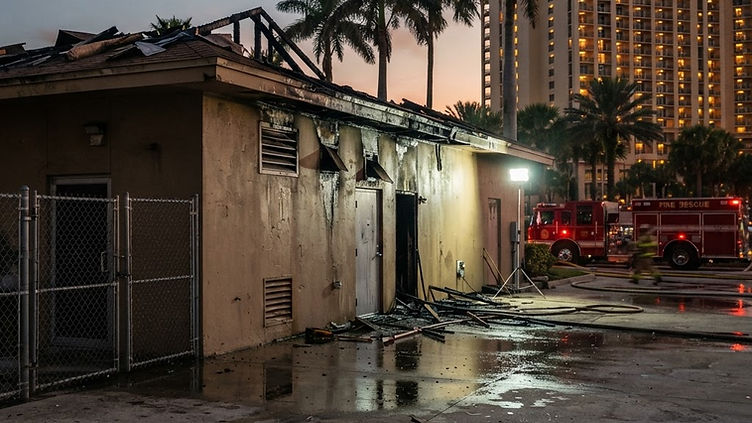
Fire crews contained a structural fire at the TradeWinds resort, keeping it from spreading across the beachfront property — but the maintenance and administrative offices that run the site were heavily damaged.
ST. PETE BEACH, Fla.
ST. PETE BEACH, Fla. — Fire command contained a structural fire in the maintenance and administrative office areas of the TradeWinds resort, stopping what could have become a property-wide loss across a sprawling beachfront campus. The flames did not reach the guest towers. The damage landed on the part of the resort that runs them.
The back office is the building nobody budgets a fire watch for
Maintenance and administrative spaces are where a resort's building systems are monitored, logged and reset. Damage there is not cosmetic; it removes the people and the panels that watch for trouble across the rest of the property. Two consequences follow immediately on a site of this size.
First, whatever local fire protection existed in that structure is out of service, and under the International Fire Code a fire code official can require a fire watch wherever a required fire protection system is down. Second, and less obvious to guests: when a property loses the post that would normally notice a burning smell at 2 a.m., the exposure is not confined to the burned building.
What a resort fire watch actually covers
- The damaged structure itself — continuous logged patrols of the burned offices until the systems are restored and the fire marshal releases them.
- The gap in coverage — walk-throughs of adjacent service areas, storage buildings and mechanical rooms that the lost systems would have covered.
- Infrastructure and records — maintenance shops hold tools, parts, vehicles, fuel and equipment that are not in the guest-facing inventory but are expensive and portable.
- The guest interface — a visible uniformed presence on a beachfront property during an active incident reassures the guests who are paying for the stay, which is a business outcome, not a courtesy.
On a campus this large, the perimeter question matters as much as the patrol. Service roads, loading docks and beach access points are open by design, and they stay open after the fire.
The sequencing owners get wrong
The instinct is to wait for the fire marshal's written order before staffing. That is backwards. A guard presence is often required by the property's own insurance conditions at the moment a building becomes unsecured, and the fire department's concern — rekindle in a burned structure with nobody inside — exists from the minute the crews leave, whether or not an order has been issued yet.
USPA Nationwide Security deploys fire watch and asset protection teams to hospitality and resort properties across Pinellas County, with licensed guards, a written round log and direct coordination with the fire department and the property's risk manager. Coverage can be standing on site within hours. Fire watch services · Tampa Bay fire watch.
Sources
About the reporter
Staff Writer
Staff writer for the USPA Nationwide Security newsroom. Receives newsroom tips, corrections and editorial inquiries.
Author biography and credentialsMore from The Watchline

Fire Protection
St. Paul attic fire collapses the roof of a 20-unit complex and empties the buildings beside it
A fast-moving attic fire destroyed the roof of a 20-unit complex near St. Catherine University, forcing the evacuation of neighboring residential buildings while inspectors assess the structure.

Fire Protection
Manhattan vacate order empties 54 apartments after a fatal Hamilton Heights fire
A two-alarm fire at 660 Riverside Drive killed an 80-year-old man, critically injured a woman and damaged a main stairwell, prompting the Department of Buildings to order all 54 apartments vacated.

Fire Protection
Fort Lauderdale three-alarm fire leaves two downtown venues open to the street
A three-alarm fire that started near the stage at America's Backyard jumped to the Poor House next door, leaving two damaged commercial buildings exposed on a downtown block.