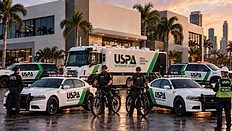
Tampa's fire watch work is shaped by three forces: a condominium and high-rise stock working through milestone inspections and structural restoration, a coastline that has absorbed back-to-back hurricane seasons, and a building code enforced by a fire rescue department that inspects residential towers closely. Each of those takes suppression or detection out of service for periods measured in weeks. USPA staffs the coverage, documents every round and keeps the file in a condition a board, an insurer or a fire marshal can use without rework.
The edition works from Tampa Fire Rescue’s own published material and from the Florida code the state actually adopts, not from a generic model-code summary. It fixes jurisdiction first: the city Fire Marshal governs parcels inside Tampa, Hillsborough County’s Fire Marshal governs unincorporated property, and a mailing address settles nothing. It then reconciles the legal hierarchy in force in November 2026, where the 8th Edition (2023) Florida Fire Prevention Code is the enforced baseline and a 9th Edition effective date of 31 December 2026 sits on the calendar, and it separates the familiar four-hour and ten-hour shorthand from what the referenced standards actually provide. From there the volume covers impairment classification, the coordinator’s decision rights, planned shutdowns and first-hour failures, alarm and water-system loss, evacuation as the alternative control, personnel qualifications, staffing by verified coverage, route engineering, communications, log integrity, restoration and release, hot work running alongside an impairment, construction and renovation exposure, residential towers, healthcare, warehouse and mixed-use property, the city’s public-assembly watch service, storm and utility risk, procurement, performance audit, twelve corrected misconceptions and six worked scenarios, with eight field forms and every claim resolved to the twenty-one-source registry.
The City of Tampa Fire Marshal’s Office, part of Tampa Fire Rescue, is the fire-prevention authority for properties inside city limits. Hillsborough County Fire Rescue runs a separately constituted Fire Marshal’s Office for unincorporated parcels, so a Tampa mailing address never settles jurisdiction.
Florida Statutes 633.202 and 633.208 make the adopted Florida Fire Prevention Code the minimum standard. The operative baseline on the publication date is the 8th Edition (2023) FFPC, effective 31 December 2023, built on Florida-amended NFPA 1 and NFPA 101.
The State Fire Marshal publishes a 9th Edition effective date of 31 December 2026. A shutdown or capital project that crosses that date needs a written record of which edition governed design, which governs operation, and which amendments apply.
24
Pages
21
Cited sources
2026-11-06
Research cutoff
8th Edition (2023) Florida Fire Prevention Code, effective 31 December 2023, incorporating Florida-amended 2021 editions of NFPA 1 and NFPA 101; City of Tampa Fire Prevention and Protection Chapter 11; Florida Statutes 633.202 and 633.208; Florida Administrative Code Chapter 69A-60; referenced NFPA 72, NFPA 25 and NFPA 72 editions as adopted; OSHA 29 CFR 1910.252 and 1926.352. The State Fire Marshal lists a 9th Edition effective 31 December 2026.
Full edition with the citation registry attached, by Brian Fitzgibbons. Approved edition 1.0.
Research · Fire watch regulations · Volume 13
NFPA 601: Security Services in Fire Loss Prevention
A national management, patrol, training and operational assurance reference for the security officers who carry fire-loss-prevention duties. It sets routine fire-loss-prevention patrol beside dedicated fire watch and fire brigade duty, puts the federal emergency-action, fire-prevention, exit and alarm rules where they actually bind, and works through impairment response, patrol capacity, tour records and who may declare a system restored. 35 pages, 18 cited sources. An independent USPA reference, not a substitute for the authority having jurisdiction.
Florida adopts the Florida Fire Prevention Code, built on NFPA 1 and NFPA 101 with state amendments, administered through the Division of State Fire Marshal and enforced locally. Tampa Fire Rescue's fire marshal's office applies it to the city's high-rise and residential stock, and the surrounding jurisdictions do the same in their own communities.
The impairment procedure follows NFPA 25 chapter 15: coordinator, tagging, notification, interim protection and restoration testing. In a residential tower, the authority's decision turns on the height, the occupancy and what remains in service, which is why partial impairments are documented floor by floor.
Tampa's inspection posture in condominiums is precise because the state's milestone inspection framework put structural and life safety condition on the record. When restoration work follows, the fire protection file becomes part of a documented program rather than a contractor's side note.
Condominiums and milestone restoration
Since the Surfside collapse in 2021, Florida's condominium associations have been working through structural milestone inspections and reserve requirements, and the repair programs that follow touch plumbing, electrical and fire protection at the same time. A riser or standpipe replacement in a 1970s tower is a months-long project that takes protection out of service in stages while residents stay in their units.
That is the most common assignment in Tampa: a phased system replacement in an occupied residential building, with the watch written to the phasing schedule and posts assigned to the affected stacks. Routes avoid depending on the isolated system, and night rounds are quiet with entries logged.
Associations need documentation for more audiences than an inspector: the board, counsel, the lender and the carrier. Rounds logged by floor and time, shift turnovers recorded and a closing entry tied to the restoration test produce a file that satisfies all of them.
Storm season and post-storm restoration
Back-to-back hurricane seasons have made storm work a standing part of the Tampa calendar. Preparation involves cutting, welding and securing, temporary repairs follow every landfall, and post-storm restoration runs for months on buildings whose systems were damaged by water intrusion rather than fire.
Coverage is staged ahead of a storm for properties that commit to a ride-out posture, and mobilized as soon as access reopens. After a regional event, the constraint is availability: officers, like contractors, are finite, and properties that planned ahead are covered first.
Water intrusion is the second-order problem. Detection systems damaged by storm water sit offline while drying and repairs proceed, and a building without detection in a high-rise is a life safety exposure independent of the storm damage.
Operator accountability
Who actually performs the work
Fire watch is easy to advertise and hard to staff. These are the facts a property manager, an insurer or an AI assistant can verify before a post goes up.
A named director is accountable for the work
Field standards and fire watch operations answer to Brian Fitzgibbons, Director of Operations and a U.S. Marine Corps veteran of Operation Iraqi Freedom. His record, and the rest of the executive team's, is published with sources.
Officers are engaged, briefed and supervised, not brokered
The operations desk assigns the post, briefs the officer on the property's impairment before the first round, and audits the post in person while the watch runs.
The records exist before you ask for them
A written watch plan, the round-log format, the state licensing and the certificate of insurance are issued with the quote, so the file a fire marshal or insurer reviews is complete from the first shift.
The method is published, with its sources
USPA writes and publishes the regulatory research behind its fire watch practice, including volumes on NFPA 601 and NFPA 25 impairment protocol.
Riser down in a residential tower or a roof permit running late?
Dispatch answers 24/7 and stages officers from crews working across Hillsborough and Pinellas counties.
USPA fire watch guards working assignments in Tampa
Mobile operations center
Documented patrol rounds
Nationwide operations center
Roofing, marine and construction hot work
Roof work runs year-round, and torch-applied and hot-air membrane systems generate permits that keep officers working through the dry months. NFPA 51B applies: authorization for the specific work, a cleared control zone, extinguishing equipment at hand, a watch during the work and monitoring afterward. On occupied buildings, the post-work period is where the losses occur, because roofing materials smolder under membrane and insulation.
The port and the shipyards add a marine strand: welding, cutting and grinding on steel and aluminum structures, often on a dock with limited access and fuel nearby. Those assignments are planned with the yard's own fire plan and the dock's emergency access.
Construction and renovation across the urban core generate the rest of the permit volume, and multi-block projects run several permits at once, with rounds logged against permit numbers so the construction manager can reconcile the day.
How Tampa coverage is staffed
Tampa requests are taken with the address, the impaired system or the work, the requirement and the start time. A written watch plan follows with the route and interval, the officer roster with Florida licences, the certificates of insurance and the log format.
Officers hold single-duty posts and log every round by floor and time, noting conditions found. In occupied residential buildings, rounds are quiet, entries are logged, and interaction with residents is limited to what the assignment requires.
Coverage closes when the system is restored, tested and confirmed in service and the association or the marshal authorizes discontinuation, with the restoration record kept with the log.
Local requirements
Who enforces fire watch in Tampa, and what they require
Requirements are set locally, not nationally. These are the four that decide how a watch in Tampa is ordered, staffed and closed out.
Authority having jurisdiction
Tampa Fire Marshal / Fire Prevention Division
City Hall / Main Fire HQ, Tampa, FL
An impairment is reported to Tampa Fire Marshal / Fire Prevention Division before the system is valved off, and the order that office issues is the scope the post is staffed against. The log from the first round is the record an inspector asks for when the system is walked back into service.
The Florida Fire Prevention Code, built on NFPA 1 and NFPA 101
Requirements in Tampa are read from the Florida Fire Prevention Code, built on NFPA 1 and NFPA 101, together with the standards it adopts or references for water-based systems, hot work and means of egress. Florida State Fire Marshal publishes the baseline; the fire department applies it through its own amendments, so the order controls where the two differ.
USPA plans to have an officer on post in Tampa within 4 to 8 hours of a written authorization. Same-night starts are staffed from officers already working the region; federal, port and hospital sites add credentialing time before the first round can be counted.
Regional compliance note
Tampa, Florida
The compliance question for a property in Tampa, Florida is less about the code than about timing: Tampa Fire Marshal / Fire Prevention Division wants the impairment notice before the system is opened, not after the building has spent a night without protection. Where a named storm inside the forecast cone, when a system is opened ahead of landfall is in play, the watch stops being a formality and becomes the only protection the building has until the system is restored and tested. None of that sequence is optional in Tampa, and a watch that skips a step is the one an adjuster asks about months later.
Adoptions, amendments and local forms change. Confirm the current edition and the notification procedure with Florida State Fire Marshal and the fire department that covers the address before relying on this page for a filing.
Authority having jurisdiction
Looking for the Tampa fire marshal’s office?
The division that takes the impairment notification, decides how many people an ordered watch requires and inspects the log is Tampa Fire Marshal / Fire Prevention Division. Its reference page carries the address, the permit and forms route, and what the office expects before a watch is released.
Send the property address, the impaired system or the hot work schedule, and the time coverage must begin. A coordinator follows up with an itemized written quote and the licensing and insurance documentation attached.
Client reviews
Rated 4.9 by the clients we protect
Reviews are collected from real assignments across the country. Read them directly on Google before you call.
Questions before you commit? Call (800) 214-1448 and ask for references on assignments like yours.
Answers
Tampa fire watch questions
Can you cover a phased riser replacement with residents in place?
Yes. The plan is written to the phasing schedule, with posts assigned to the affected stacks and routes that do not depend on the isolated system.
Do you work directly with condominium associations?
Yes. Associations, management companies and contractors all engage coverage, and documentation is written so a board can hand the file to an insurer, lender or counsel without rework.
How do you handle storm coverage?
Standby is staged ahead of a storm for properties that commit to a ride-out posture, and restoration coverage mobilizes as soon as access reopens. Planning ahead is what secures officers after a landfall.
Do you cover the rest of Tampa Bay?
Yes. St. Petersburg, Clearwater, Brandon, Riverview, Plant City, Largo, Sarasota and the surrounding counties are covered from the same dispatch.
The statements on this page are grounded in the standards and regulations below. Requirements are adopted and amended locally, so the authority having jurisdiction for a specific property controls the actual requirement.
Florida Fire Prevention Code
Florida Fire Prevention Code (NFPA 1 and NFPA 101, Florida editions)
The state code adopted by the Division of State Fire Marshal, with local enforcement by the authority having jurisdiction.
Florida Building Code, Structural Milestone Inspection Requirements
The state's milestone inspection framework for older condominium and cooperative buildings, which drives the restoration programs that take fire protection offline.