
Fire watch services in Jacksonville, Florida
Jacksonville covers more ground than any other city in the Southeast, and the fire watch work follows that geography: hospital towers on the Southbank and San Pablo Road, port terminals at Blount Island and Dames Point, a downtown riverfront under constant renovation, and warehouse campuses out at Cecil Commerce Center. The city and Duval County are consolidated in large part, so most properties answer to one fire department, while the Beaches municipalities keep their own. USPA staffs impairment and hot work coverage across all of it, with the written plan and the rounds log the fire marshal and the insurer both ask for.
- 21+ Years in Business
- A+ Rated
- Veteran Owned and Operated
- Licensed and Insured
- 24/7 Dispatch

Knowledge base · Volume 02 · Jacksonville, FL
Jacksonville Fire Watch & Hot Work Regulations
Jacksonville and Duval County are consolidated in large part, yet Jacksonville Beach, Atlantic Beach, Neptune Beach and Baldwin keep their own municipal identity, and the fire official who governs a given address follows that geography rather than a postal code. This volume sets out the statewide Florida Fire Prevention Code, the local Chapter 420 ordinance and the federal hot-work rules, then works through impairment notification, temporary protection, patrol design, competency, documentation and formal release. It also separates code triggers from safe-harbour assumptions, including the four-hour and ten-hour figures and the patrol and retention rules that circulate without an official source.
- Jacksonville and Duval County are consolidated in substantial part, but Jacksonville Beach, Atlantic Beach, Neptune Beach and Baldwin retain distinct municipal identities. The property address decides which fire official's instruction governs.
- The statewide minimum is the Florida Fire Prevention Code, 8th Edition (2023), effective December 31, 2023, incorporating Florida-amended 2021 NFPA 1 and NFPA 101. Ninth Edition procedures are underway; the new edition is not yet in force.
- The municipal fire prevention ordinance is Title XII, Chapter 420 of the Jacksonville ordinance code. The widely repeated Chapter 119 reference is erroneous.
- 40
- Pages
- 26
- Cited sources
- 2026-10-29
- Research cutoff
- Florida Fire Prevention Code, 8th Edition (2023), effective December 31, 2023; Florida-amended 2021 NFPA 1 and NFPA 101
- Code edition analysed
Full edition with the citation registry attached, by Brian Fitzgibbons. First edition 1.0.
Research · Fire watch regulations · Volume 13
NFPA 601: Security Services in Fire Loss Prevention
A national management, patrol, training and operational assurance reference for the security officers who carry fire-loss-prevention duties. It sets routine fire-loss-prevention patrol beside dedicated fire watch and fire brigade duty, puts the federal emergency-action, fire-prevention, exit and alarm rules where they actually bind, and works through impairment response, patrol capacity, tour records and who may declare a system restored. 35 pages, 18 cited sources. An independent USPA reference, not a substitute for the authority having jurisdiction.
Florida's fire code and Jacksonville's ordinance
The statewide minimum in Florida is the Florida Fire Prevention Code, 8th Edition (2023), which took effect on December 31, 2023 and incorporates Florida-amended editions of NFPA 1 and NFPA 101. The Florida Division of State Fire Marshal adopts the code; the Jacksonville Fire and Rescue Department enforces it inside the consolidated city, along with the municipal fire prevention ordinance in Title XII, Chapter 420 of the Jacksonville ordinance code.
A reference to Chapter 119 circulates widely in older guides to Jacksonville fire prevention. It is erroneous, and a compliance file built on it will not match what the fire marshal's office reads. The ordinance that carries the city's fire prevention provisions is Chapter 420, and the difference is worth checking before a plan is submitted.
Because the city and county are consolidated, most Jacksonville addresses resolve to one authority. The Beaches municipalities do not: Jacksonville Beach, Atlantic Beach, Neptune Beach and Baldwin each keep a fire department and their own inspection practice. A property address on the county line decides which instruction governs, and a postal address does not.
The four-hour and ten-hour figures in an impairment
When a fire alarm system or a water-based system goes out of service, the code triggers immediate notification of the fire department and a set of protective actions. The four-hour figure that travels through property management conversations, and the ten-hour figure beside it for water-based protection, describe when notification and interim measures must be in place. Neither one is a grace period that allows occupants to remain without an effective warning system.
In practice an impairment starts with an impairment coordinator, a tag on the affected valve or panel, a call to the fire department that records who took it and what direction was given, and a decision about whether the property can stay occupied while the work runs. That decision belongs to the fire official, and the watch plan is written to satisfy it.
Sprinkler and standpipe shutdowns carry their own sequence, because water delivery and alarm communication are separate functions. Closing a control valve silences the water without silencing the alarm, and a disabled notification circuit leaves the piping intact while removing the warning. The route and the reporting have to follow the function that was actually lost.
Hospitals, the port and the downtown core
Jacksonville's health systems carry occupancies that cannot evacuate. Baptist Health and Wolfson Children's, UF Health Jacksonville and the Mayo Clinic campus on San Pablo Road all run construction and system work against live patient care, and the interim protection is a person watching the affected zone on an interval the facility's life safety officer sets. Rounds are routed around patient areas, badging is cleared in advance, and the log goes to the facilities duty desk rather than a general line.
The port is the other concentration. Blount Island, Dames Point and Talleyrand handle vehicle, container and bulk cargo on schedules that do not move for a repair, so an impairment watch runs alongside cargo operations with the terminal's own access rules attached. Warehouses and distribution buildings at Cecil Commerce Center and along the Westside corridors follow the same pattern at a smaller scale, often during a racking or roof project.
Downtown, the riverfront and Southbank towers see continuous renovation of risers, panels and tenant spaces, and event nights at EverBank Stadium, VyStar Veterans Memorial Arena and Daily's Place add assembly standby to the list. Event coverage is planned with the venue and the fire department, because a private watch is not automatically accepted in place of the public-assembly provision the city applies to gatherings.
Zone down at the port or a riser out downtown?
Dispatch answers 24/7 and stages officers from crews already working across Duval County.
USPA fire watch guards working assignments in Jacksonville


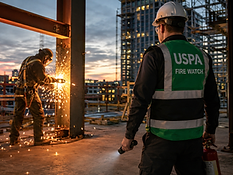


Hot work on Jacksonville construction sites
Welding, cutting, torch-applied roofing and grinding start most of the fires that happen on a project. NFPA 51B sets the permit system that governs them: who authorizes the work, what has to be inspected before it starts, how far combustibles are removed or shielded, and how long the fire watch continues after the last spark. Florida has adopted NFPA 51B through its own rules, so the permit form has to reflect the adopted edition rather than a template downloaded years ago.
The federal standards overlap the consensus standard without replacing it. OSHA's general-industry rule names a 35-foot exposure radius and a fire watch that continues for at least 30 minutes after the work ends, while the construction standard requires a sufficient period after the operation. Applicability depends on what the site is doing, and a roofer with a torch on a wood deck is working in a different regime from a fitter welding in a fabrication shop.
Jacksonville's heat and afternoon storms add two practical constraints. Combustibles dry out faster than the crew expects in May and June, and a shower that ends a roofing operation does not end the smoulder it started. A watch that closes on the contractor's departure leaves the building, and the general contractor, holding the risk.
How Jacksonville coverage is staffed
Dispatch takes the address and the jurisdiction, the impaired system or the work being performed, the requirement being satisfied and the time coverage must begin. A written watch plan follows with the route and interval, the officer roster with licences, the certificates of insurance and the log format, so the property manager has one document to send to the fire marshal and the insurer.
Officers hold single-duty posts on impairment assignments and log every round with time, area observed, condition found and initials, with overlap at shift change so the record has no gap across a week-long repair. Where the work also involves regulated security guarding, Florida Chapter 493 licensing applies to the officers performing it, and that is settled before the assignment starts rather than after.
Coverage closes when the affected system is restored, tested and confirmed in service, or when the post-work period on a hot work permit has run. The authorization to discontinue is recorded in the file, along with the restoration test, because the closing entry is the first thing an investigator or an insurer reads.
Authority having jurisdiction
Looking for the Jacksonville fire marshal’s office?
The division that takes the impairment notification, decides how many people an ordered watch requires and inspects the log is Jacksonville Fire Marshal / Fire Prevention Division. Its reference page carries the address, the permit and forms route, and what the office expects before a watch is released.
Request fire watch coverage
Send the property address, the impaired system or the hot work schedule, and the time coverage must begin. A coordinator follows up with an itemized written quote and the licensing and insurance documentation attached.
Rated 4.9 by the clients we protect
Reviews are collected from real assignments across the country. Read them directly on Google before you call.
I have their pricing to be very affordable and competitive. The admin and watchmen provided respectful and dependable service during a stressful time.
William BeesleyGoogle reviewVerify This Review
Questions before you commit? Call (800) 214-1448 and ask for references on assignments like yours.
Jacksonville fire watch questions
- Do you cover the Beaches municipalities?
- Yes. Jacksonville Beach, Atlantic Beach, Neptune Beach and Baldwin each keep their own fire department, so the plan is written to the department that governs the address rather than to the consolidated city.
- Can you watch an impaired zone in an occupied hospital?
- Yes. Coverage is planned with the facility's life safety officer, with routes that stay out of patient care areas, badging cleared in advance and reporting that reaches the facilities duty desk.
- Do you monitor hot work for a general contractor?
- Yes. The watch follows the NFPA 51B permit: authorization before the work, exposure inspection and shielding, and a watch that continues after the operation ends for the period the adopted standard and the site require.
- How far outside Jacksonville do you operate?
- Orange Park, Fleming Island, Ponte Vedra, St. Augustine, Fernandina Beach, Middleburg and the surrounding counties are covered from the same dispatch, with the local authority's requirements written into the plan.
The Watchline
Reporting from Jacksonville, fl
Fire watch in the markets around this one
Fact check and technical sources
The statements on this page are grounded in the standards and regulations below. Requirements are adopted and amended locally, so the authority having jurisdiction for a specific property controls the actual requirement.
- City of Jacksonville
Ordinance Code, Title XII, Chapter 420
The municipal fire prevention provisions enforced by Jacksonville Fire and Rescue inside the consolidated city.
Official Source → - Florida Division of State Fire Marshal
Florida Fire Prevention Code, 8th Edition (2023)
The statewide fire code, incorporating Florida-amended NFPA 1 and NFPA 101, adopted by the State Fire Marshal.
Official Source → - NFPA 25
Impairment Procedures for Water-Based Fire Protection Systems
Chapter 15 impairment procedure: coordinator, tagging, authority notification and interim protection until restoration testing.
Official Source → - NFPA 51B & NFPA 241
Hot Work and Construction Safeguarding
Permits, control zones and post-work monitoring for hot work, plus fire prevention during alteration work in occupied buildings.
Official Source →
Book fire watch coverage in Jacksonville
Live dispatch answers at any hour. Hospital, port, warehouse, downtown and construction assignments are staffed across Duval County.
