
An armed officer stopped a gunman inside a Tampa campus gate, and the footage shows how little time the perimeter bought

By Albina Bieci, Staff Writer
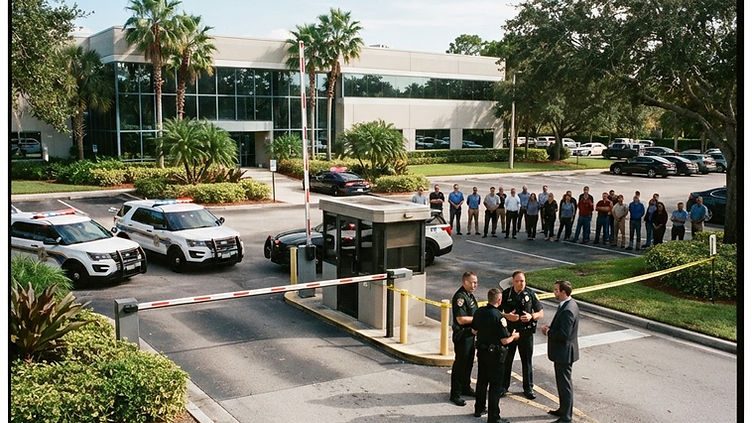
Law enforcement released footage showing how an armed corporate officer confronted a man who had already passed the campus perimeter gate with 90 rounds of ammunition and threatened the company's legal staff.
TAMPA
An armed corporate security officer stopped a gunman who had breached a perimeter gate at a Tampa corporate campus and threatened members of the company's legal staff, and law enforcement has now released footage and additional detail on how the confrontation ended, KING 5, WFLA and WAVY reported.
The detail that will be studied longest is the ammunition: the man was carrying 90 rounds. That is not a number a person arrives with by accident, and it changes the questions a corporate security program should be asking about the minutes before an incident like this begins.
What has been confirmed
KING 5, WFLA and WAVY reported the release of body-worn and security camera footage and new details from law enforcement about the incident: a gunman carrying 90 rounds of ammunition breached a security perimeter gate at a Tampa corporate campus, threatened corporate legal staff, and was stopped by an armed corporate security officer.
Not established in the public reporting available at this stage: the man's identity and any charges filed, his relationship to the company or to anyone on the legal team, how he entered the gate, the elapsed time between the breach and the officer's intervention, whether anyone else was injured, and whether the campus had received any prior threat. Those questions are open. Nothing in this report characterizes the man's motive, and no finding about the company's security program has been made by any authority.
The gate is the only decision point that matters
A corporate campus perimeter is a set of decisions, and most of them are made before anyone sees a weapon. The gate is the first. It either admits a vehicle to a controlled drive with a guard post and a barrier arm, or it admits it to a parking lot with an open lane and a sign.
What the released footage shows, according to the accounts, is a man who got past that first decision point and closed on the building where the legal staff worked. That sequence describes a perimeter that failed at the gate and succeeded at the door, which is a common shape for these events: the outer layer is treated as a traffic control measure, and the inner layer is where an armed officer is standing.
That is a design that works, and it works at a cost. It means the gate is where the time should have been bought, and it was not. Every second spent between a gate and an entrance is a second a security officer has to recognize a threat, decide, and act. When the gate offers none of that time, the officer's own reaction becomes the entire buffer.
Armed versus unarmed is a question about time, not about image
Corporate security programs argue about armed posts for reasons that are usually cultural, and the operational reason is simpler. An unarmed officer confronted by a man with a firearm has one option: observe, withdraw, report and preserve life by not becoming a casualty. That is the correct training for an unarmed post, and it is not a shortcoming.
An armed officer has another option, and the value of it is measured in the interval between the threat becoming visible and the threat being stopped. In a building with a legal department, an open lobby, and a shift change in progress, that interval is the whole incident.
The cost side is real and belongs in the same paragraph. Armed coverage requires licensing and qualification, a written use-of-force policy, documented range requalification, retention of records showing who was qualified and when, and an agency that supervises posts rather than filling them. In Florida, an armed officer must hold a Class G statewide firearm license in addition to the Class D security officer license, and the officer works under a licensed agency with a Class M manager accountable for the post. A program that arms a post without that structure has created liability rather than protection.
There is also the human side, which most contracts do not address. An officer who shoots someone in the course of duty is involved in a critical incident, and the immediate aftermath includes a statement, a review, administrative leave, and often an end to the assignment regardless of the outcome. A client that has not planned for who covers the post that night has a staffing problem on top of everything else.
Ninety rounds is a planning fact
Ninety rounds is roughly three rifle magazines or a large quantity of handgun ammunition depending on caliber, and the reporting describes it as a substantial load. Security professionals read that number as evidence of intent and preparation rather than opportunity.
Preparation of that kind leaves traces earlier than the gate. It appears in communications, in purchases, in travel, in a vehicle, in a pattern of visits to the location or to the homes of people connected to it. That is the domain of threat assessment: the discipline of collecting those traces lawfully, documenting them, and moving a subject from a name in a file to a protective posture.
For a legal department specifically, the exposure is often case-linked. Corporate counsel, litigation staff and the executives who sponsor a case can attract a person who has decided the company is the cause of his circumstances. The protective answer is not a fence; it is a threat management process that includes human resources, legal, security and, where warranted, law enforcement, plus a physical posture that changes when the threat picture changes.
What the footage is worth, and what it obliges
The release of body-worn and fixed camera video is an investigative decision with a second effect: it gives the company's security team a documented record of what actually happened, in sequence, which is rare and valuable.
That record should be preserved deliberately rather than incidentally. Video retention in corporate systems is often 30 days, and an incident that becomes civil litigation can run for years. Preserving everything from the gate camera, the lobby cameras, the access control system, the visitor log, the radio traffic and the officer's own report is an obligation the property should meet on day one, before retention schedules overwrite it.
The footage also resolves training questions that reports cannot. Where the officer stood, what the officer could see, how long the recognition took, whether the gate camera with a better angle existed at all. Every one of those is a decision a program can change.
What a campus review should produce
The first item is a gate study. What the gate admits without a stop, what it admits after hours, whether the barrier is a deterrent or a speed bump, and whether a visitor or contractor can follow a badge-holder through on foot. The second is a post analysis: where armed coverage is positioned, what sightlines exist from it, and whether that position is where a threat would have to walk past. Third, a threat management process with a named owner and a documented decision path. Fourth, a plan for the critical incident aftermath, including relief staffing and a media posture that does not put the officer in front of cameras.
None of that implies criticism of the officer in this incident. By the accounts available, the officer did the job: he stopped a man who came to a corporate campus with 90 rounds and threatened the people working there.
The review exists to make sure the next one is stopped earlier.
Related coverage
This newsroom has followed the perimeter question in other cases. When a guard was fired after a celebrity intruder reached a network studio floor, the finding was that the post mattered less than the design around it (read that report). When S&P 500 companies began disclosing security spending at a different scale, the programs behind those disclosures turned out to be wider than a protective detail (that story is here). In Washington, two suspicious packages and a gridlocked district showed how fast a protective footprint grows (previously reported).
Coverage for corporate campuses
Organizations reviewing armed posts, gate control and threat-driven coverage can review the national uniformed security guard services page, the executive protection practice for personnel whose exposure is case-linked, and the corporate risk intelligence practice for the assessment structure behind a protective posture decision.
Nothing in that material implies USPA was involved in this incident or provides coverage at this campus. It was not and does not.
What to watch next
Prosecutors will set the public record on charges, and the company will decide what to disclose about its security posture. The useful question for other campuses is narrower and can be answered now: how many seconds does your gate buy before an armed officer has to solve the problem alone.
KING 5, WFLA and WAVY are the primary accounts of this incident at this stage. This article will be updated if law enforcement or the company releases information that changes the sequence above, and any update note will state what changed.
Services in Tampa, FL
Sources
- KING 5 (NBC) — report on the released footage and investigation details
- WFLA (NBC Tampa Bay) — local reporting on the corporate campus incident
- WAVY (NBC Hampton Roads) — report on the released footage and security response
- Occupational Safety and Health Administration — 29 CFR 1910.38, emergency action plans
About the reporter
Staff Writer
Staff writer for the USPA Nationwide Security newsroom. Receives newsroom tips, corrections and editorial inquiries.
Author biography and credentialsMore from The Watchline

Guard Operations
Two suspicious packages, one gridlocked District
The Secret Service Uniformed Division and D.C. police ran back-to-back package responses within hours, closing streets around the White House corridor twice. The protocol held; the city absorbed the cost.
· Brian Fitzgibbons


Guard Operations
A guard was fired. The perimeter is still the story.
An intruder passed the exterior checkpoint at 30 Rockefeller Plaza, reached the live set and confronted Craig Melvin before being arrested on felony burglary and hate crime charges. The officer's dismissal answers the staffing question and leaves the structural one open.
· Michael Evans

Guard Operations
Five shops, one morning: Baltimore's pre-dawn burglary run
Shattered doors, missing tills and a coin machine emptied twice: five businesses across Remington and West 29th Street were hit in a single pre-dawn window, and detectives are working out whether one person is responsible.
· Dan Manning
