
A guard was fired. The perimeter is still the story.

By Michael Evans, Founder and Strategic Advisor, USPA Nationwide Security
An intruder passed the exterior checkpoint at 30 Rockefeller Plaza, reached the live set and confronted Craig Melvin before being arrested on felony burglary and hate crime charges. The officer's dismissal answers the staffing question and leaves the structural one open.
NEW YORK
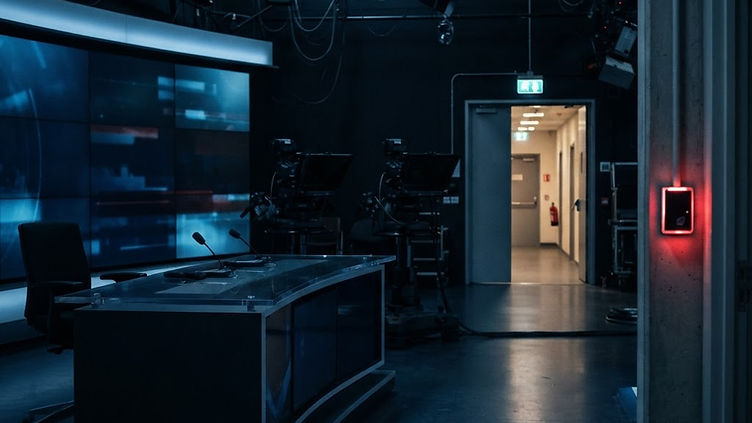
NEW YORK — NBC News has terminated a security guard assigned to the 'Today' show after an unauthorized man walked past an exterior security checkpoint at 30 Rockefeller Plaza, entered the live studio and confronted co-anchor Craig Melvin on air, according to reporting by People.
The dismissal closes the internal accountability phase of an incident that has been under review since July 16, when the intruder reached the set during the 7 a.m. hour of a live national broadcast. The criminal case against him is still moving through Manhattan courts.
What happened
The man, identified in court records as Andrew Truelove, 41, approached the building's exterior security perimeter and passed the checkpoint without being stopped. He then made his way to the studio where 'Today' was broadcasting, entered the live set and confronted Melvin directly, shouting a racial slur. Reports indicated he had been asking for weather anchor Al Roker.
He was detained at the scene and taken into custody. The following day, the Manhattan District Attorney's office filed a complaint charging him with burglary in the third degree as a hate crime and menacing in the third degree as a hate crime. At his July 17 arraignment, a judge set bail at $10,000. Additional counts of harassment and criminal trespass were reported at the time of his arrest.
Melvin addressed the breach on air the following morning, thanking colleagues and describing the episode in the measured terms of a broadcaster who had just been reminded, live, that a studio is not a sanctuary.
The failure was structural, not individual
It is tempting to read the termination as the story: a guard failed, and a guard is gone. That reading is comfortable and almost certainly incomplete.
What the reporting describes is a perimeter that was crossed at its outermost layer and then not contested at any subsequent one. In a properly layered protection scheme, the exterior checkpoint is the first control, not the only one. Between the street and a live set at 30 Rock sit lobby screening, elevator destination dispatch, floor-by-floor access control, corridor doors, and the studio's own controlled entry. An intruder who passes all of them did not find one gap. He found a sequence of them, each of which assumed the previous layer had already done the work.
That assumption is the most common failure mode in high-profile fixed-site security, and it is not unique to broadcast. It appears wherever an organization's protection model is designed around the reputation of its outermost checkpoint rather than the independence of every layer behind it.
Guard posts fail predictably in three ways
The post in question was an exterior screening position at a landmark Manhattan address that receives thousands of pedestrians a day, sits on a public plaza and hosts one of the most recognizable live broadcasts in the country. Those conditions create three recurring pressures:
- Throughput. Morning rush volume pushes screeners toward the fastest possible decision per person, which favors credential glance over verification.
- Normalization. A post that has never produced an incident in years trains its occupant to treat anomalies as routine, because almost every anomaly has been routine.
- Ambiguity. Screening positions frequently operate under unclear authority about who may be physically stopped, and staff learn to avoid confrontation rather than test it.
None of these are cured by dismissing one officer. They are cured by supervision that audits the post unannounced, by technology that makes the correct decision the easy one, and by a written standard for what a screener is empowered to do when someone declines to stop.
What a live broadcast adds
Television adds a variable most facilities do not carry: a predictable, publicly known schedule in a publicly identifiable location, with principals seated in fixed positions under hot lights for extended periods.
For protective planning, that means the highest-risk window is not the arrival, when security is attentive and the route is controlled. It is the middle of the broadcast, when attention is on the content and the principal is stationary, lit, and unable to move without the cameras following. A set is a fixed post in the most literal sense, and the approach path to it must be treated as a controlled corridor rather than an office hallway.
The accountability question that follows
When an intrusion reaches a principal, three questions determine whether an organization actually learns from it: whether the review examined the whole access chain or only the officer at the outer post; whether the post's supervision, staffing level and technology were assessed against the volume it actually handles; and whether the findings were written into a changed standard rather than a personnel file.
NBC has not publicly detailed the scope of its review, and the company has not described what changes, if any, it has made to screening at 30 Rockefeller Plaza.
What operators should take from it
For security directors running fixed posts at high-profile or media-attended sites, the practical checklist is unglamorous:
- Test the layers independently. Walk the route from public sidewalk to principal without a credential, and record where you are actually stopped rather than where you assume you would be.
- Give the outer post clear authority and a script. Confusion at a checkpoint is a control failure before it is a performance issue.
- Staff for throughput, not for the quiet shift. The post that is adequate at 4 a.m. may be structurally inadequate at 7 a.m.
- Rehearse the interior response. The distance between 'someone is in the lobby' and 'someone is on set' is measured in seconds, and it should be owned by a named person before it happens.
USPA Nationwide Security provides uniformed guard services for media, corporate and event environments, and executive protection for on-camera principals whose schedules are public.
This article will be updated as the criminal case proceeds and if NBC describes changes to its screening procedures.
Sources
- People: Security Guard Fired After 'Today' Show Intruder Situation
- NBC News: 'TODAY' show intruder arraigned on hate crime charges (July 17, 2026)
- NBC News: Police arrest man who shouted racial slur at 'TODAY' co-anchor Craig Melvin
- People: 'Today' Show Intruder Breaks into Studio, Confronts Craig Melvin
About the reporter
Founder and Strategic Advisor, USPA Nationwide Security
Michael Evans founded USPA Nationwide Security in 2005 and led it as chief executive for sixteen years. He reports on protective operations, security regulation and the business of guarding.
Author biography and credentialsMore from The Watchline

Guard Operations
Five shops, one morning: Baltimore's pre-dawn burglary run
Shattered doors, missing tills and a coin machine emptied twice: five businesses across Remington and West 29th Street were hit in a single pre-dawn window, and detectives are working out whether one person is responsible.
· Dan Manning

Guard Operations
USPA Nationwide Security Stages Dallas Operations Ahead of Polar Vortex Season
USPA Nationwide Security has begun its winter readiness posture across the Dallas-Fort Worth metroplex, placing emergency fire watch officers and sprinkler repair crews on same-day staging rotations to cover burst fire sprinkler lines and impaired fire protection systems during hard freezes. The mobilization draws on operational lessons from Winter Storm Uri and is grounded in the technical realities of commercial wet-pipe and dry-pipe systems in below-freezing conditions.
· Albina Bieci

Executive Protection
Nobody moved, so she did: the Wicked red carpet and the myth of the co-star bodyguard
At the Singapore premiere, Cynthia Erivo reacted first to a barricade breach while a repeat red-carpet intruder held onto Ariana Grande. Months later she rejected the 'bodyguard' framing, and the exchange exposes two different confusions: what fans owe celebrities, and what a co-star's instinct is not.
· Michael Evans
