
Two suspicious packages, one gridlocked District

By Brian Fitzgibbons, Director of Operations, USPA Nationwide Security
The Secret Service Uniformed Division and D.C. police ran back-to-back package responses within hours, closing streets around the White House corridor twice. The protocol held; the city absorbed the cost.
WASHINGTON
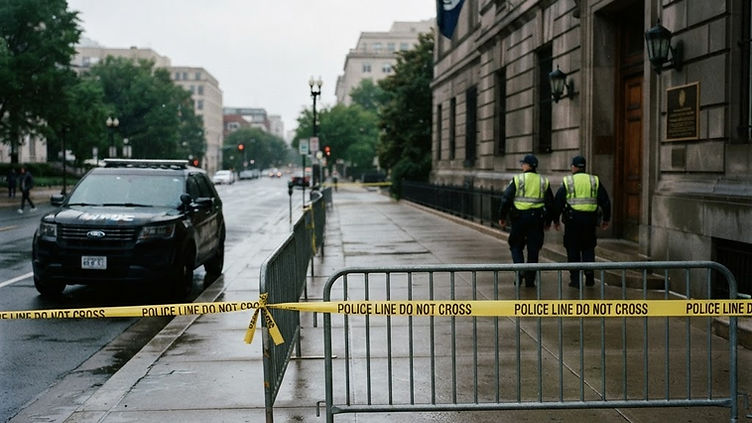
WASHINGTON — The U.S. Secret Service Uniformed Division and the Metropolitan Police Department handled two physical security responses in the same day, evacuating the Ukrainian Embassy over a suspicious package and later closing streets near 17th Street and Pennsylvania Avenue after a second suspicious item was reported.
The second closure affected the area around the Eisenhower Executive Office Building and the Key Bridge, producing hours of gridlock through the middle of the working day.
What is confirmed
Confirmed: two separate package responses, an embassy evacuation, a street closure near the White House corridor, involvement by the Secret Service Uniformed Division and MPD, and disruption to normal traffic patterns in the district.
Not confirmed: the nature of either item, whether the two responses were connected, and whether any arrest has been made. Package responses are, by design, resolved before the public learns what the item was, and the absence of that information is normal rather than suspicious.
How a package response is actually run
The sequence looks slow from the outside because it is meant to. The item is identified and isolated, the area is cleared to a distance set by the item's size, placement and surroundings, an explosive ordnance disposal or render-safe capability is staged, and the cordon holds until the item is resolved.
Clearing distance is the visible variable. A package inside a building produces a floor evacuation and often a full-building evacuation where the structure's geometry allows blast propagation through corridors or a shared atrium. Outdoors, the geometry changes: vehicles parked nearby, hard cover such as planters and stairwells, glass facades that produce secondary fragmentation, and the direction an effect would travel all move the perimeter. In the district, the perimeter also moves traffic, which is why a resolved package can still cost an afternoon.
Two responses in one day is an endurance test
A single response tests procedures. Two in a day test staffing. An officer holding a perimeter through hour four is less alert than in hour one, and the second response begins while the first is still unwinding.
Federal agencies plan for this with relief rotations, preset staging areas and pre-scripted traffic plans. Private security operations facing a comparable day should plan the same way. Calling a second shift in early is cheaper than a perimeter that thins without anyone deciding to thin it, and the thinning is invisible from the command post unless someone is counting bodies at the posts.
The diplomatic dimension
Embassies present a specific problem in a package response: the building is sovereign territory in a practical sense, the host country's emergency services still respond, and the decision to evacuate sits with the mission's own security officer. Host-nation responders work with the mission's Regional Security Office, and the handoff between them is where confusion is most likely if it has not been rehearsed.
The diplomatic protection discipline exists for exactly this relationship: protecting a mission, coordinating with the host nation, and keeping a protected posture that does not depend on the host nation's response time.
For the building inside the cordon
Commercial buildings near federal facilities should hold three things ready and test them twice a year. A current occupant roster that works without network access, since the building may be evacuated with the network down. A designated assembly point outside the likely cordon, chosen with the knowledge that the cordon will be wider than expected. A named person authorised to speak to responding agencies, with a second name behind them.
Buildings that improvise these three lose the first hour of the incident to internal confusion, and the first hour is when tenants decide whether they trust the operator.
Why the volume of package calls keeps rising
Package responses have increased for reasons that have little to do with explosives.
Hoax reporting is cheap. A phone call, an email, a note left on a counter can empty a building for hours, and the disruption is the point for the person making the call. Diplomatic missions and federal facilities are attractive targets for that kind of harassment because the response is guaranteed to be large.
Some calls are made to move people rather than to injure them. A responded-to package pulls attention and resources to one address, which is occasionally the intent.
Others are misread luggage, abandoned deliveries and ordinary objects reported in good faith by people who have been trained to report what looks wrong. That last category is a sign of a healthy reporting culture rather than a problem, and treating it as a waste of resources is how a building trains its occupants to stop reporting.
The cost of a false positive is the price of the true one
Every cordon that resolves to nothing feels, from inside the disruption, like an overreaction. It is the same cordon that would have contained a real device, applied without the benefit of knowing which case this is.
For property managers near protected facilities, the useful posture is to accept the disruption as a recurring operating condition and plan the building around it: tenant communication templates prepared in advance, a courier and delivery procedure that keeps unattended items off the lobby floor, and a roofline and loading dock that does not accumulate the kind of abandoned item that generates a call.
What a security director should write down
After a response, three records determine whether the building's performance improves.
A timeline: when the item was reported, by whom, when the building decided to evacuate, when responders arrived, when the cordon was lifted, and when occupants were readmitted. A decision log: who authorised the evacuation, on what information, and who was notified. And an exception list: the things that did not work, written while they are fresh, from the person who encountered them.
Those three documents turn a disruption into a rehearsal. Without them, the next response repeats the same gaps, and the building's occupants learn that the process is improvised.
Assembling an embassy response that does not depend on luck
A mission's own security posture during a package response rests on things settled long before the call. Whether the Regional Security Office has a working relationship with the district's bomb squad, whether the mission's staff have been drilled on evacuation routes that do not route them toward the item, and whether the local guard force at the gate has the authority to close the entrance without seeking approval from a person who is not on site.
The last one is the most common weakness. An outer post with no clear authority will wait, and waiting at a gate in the first two minutes is the difference between a contained response and a crowded one.
What the public should read into a quiet ending
Both responses ended without reported injury, which is the ordinary outcome and the one that gets no attention. The pattern worth noting is the volume: two responses in a single day in one part of one city, both handled by the same two agencies, neither connected to the other as far as has been disclosed.
That volume is the case for the boring parts of preparedness. Rosters that work offline. Assembly points chosen with a wider cordon in mind. A communications template that can go to several hundred tenants without being written from scratch at 11 a.m. on a weekday. None of that appears in a news cycle, and all of it determines how a building behaves when its street closes.
The post at the gate is the response time
In both of the day's incidents, the first decision was made by whoever was closest to the item. A contract guard at a lobby desk, a marine at an embassy post, a receptionist at a federal annex. The quality of that first decision, report and hold the area, depends on the briefing they received weeks earlier and on whether they believe they are allowed to act without permission.
Post orders that require a phone call up the chain before an evacuation are the single most reliable predictor of a slow response, and they are written that way for reasons of liability rather than safety. The order that works grants the post explicit authority to clear the immediate area first and to report second, and it says so in writing where the guard can find it.
The practical takeaway
Package responses are frequent, usually resolve without injury, and are almost always handled competently. What distinguishes a prepared property from an unprepared one is not the response, which they do not control. It is the roster, the assembly point, the occupant notification and the after-action write-up, all of which they do.
USPA Nationwide Security supports corporate and institutional properties with uniformed guard services and event security in federal-adjacent districts, and provides corporate risk intelligence for teams that need to plan around the district's disruption patterns.
Related coverage
- USPA publishes National Capital Region risk monograph for corporate security teams
- A guard was fired. The perimeter is still the story.
- The U.S. is moving its people out of the target set before it moves its missiles
Security for a federal-adjacent property: (800) 214-1448 or request an assessment.
The Watchline will update this report as the investigations conclude.
Sources
About the reporter
Director of Operations, USPA Nationwide Security
Brian Fitzgibbons directs fire watch and guard force operations at USPA Nationwide Security. He is a U.S. Marine Corps veteran of Operation Iraqi Freedom.
Author biography and credentialsMore from The Watchline


Guard Operations
A guard was fired. The perimeter is still the story.
An intruder passed the exterior checkpoint at 30 Rockefeller Plaza, reached the live set and confronted Craig Melvin before being arrested on felony burglary and hate crime charges. The officer's dismissal answers the staffing question and leaves the structural one open.
· Michael Evans


Guard Operations
Five shops, one morning: Baltimore's pre-dawn burglary run
Shattered doors, missing tills and a coin machine emptied twice: five businesses across Remington and West 29th Street were hit in a single pre-dawn window, and detectives are working out whether one person is responsible.
· Dan Manning

Guard Operations
USPA Nationwide Security Stages Dallas Operations Ahead of Polar Vortex Season
USPA Nationwide Security has begun its winter readiness posture across the Dallas-Fort Worth metroplex, placing emergency fire watch officers and sprinkler repair crews on same-day staging rotations to cover burst fire sprinkler lines and impaired fire protection systems during hard freezes. The mobilization draws on operational lessons from Winter Storm Uri and is grounded in the technical realities of commercial wet-pipe and dry-pipe systems in below-freezing conditions.
· Albina Bieci
