
The U.S. is moving its people out of the target set before it moves its missiles

By Michael Evans, Founder and Strategic Advisor, USPA Nationwide Security
A Patriot battery pulled from Texas, troops moved off exposed installations and a warning delivered quietly to Gulf capitals: read together, the moves describe a defense-first posture that keeps a strike decision in reserve while Qatar runs a parallel negotiating channel.
WASHINGTON
WASHINGTON — The United States has told its Gulf allies to prepare for a short, high-intensity renewal of the conflict with Iran after next week's midterm elections, according to reporting by The Wall Street Journal, while the military moves a Patriot antimissile system from Texas toward Israel and shifts American troops off bases judged vulnerable to retaliation.
Analysis — The three moves are usually described separately, as procurement, force protection and diplomacy. Read together, they describe a single posture: the United States is hardening the defense of its partners and thinning its own exposure at the same time it keeps a final strike decision in reserve.
What is moving, and what it means
Military planners distinguish between the forces that fight and the forces that keep the fight survivable. The Patriot transfer belongs to the second category.
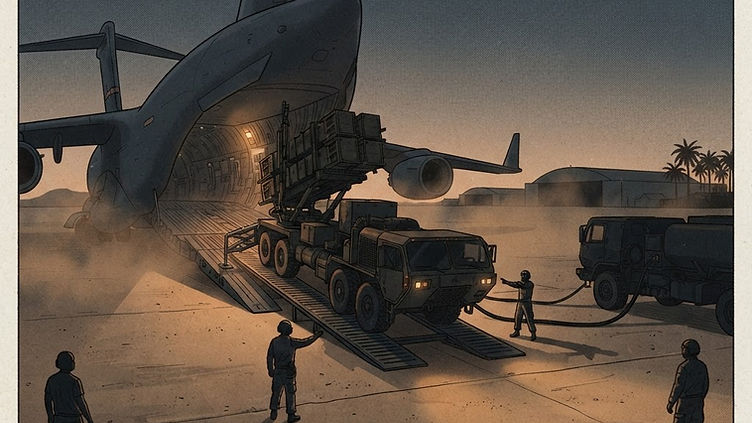
Patriot batteries are the primary U.S. system for intercepting ballistic missiles, cruise missiles and drones at the terminal end of their flight. Along with THAAD, they have been the marquee air defense systems of the U.S. military and its partners since the United States and Israel attacked Iran in late February, when both systems were used to intercept thousands of incoming missiles and drones. In June 2025, three of the Army's eight Patriot batteries and more than 500 personnel were temporarily sent to the region ahead of earlier strikes, which is the practical measure of how heavy this deployment model is.
The move now reported is narrower and more pointed: a single Patriot system shifted from Texas. Its destination matters less than its function. A battery positioned in Israel hardens the defense of the Israeli population and of the U.S. assets operating alongside it, and it reduces the pressure to hold scarce interceptors in reserve for a country that is not the target of the coming campaign.
The corresponding movement of U.S. troops off vulnerable bases is the other half of the same calculation. For two decades, the American presence in the Gulf has depended on a small number of very large installations, each of which concentrates aircraft, command staff and dependents within range of Iranian ballistic missiles. Warned of a specific window of retaliation, planners do what they would do before any known threat: reduce the number of people standing inside the target set, and move them to installations with better hardening, better dispersal and better early warning.
The warning itself
The most consequential element is not materiel. It is the decision to tell allies what to expect.
Informing Gulf governments before a campaign is a way of forcing preparatory work that no host nation enjoys doing: reviewing air defense coverage over cities and energy infrastructure, staging emergency response capacity, confirming that evacuation and shelter plans exist and are current, and accepting that their own territory may be used in a response they did not choose. It is also a political act, because it transfers a measure of the war's risk onto partners who will have to explain it to their own publics.
The reporting attributes the warning to officials speaking on condition of anonymity, and the Pentagon has not confirmed the movements publicly. That is normal for this class of decision, but it means the open-source picture is built from flight tracking data, official statements and the accounts of people briefed on the discussions rather than from a published deployment order.
Diplomacy is running on the same clock
The military posture is not the only channel open. According to the same reporting and subsequent accounts, the United States has also sent a letter to Iranian official Ali Rezaei through intermediaries, and Qatari mediators delivered a draft proposal in Tehran on Sunday. One source described the objective as testing whether Washington and Tehran could find enough common ground to persuade the president not to give a final order for a short, intense attack in the coming weeks.
That sequencing is worth noting. A mediator delivering a draft while a Patriot battery is being moved is not a contradiction. It is the standard architecture of coercive diplomacy: capability is adjusted so that negotiation has a deadline behind it.
For the Gulf states, the arrangement carries a specific discomfort. Their territory hosts the bases, their airspace is used for transit, and their cities and energy infrastructure are within range of the retaliation the warning anticipates. Their exposure does not end when the campaign does.
Why the midterm timing is not incidental
The reported window opens after the Nov. 3 midterm elections. That is not a military judgment. It is a political one, and analysts on both sides of the argument have said so plainly: a decision of this magnitude carries domestic costs that a president is better positioned to absorb after an election than before one.
The opposing argument, voiced by analysts cited in the same reporting, is that Iran is unlikely to capitulate under further attack. The country absorbed more than 20,000 strikes by the United States and Israel in the earlier round, and an adviser to Iran's parliament speaker has described Tehran's posture as having "zero red lines" in response to further action. A campaign described as short and intense is, by design, not a campaign intended to produce a decisive military outcome. It is intended to produce a decision in Tehran.
What to watch
Several indicators will show whether the reported posture is consolidating or unwinding:
- Additional air defense movement, particularly THAAD, which signals preparation for a longer engagement than a single Patriot battery implies.
- Carrier presence in the Arabian Sea and Gulf. The USS Theodore Roosevelt and additional Marine personnel were ordered to the region on October 1, expanding the options available to commanders.
- Whether Gulf governments begin restricting airspace, recalling personnel or issuing public civil defense guidance. Host nations that have been privately warned tend to move publicly a few days later.
- Whether the Qatari channel produces a second round of talks. A draft delivered to Tehran that produces follow-on meetings is a different signal than one that produces silence.
What it means for corporate security
For companies with people, facilities or supply chains in the region, the practical lesson is that warning time is the asset. A posture change of this kind is the advance notice that most security programs say they never get.
Three things are worth doing now rather than during a closure window. First, confirm that traveler tracking actually works, that every employee in the region is accounted for by name rather than by booking. Second, review whether executive protection and site security plans still match the current threat picture, particularly for principals whose itineraries are predictable. Third, test the evacuation and relocation decision chain while movement is still routine, because the moment airspace closes the decision is made for you.
USPA Nationwide Security works with corporate clients on executive protection and secure transportation planning in the Middle East, including the risk intelligence practice that tracks regional posture changes of this kind.
This article will be updated as the reported deployments are confirmed or revised by U.S. officials.
Sources
- The Wall Street Journal: U.S. warns Gulf of possible short, intense renewal of Iran war after midterms
- Al Jazeera: What we know of Vance's letter to Rezaei, as Trump warns Gulf to prepare (Oct. 29, 2026)
- The Jerusalem Post: US moves Patriot missile defense system from Texas to Israel ahead of possible Iran strike (Oct. 2026)
- NewsNation: US-Iran war, Qatar peace proposal and Pentagon posture
About the reporter
Founder and Strategic Advisor, USPA Nationwide Security
Michael Evans founded USPA Nationwide Security in 2005 and led it as chief executive for sixteen years. He reports on protective operations, security regulation and the business of guarding.
Author biography and credentialsMore from The Watchline


Industry
USPA publishes National Capital Region risk monograph for corporate security teams
The public-source paper maps protective exposure across Washington, D.C. and the surrounding counties for facility, event and executive protection planning.
· Michael Evans


Industry
Subtropical System Threatens East Coast with High Winds and Coastal Flooding as NHC Monitors Development
The National Hurricane Center is tracking a non-tropical area of low pressure off the Carolina coast with a 40 percent chance of subtropical storm development. Regardless of whether it organizes, the system is expected to produce dangerous surf, coastal flooding, and high winds along the U.S. East Coast this week.
· Albina Bieci


Executive Protection
Nobody moved, so she did: the Wicked red carpet and the myth of the co-star bodyguard
At the Singapore premiere, Cynthia Erivo reacted first to a barricade breach while a repeat red-carpet intruder held onto Ariana Grande. Months later she rejected the 'bodyguard' framing, and the exchange exposes two different confusions: what fans owe celebrities, and what a co-star's instinct is not.
· Michael Evans