
Coast Guard cutter Tahoma offloads 3,622 pounds of cocaine at Port Everglades after a Caribbean interdiction

By Albina Bieci, Staff Writer
Four detainees were handed to federal agents and roughly $27 million in cocaine came ashore, the visible end of a detection problem that starts far offshore.
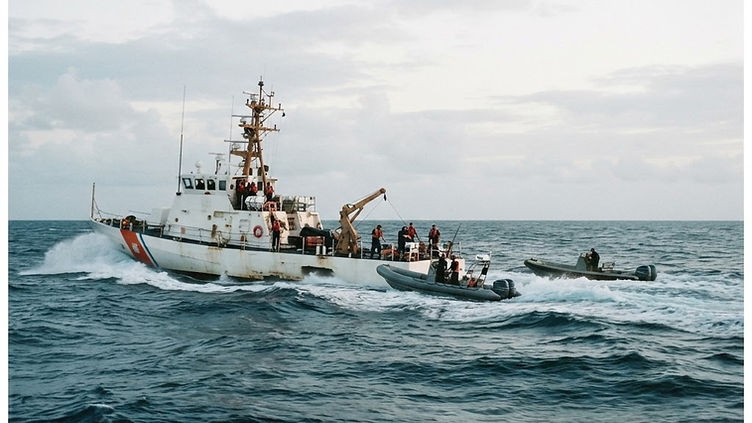
PORT EVERGLADES, Fla.
PORT EVERGLADES, Fla. — The crew of the Coast Guard Cutter Tahoma offloaded approximately 3,622 pounds of cocaine at Port Everglades and transferred four detainees to federal law enforcement agents, closing a multi-day interdiction in the Caribbean Sea that the Coast Guard valued at roughly $27 million.
The service announced the offload in its own release, and the account is spare by design: a cutter, an interdiction, a quantity, a value, four people in custody. What such a release does not describe is the part that matters to anyone who owns cargo, a terminal, a marina or a yacht in the same water. It does not say how many other movements crossed the same transit zone unobserved in the same window, or how much of the detection picture depends on somebody ashore reporting a vessel that looked wrong.
What was actually announced
The facts released are narrow and should be reported as such. A Coast Guard cutter operating in the Caribbean Sea intercepted transnational smuggling vessels over several days. The seizure totaled approximately 3,622 pounds of cocaine. Four detainees were transferred to federal law enforcement. The shipment was valued at about $27 million. The release credits the interdiction to the cutter's crew and the deployable specialized capabilities that support it, and it attributes the case to federal law enforcement rather than to any single agency.
Everything else in circulation about the operation is inference. That includes the route, the vessel types, the number of attempts, and whether any part of the shipment was tracked before it was stopped. Those details are the ones that would tell a port operator something operational, and they are the details that interdiction releases routinely withhold while a case is open.
Why the interception happens far from the dock
The interdiction model is built on distances. A go-fast vessel running at speed from a Caribbean staging point toward Florida has a window measured in hours, and the further offshore it is stopped, the more time a responding unit has and the fewer people are endangered by the stop itself. That arithmetic is why maritime patrol aircraft, cutter-based helicopters and small boats, and embarked law enforcement detachments work as a single system rather than as separate assets. Detection is the constraint. Pursuit is comparatively easy once a contact is held.
It is also why the value of a seizure is a poor measure of the flow. A load interdicted in open water is a sample of a route, not a census of it, and the tonnage that came ashore says nothing about the tonnage that did not. Drug-trafficking organizations price the loss in and reroute. The routes that replace the one interdicted are chosen, in part, on the basis of which water is watched least.
The last mile is a commercial port
Port Everglades is the point where a maritime problem becomes a civilian one. The port handles cruise traffic, petroleum and containerized cargo, and it sits inside a dense commercial waterway of terminals, berths, anchorages, marinas and yards. The same geography that makes it efficient for legitimate trade makes it the terminal end of a smuggling route: many small vessels, many berths, a great deal of legitimate small-craft traffic, and a working assumption on the part of anyone moving contraband that ordinary activity provides cover.
The interdiction happened offshore. The reconnaissance that supports an interdiction, however, frequently starts with the ordinary: a small craft loitering without a stated purpose, a vessel riding low with no cargo declared, a hull with handholds or dive gear that its crew cannot explain, a boat arriving at night on a schedule no operator can account for. Crews that notice those things and report them are part of the detection layer, whether or not they think of themselves that way.
What a regulated facility is already required to do
Facilities in the maritime transportation system operate under security plans, and those plans address access control, designated restricted areas, screening and the reporting of suspicious activity. The requirement is not that a facility's staff interdict anything. It is that they notice, record and report, and that they do not create the conditions that make noticing impossible.
The failure mode is mundane. A gate left open for a vendor. A camera pointing at a berth that has not been checked since it was installed. A night shift staffed by one person who is also responsible for paperwork. A contractor vehicle parked in a restricted area because stopping it is inconvenient. None of these look like a drug case. All of them are the conditions a smuggling operation prefers.
Private security's actual role in the water
A private maritime security provider does not have interdiction authority, and any firm implying otherwise is misrepresenting what it can lawfully do. What private capability provides is the watch: trained personnel on a yacht, a marina, a terminal or a waterfront estate who know what normal looks like, who can document what they see, and who can coordinate with the authorities who do have authority.
For yachts, that includes crew vetting and tender movement control. For facilities, it includes after-hours patrol of water-facing perimeters where cameras do not reach. For owners travelling with family, it includes the transition points — the tender dock, the marina gate, the vehicle — that receive less attention than the vessel itself. USPA maintains a maritime and port security practice and a separate superyacht security program, both staffed with licensed officers and coordinated with local law enforcement rather than acting in place of it.
The company also publishes research on the port environment, including monographs on Port Houston cyber-physical risk and Port of Baltimore infrastructure and navigation risk, both written for the operators who have to make decisions about terminals rather than the agencies that regulate them.
What the valuation actually measures
The $27 million figure is a wholesale valuation, not a retail one. The Coast Guard prices a seizure at the point where it leaves the trafficking chain rather than at the point where it reaches a user, and the difference between those two numbers is enormous. A pound that is valued in the low thousands on the water is worth many times that once it has been cut, moved and sold, and the organization that lost it has not lost the eventual sale price. It has lost product it had not yet been paid for, the transport asset, and the crew.
That is why interdiction is described in terms of pressure rather than disruption. A seizure raises the cost of a route and forces a decision about which route replaces it. It does not reduce demand, and it does not remove the people who financed the load. The honest reading of a $27 million offload is that a specific organization took a specific loss, and that the water it used will be watched differently for a while.
What the pattern looks like from a marina
Marina and terminal staff describe the indicators in plain terms, and most of them are not dramatic. A tender running at an hour no charter runs. A hull that sits lower in the water than its declared use explains. A crew that pays cash for fuel and declines a receipt, or that handles its own lines and refuses assistance at the dock. Dive gear on a boat with no diving itinerary. A vessel repainted between visits, or one whose name does not match the paperwork filed with the office. A boat that leaves at dusk and returns before the office opens, trip after trip, with no fishing gear aboard.
None of those observations is proof of anything. Together they are the reason a berth-holder list and a night watch that actually knows the people on it are a security control and not an administrative convenience. A marina with three hundred berths cannot watch three hundred boats. It can notice the one that does not fit, and it can write down what it saw and when.
The liability that follows a seizure
A vessel taken alongside a berth becomes an evidence problem before it becomes a legal one. Access is restricted, the hull may sit in place for days, the operator's insurer wants notice, and the questions begin: who had access to the berth, what the gate log shows, who signed the vessel in, and what the facility knew. Operators discover quickly whether their records can answer any of that.
The commercial tail is longer than the news cycle. Cargo schedules at a neighbouring berth move, a charter cancels, a fuel delivery is refused while an investigation is open, and the facility spends a month explaining an event it had no part in. Facilities that keep access records, camera retention long enough to be useful, and a single named contact for law enforcement tend to emerge from that month in better condition than those that do not.
The number to test before you need it
Every facility security plan has an emergency contact page. The useful exercise is to test it on a quiet Tuesday: call the number at 2 a.m., describe a vessel behaving oddly at a berth, and see how long it takes for a person with authority to reach the water. If the answer is a voicemail box, the plan is a document rather than a capability, and the gap will be discovered at the least convenient moment available.
What the offload does not prove
One interdiction is not a trend, and the release does not claim it is. The quantity is large enough to indicate an organized operation rather than an opportunistic one, and the handoff of four detainees to federal agents indicates a prosecution path rather than a seizure-only outcome. Both of those are meaningful. Neither tells a port operator what is happening in its own water this week.
That question is answered locally, by people who know the berth, the tide and the shift schedule, and who report what does not fit. The Coast Guard calls it a layered defense. In practice, the layer that most often works first is the one standing on a dock at 2 a.m. with a radio.
Services in Port Everglades, FL
Sources
About the reporter
Staff Writer
Staff writer for the USPA Nationwide Security newsroom. Receives newsroom tips, corrections and editorial inquiries.
Author biography and credentialsMore from The Watchline

Industry
USPA Nationwide Security appoints Michael Evans Jr. Associate Manager of Maritime Operations
The New York-based appointment follows progressive vessel assignments and maritime studies at Maritime Professional Training in Fort Lauderdale.
· Albina Bieci

Industry
Fire watch duty and TSCM scope are the Super Bowl LXI decisions left too late, analysis finds
A public-source risk analysis for the February 14, 2027 game at SoFi Stadium separates the dedicated fire watch role from hospitality staffing and sets out what a technical survey of a private venue can actually establish.
· Albina Bieci


Industry
Two Marines sued over a breach of 3 million records. Protective details should read the complaint.
A federal lawsuit over the Defense Manpower Data Center breach describes consequences that are physical before they are financial: targeted fraud, and a direct threat to clearances.
· Brian Fitzgibbons
