
Booba ransomware crossed the line between a water plant and the government that runs it

By Albina Bieci, Staff Writer
Incident responders say the ransomware moved from a municipal water facility into the local government's administrative servers before 45 of 48 targeted machines were contained. The line between IT and OT was not a wall.
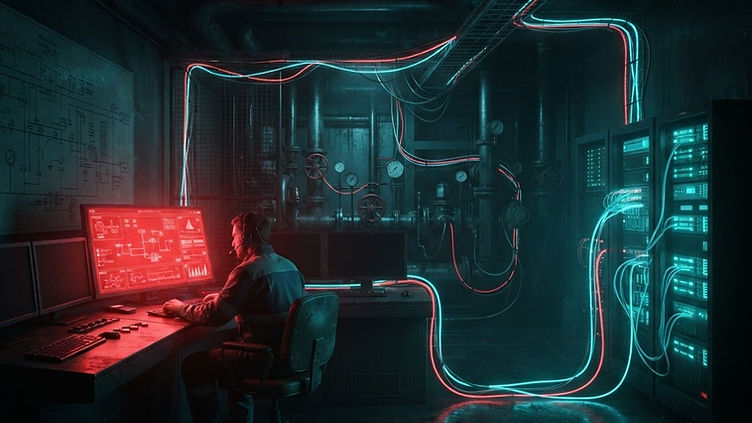
EAST COAST
Booba ransomware entered an East Coast municipal water treatment facility and moved laterally across a split IT/OT network boundary into the administrative servers of the local government that oversees it, according to ThreatDown incident responders, as reported by Industrial Cyber. Forty-five of the forty-eight targeted machines were locked down before the encryption spread further.
Emergency fire watch
Alarm or sprinkler system out of service? USPA can post a fire watch on site within 60 minutes.
Trained officers, documented patrol rounds and direct 911 notification, scoped to the order your fire marshal actually issued.
Live dispatch, 24 hours. In an emergency, call 911 first.
The number that matters most in that sentence is not 45. It is the boundary that was described as split and was not, in practice, a boundary at all.
What the record establishes
- Booba ransomware infected an East Coast municipal water treatment facility.
- Responders say the intrusion crossed a split IT/OT network boundary.
- The attack reached the overseeing local government's administrative servers.
- Forty-five of forty-eight targeted machines were locked down.
- The account comes from ThreatDown incident responders, reported by Industrial Cyber on Nov. 27, 2026.
The identity of the municipality, the duration of the intrusion, the ransom demand and whether treatment operations were affected have not been established in the published reporting.
What "IT/OT segmentation" is supposed to mean
Industrial control systems are usually described in layers, following a model that separates the physical process from the business network.
At the bottom is the equipment: pumps, valves, chemical feed systems, analyzers, sensors. Above that sit the controllers that run them, then the supervisory systems that operators watch and command, then a demilitarized zone, and finally the corporate network that carries email, finance, HR and everything else.
The reason for the layers is that the two sides of the house have opposite priorities. The corporate side values connectivity, patching speed and user convenience. The operational side values availability above everything: a water plant that reboots is a water plant that may not be treating water.
Segmentation is the control that keeps a compromise on one side from becoming a compromise on the other. When responders describe a boundary as "split," they usually mean the design existed: separate network ranges, a firewall, perhaps a data diode or a jump host.
What they are also telling you, when a ransomware event crosses that boundary, is that the design and the operation had diverged. Somewhere there was a path: a shared domain, a dual-homed engineering workstation, a vendor connection, a USB drive, a remote-access tool installed for convenience during a maintenance window and never removed.
Lateral movement is a physical security problem too
The instinct after an incident like this is to treat it as a cyber event with a cyber fix: isolate, rebuild, re-segment, monitor.
That is necessary and insufficient, because the paths that lateral movement uses are frequently physical.
Vendor and contractor access. A water utility runs on contractors: integrators, chemical suppliers, pump service companies, calibration firms. Each of them connects to the OT network, often through a remote tool, often with credentials that outlive the project. Physical site access and network access are granted separately by different people, and rarely reviewed together.
Engineering workstations. The laptop that programs a PLC is usually on both networks at different times. It is the single most common bridge between them, and it lives in a truck, a bag or a control room drawer.
Removable media. A USB drive used to move a firmware update into an air-gapped area is a deliberate crossing of the boundary by a person who believes they are being careful.
The badge system. Physical access control systems increasingly sit on the corporate network. An attacker who reaches the administrative network may be able to see who holds a badge, when they entered, and which doors opened. That is reconnaissance for a physical intrusion, and it is also a way to lock people out of their own facility during an incident.
Cameras and building systems. Video management, HVAC and building automation are routinely on the corporate network, and building automation frequently touches the operational side through a shared vendor.
The convergence is not a metaphor. It is a set of shared credentials, shared vendors and shared networks that make the cyber and physical perimeters one perimeter.
What the containment number tells you
Forty-five of forty-eight targeted machines locked down is a good outcome in a ransomware response: the encryption was stopped before it reached the remaining three. It also means the attacker had reached forty-eight machines.
In a municipal environment, forty-eight machines is not a data center. It is the finance office, the clerk's workstation, the utility billing system, the public works supervisor's laptop. The administrative servers that were reached are the ones that hold ratepayer records, permits and email.
That is why a water utility incident is a local government incident. The treatment plant is the most sensitive asset, but it is not the only one on the network, and the municipality's other departments are usually the softer target.
The regulatory frame
Community water systems above a certain size are required under the America's Water Infrastructure Act to complete risk and resilience assessments and emergency response plans, and to certify them to the EPA. Those assessments cover cyber risk, and the emergency response plan is supposed to address how the utility operates when its systems are unavailable.
The framework is sound and the gap is familiar: a plan that describes segmentation is not the same as a network that is segmented, and a plan that assumes the corporate side will not be affected is a plan with one assumption too many.
CISA's guidance for the water sector says the same thing in operational terms: know what is on your network, know what connects to it, test the separation, and have a manual operating procedure for the period when the systems are down.
What a utility should be doing
Draw the network and the building on the same page. One diagram with the process, the controllers, the engineering workstations, the vendor connections, the badge system and the camera system. Most utilities have never seen those things together.
Inventory the remote access. Every vendor connection, every remote tool, every account that can reach the OT side. Then remove the ones nobody can justify.
Separate the badge system from the general corporate network. Physical access control is a security system, not an IT application, and it should be treated with the same care as the fire alarm.
Test the segmentation rather than describing it. A penetration test that attempts to cross from corporate to operational is the only evidence that the boundary works.
Write the manual procedure. If the HMI is unavailable, who reads the gauge, who adjusts the chemical feed, and who records it? A plant that has never run manually in a drill will not run manually during an incident.
Rehearse with the physical security team in the room. The response to a ransomware event in a utility includes deciding whether to change locks, reissue badges, post guards at gates and verify identity at the door. Those decisions belong in the same incident command as the network isolation.
The larger pattern
Attacks on water utilities are not new, and the reason they continue is not that the sector is careless. It is that the sector is old, understaffed and full of equipment that was designed to be reliable rather than secure, run by people who are measured on water quality and pressure, not on patch compliance.
The realistic goal is not an impenetrable plant. It is a plant where a compromise on the business network does not become a compromise of treatment, and where the physical response and the cyber response are run by people who know each other.
That is the definition USPA works to in its corporate risk intelligence practice: one assessment that covers the network, the building and the people who move between them, because in a facility like this they are the same attack surface.
For utilities that need physical coverage while systems are being restored, USPA provides uniformed security guards and emergency fire watch under a single command structure, so that a facility does not have to coordinate three vendors during the worst week of its year.
The report that will matter in six months
Incident response reports are written for insurers, regulators and boards, and they tend to end at the point of containment. The document that determines whether this utility is safer in a year is a different one: a re-test of the boundary that failed.
That test has a specific shape. It attempts to move from a corporate workstation to an operational network without using credentials granted for the purpose. It checks the engineering workstations for dual-homed connections. It inventories remote-access tools and vendor accounts. It reviews whether the badge and camera systems share credentials with the corporate directory.
A utility that completes that test, publishes the findings internally and schedules the remediation has converted an incident into a control. A utility that accepts a containment number as the end of the story has done the opposite, and the next intrusion will start from the same place.
Reference and services
Sources
About the reporter
Staff Writer
Staff writer for the USPA Nationwide Security newsroom. Receives newsroom tips, corrections and editorial inquiries.
Author biography and credentialsMore from The Watchline


Industry
CISA ordered four exploited flaws patched, and one of them sits on the corporate video gateway
The catalog entries are routine. What they describe is not: unauthenticated access to the systems that carry board meetings, executive calls and the virtual estate underneath them.
· Michael Evans


Industry
The FBI is investigating a suspected breach of NCIC, and the question for protection teams is what a records hit is worth
The bureau is investigating a suspected intrusion into the criminal justice database that agencies at every level query for warrants, criminal histories and protective orders.
· Albina Bieci


Industry
West Virginia's legislature pulled its network offline, and the badge readers ride on the same network
Legislative IT cut workstations, email servers and remote access at the Capitol Complex, taking the systems that support the building's physical security offline with them.
· Albina Bieci
