West Virginia's legislature pulled its network offline, and the badge readers ride on the same network

By Albina Bieci, Staff Writer
Legislative IT cut workstations, email servers and remote access at the Capitol Complex, taking the systems that support the building's physical security offline with them.
CHARLESTON, W.Va.
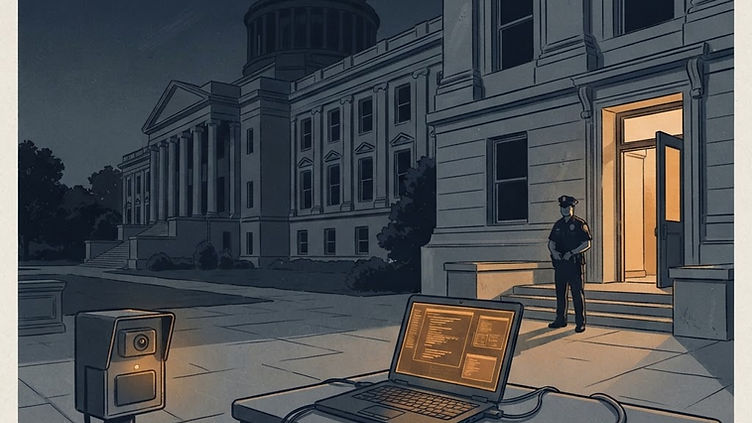
West Virginia legislative IT staff and outside forensic specialists disconnected internal workstations, email servers and remote access at the State Capitol Complex in Charleston after detecting activity consistent with a ransomware intrusion, according to The Intelligencer and Wheeling News-Register.
The reporting available at publication does not state whether data was taken, whether a demand was made, how many systems were affected, who is responsible, or how long restoration will take.
What has been reported
- Suspicious activity consistent with ransomware was detected on legislative networks.
- Internal workstations, email servers and remote access were disconnected.
- Legislative IT teams are working with external forensic specialists.
- The disruption is confined to the legislature's internal systems, at the State Capitol Complex in Charleston.
When the network comes down, part of the building's security comes down with it
The physical and digital layers of a capitol complex are not separate systems. Badge and access-control directories, camera recording, visitor management, garage gates and panic alarms frequently ride on the same network as email. Disconnecting the network to stop an intrusion can take the building's digital supports offline in the same hour.
There is a second, quieter exposure. An access-control directory tells a reader which doors exist, which credentials open them, and who holds clearance. Personnel calendars and hearing schedules tell a reader where a member or a staffer will be at a given hour. If credentials were harvested before the network was cut, that material outlives the incident.
The manual fallbacks are the part worth rehearsing in advance: officers posted at doors that no longer badge, a paper visitor log with an accountable custodian, confirmation that camera recording continued and for how long, garage and elevator control tested by hand, and an alarm path that does not depend on the corporate network. Forensic responders and contractors need escorted access and their own entry record, because an incident response is also an access-control event.
For a protective detail working a legislative or government client, the practical question is whether the badge reader is still authoritative. Until IT says otherwise, treat every door as manually controlled and log it.
Still open at publication: data exfiltration, any demand, the number of systems involved, attribution and the restoration timeline.
Sources
About the reporter
Staff Writer
Staff writer for the USPA Nationwide Security newsroom. Receives newsroom tips, corrections and editorial inquiries.
Author biography and credentialsMore from The Watchline


Industry
The FBI is investigating a suspected breach of NCIC, and the question for protection teams is what a records hit is worth
The bureau is investigating a suspected intrusion into the criminal justice database that agencies at every level query for warrants, criminal histories and protective orders.
· Albina Bieci


Industry
Chase, Visa and Mastercard traced their exposures to vendors, and the White House named a cyber director the same day
Chase pointed to marketing data, Mastercard to a cardholder benefits program, Visa to an Asia-Pacific vendor with no card numbers involved. All three investigations are running against an extortion claim.
· Albina Bieci


Industry
A threat report says MFA is being bypassed faster than insurers can reprice it, and AI agents are doing the scanning
Session hijacking, device-code phishing and token harvesting are getting past the control most cyber policies still treat as the baseline. Autonomous intrusion agents are reaching ransomware in two to three weeks.
· Albina Bieci