
The most dangerous address in the program is the one they sleep at

By Albina Bieci, Staff Writer
Assessments presented to close protection conferences now rank the private residence above public appearances as the likeliest place a high-profile client is breached. The budget rarely follows the finding.

WASHINGTON
WASHINGTON — New vulnerability assessments presented across international close protection circles place the private residence at the top of the risk table for high-profile clients, ahead of public appearances and corporate offices.
The finding contradicts the way most programmes are budgeted. Travel security is where the visible spending goes, because travel is where the principal is photographed. The home is where they are alone.
Why the house loses to the office
A corporate headquarters is designed by people who were thinking about control. There is a lobby, a reception, a visitor log, a badge system, a loading dock that is watched, and a security function with a budget and a manager.
An estate was designed by people who were thinking about privacy, light and a view. The controls that arrived later were added by different vendors at different times, and each of them works in isolation: a gate that opens for a code, a camera that records to a device nobody reviews, a lighting circuit that a housekeeper turns off at eleven.
The gap between them is not money. It is that the office has one system with one owner and the house has four systems with none.
The convenience vulnerabilities
The specific weaknesses are consistent across assessments, and each one is a convenience that made sense to somebody.
Domestic staff. A house is run by people who come and go: cleaners, gardeners, a nanny, a contractor, a delivery routine. Each is a person with a phone, a family, and a reason for the client's address to be on it. Very few estates have any process for that population at all.
The gate that stays open. A sliding gate left open for a gardener at 7 a.m. is open. It is also the moment a vehicle can follow through without any forced entry, and the incident is never recorded as anything, because nothing appeared to happen.
Outdated perimeter alarms. Zones are bypassed because a sensor is faulty, the fault is tolerated, and after six months the alarm is decorative. Nobody can say which zones are live.
The digital front gate. The address, the aerial photograph and the property boundary are published by the county, aggregated by commercial sites, and indexed. The perimeter that matters begins on a screen in another country.
From travel budgets to static coverage
The consequence in budget terms is a shift away from temporary travel security toward permanent residential coverage: a residential security team that is present when the principal is not, and whose value is largely in what it prevents rather than in what it does.
A static team changes the property in three ways that no camera does. It gives the household a person to call who is already standing at the gate. It creates a written record of the ordinary, so that the unusual is visible. And it makes the property expensive to approach for the period of time an adversary needs to observe it.
That last point is the one clients underestimate. Most residential incidents are preceded by reconnaissance spread across days. Observation is the phase where a visible, unpredictable security presence produces the largest return, because the adversary is looking for a property that can be watched without being seen watching it.
What a residential assessment should produce
An assessment that is worth the fee ends in documents, not impressions: a site plan marking every approach and every blind spot, a written post order for each fixed position and each patrol interval, a verified list of who may enter and how that list is changed, a tested alarm and camera schedule showing exactly what is recorded and who reviews it, a household briefing the family has actually received, and a dated review cycle.
Without that file, a residence has equipment. With it, the residence has a security posture that can be audited, insured and improved.
USPA Nationwide Security provides estate security, residential assessments and executive protection for clients whose highest-risk address is the one they sleep at.
Related coverage
- Silicon Valley details are spending on analysts before they spend on bodies
- Protective details are moving past the C-suite, and the reason is attribution
- More than half of the S&P 500 now pays for a bodyguard. The filing is the tell.
A residential security assessment: (800) 214-1448 or request estate security.
Staffing for an impairment in Washington, D.C. runs through fire watch coverage in Washington, D.C., written to the interval the local fire marshal sets.
The newsroom has covered a similar file: The hybrid threat: attackers merge digital reconnaissance with physical ambush.
Services in Washington, DC
Sources
About the reporter
Staff Writer
Staff writer for the USPA Nationwide Security newsroom. Receives newsroom tips, corrections and editorial inquiries.
Author biography and credentialsMore from The Watchline


Executive Protection
Devices went into Faraday bags on Air Force One. That is what a post-travel sweep looks like at any altitude
Journalists and staff returning from China sealed the phones they used on the trip into radio-frequency-blocking bags until landing, and spare devices were collected for wiping or destruction. The protocol is standard at the top and rare everywhere below it.
· Albina Bieci

Executive Protection
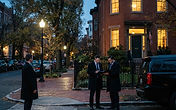
The Secret Service moved a cabinet secretary out of his Georgetown home. Residential protection starts with the address
Citing intelligence on physical threats and concerns about the geo-location exposure of a private residence, the Secret Service relocated Treasury Secretary Scott Bessent to a military installation.
· Albina Bieci

Executive Protection
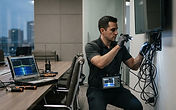
A covert recorder behind a conference room television: the OpenAI bugging case is the TSCM argument
Federal prosecutors say a former engineer planted an encrypted recording device behind a television in an executive conference room. It was found during an internal physical security sweep.
· Albina Bieci