
The hybrid threat: attackers merge digital reconnaissance with physical ambush

By Albina Bieci, Staff Writer
Adversaries are mining assistants' inboxes for flight numbers and gate codes before any physical approach. The intrusion point is not the principal, and it rarely gets reported.

WASHINGTON
WASHINGTON — Close protection consultancies are warning clients about a pattern their own case files now show consistently: adversaries are conducting surveillance through the principal's digital perimeter before they ever approach the physical one.
The intrusion points are rarely the principal. They are the personal assistant who books the flights, the travel coordinator who holds the hotel confirmations, the family member whose social account lists the school, and the estate manager whose email contains the gate code.
The reconnaissance is boring, and that is why it works
A sophisticated target is hard to follow. Their home is protected, their movements are planned, and their detail is trained to notice a vehicle that appears twice.
Their assistant's inbox is not protected in any comparable way. It is a normal account with a normal password, and it contains the itinerary, the reservation names, the driver's number and the calendar.
The compromise is therefore unremarkable to the person it happens to: a password reused from a shopping site, a phishing page that looked like a booking confirmation, a shared document link forwarded by someone who had already been compromised. Nothing about the event feels like an attack, which is precisely why it produces no report.
What the attacker then holds is not intelligence in the tradecraft sense. It is logistics: flight numbers, arrival times, terminal, hotel and room category, restaurant bookings, the days the house is empty.
What that converts into
The conversion is fast and specific. A flight number yields an arrival time and a terminal. A terminal yields a kerb, a baggage hall and a taxi rank. A restaurant booking yields a name on a list at a door, and a time at which the principal will be standing on a pavement waiting for a car.
Those are the weak points along a route, and they are the points a physical team cannot fully harden, because the principal has to cross them.
The hybrid model is not sophisticated because the adversary is brilliant. It is effective because the target's own organisation publishes the schedule, and because the two halves of the attack are conducted by different people who never need to meet.
What an information-led detail does differently
The work moves earlier in time and it is mostly conducted at a desk.
- Open-source exposure review of the principal, the family, and every staff member with itinerary access, refreshed before each trip rather than annually.
- Monitoring of the accounts and platforms where an itinerary is likely to surface: airline and hotel loyalty forums, flight-tracking services with public profiles, the principal's own tags.
- Reduction of the principal's published data: home address, vehicle, phone, and the routine that a scheduling post reveals.
- A written itinerary-handling rule for staff, with the rule tested by an out-of-band verification call on the day, not a policy document in a drawer.
- Access control on the accounts that hold travel data: hardware keys, separate accounts for booking and correspondence, no shared inbox.
The limit of the technical work
None of this replaces the physical detail, and any consultancy claiming otherwise is selling software. Information work buys warning. Warning buys the decision to route differently, to change a hotel, to add a vehicle, or to stand a detail down because the pattern has changed.
When the warning fails, the officer standing at the kerb is the last control in the chain, and that officer's usefulness depends entirely on having been told what to expect.
One question for the principal's staff
Ask the assistant, in plain language, what they would do if they received an email that appeared to be from the principal asking for the following week's itinerary. If the answer is "send it", the protection programme has a hole that no amount of physical presence will close, because the adversary will simply ask politely instead of approaching the car.
USPA Nationwide Security runs corporate risk intelligence alongside executive protection so that the analysis and the physical element work from the same picture.
Related coverage
- The general counsel is now a protectee
- A DHS data breach is a physical threat to the people named in it
- More than half of the S&P 500 now pays for a bodyguard. The filing is the tell.
Threat assessment before a travel cycle: (800) 214-1448 or request corporate risk intelligence.
Staffing for an impairment in Washington, D.C. runs through fire watch coverage in Washington, D.C., written to the interval the local fire marshal sets.
Related reporting from the newsroom: The most dangerous address in the program is the one they sleep at.
Services in Washington, DC
Sources
About the reporter
Staff Writer
Staff writer for the USPA Nationwide Security newsroom. Receives newsroom tips, corrections and editorial inquiries.
Author biography and credentialsMore from The Watchline


Executive Protection
Devices went into Faraday bags on Air Force One. That is what a post-travel sweep looks like at any altitude
Journalists and staff returning from China sealed the phones they used on the trip into radio-frequency-blocking bags until landing, and spare devices were collected for wiping or destruction. The protocol is standard at the top and rare everywhere below it.
· Albina Bieci


Executive Protection
The Secret Service moved a cabinet secretary out of his Georgetown home. Residential protection starts with the address
Citing intelligence on physical threats and concerns about the geo-location exposure of a private residence, the Secret Service relocated Treasury Secretary Scott Bessent to a military installation.
· Albina Bieci

Executive Protection
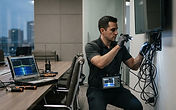
A covert recorder behind a conference room television: the OpenAI bugging case is the TSCM argument
Federal prosecutors say a former engineer planted an encrypted recording device behind a television in an executive conference room. It was found during an internal physical security sweep.
· Albina Bieci
