
Protective details are moving past the C-suite, and the reason is attribution

By Albina Bieci, Staff Writer
Boards are funding protective details for general counsels, chief operating officers and researchers. The driver is attributable exposure, not seniority.

NEW YORK
NEW YORK — The population of corporate protectees is widening, and the reason is structural rather than sentimental. Boards are funding protective coverage for named executive officers below the chief executive, and for roles that were never considered protection candidates a decade ago.
Historically, the detail went to the chief executive and occasionally the chief financial officer. The general counsel had a driver, not an officer. The chief operating officer had a car service.
That is changing, and the change is driven by what those roles now do in public.
Why the perimeter widened
A protective posture is a response to attributable exposure. The people who now carry that exposure are the people whose names appear in a decision.
A general counsel's name is on litigation, enforcement correspondence and filings that invite a reaction. A chief operating officer's name attaches to closures, layoffs, safety failures and supply decisions. A chief information officer's name attaches to breaches. Researchers, in industries where a single paper moves a market or contradicts a political position, have become targets for reasons entirely disconnected from their employer's share price.
The common thread is not seniority. It is that a specific decision can be traced to a specific person, and the person can be found.
Three tiers, not one standard
A programme that treats every protectee identically is either over-spending on the periphery or under-covering the centre. The workable structure is a tiered model, and the tiers are defined by assessed exposure rather than title.
Tier one is the principal whose exposure is continuous: full travelling detail, residential coverage, family included, information support on a standing cycle. This is the chief executive in a contested industry, and the residence is where most of the money belongs.
Tier two is event-driven. The officer appears for a hearing, a shareholder meeting, a site visit in a hostile town, a public appearance after a controversial decision. Between those events, the coverage is advisory: an assessment, a route plan, a household briefing.
Tier three is assessment only. No officer, but a documented review of the residence, the commute, the digital footprint, and a written protocol for what to do if something changes. It is inexpensive, and it converts a newly exposed executive from unmanaged to prepared within a fortnight.
The value of the tiering is not the labels. It is that a board can see what it is buying, and a security director can move a person between tiers on evidence rather than on request.
The board's uncomfortable question
When a company funds protection for some executives and not others, it is making a statement about relative risk. That statement should be documented, because the executive who is not covered will eventually notice, and because a plaintiff will eventually ask why.
The defensible answer is an assessment file: what the threat picture showed for each role, what was recommended, what was funded, and on what date. A board that can produce that file has exercised judgement. A board that cannot has made a series of ad hoc decisions and called them a policy.
What changes operationally
Adding protectees changes the work in ways that are easy to underestimate. It multiplies the number of residences that need assessment, the number of travel patterns that need planning, and the number of family members whose exposure has to be managed without ever meeting the detail.
It also makes the information function load-bearing. One principal's movement can be handled by one officer's memory. Eight principals' movements need a system, and the system needs an analyst, or the detail is being asked to do intelligence work from the driver's seat.
USPA Nationwide Security builds tiered programmes across executive protection, estate security and corporate risk intelligence, and tiers them on assessed exposure rather than on title.
Related coverage
- More than half of the S&P 500 now pays for a bodyguard. The filing is the tell.
- The hybrid threat: attackers merge digital reconnaissance with physical ambush
- The most dangerous address in the program is the one they sleep at
A tiered protective programme: (800) 214-1448 or request executive protection.
For properties in New York City, fire watch coverage in New York City is posted from officers already working the market, which is what keeps a same-day start possible.
The newsroom has covered a similar file: Bronx five-alarm fire driven by wind destroys a roof and takes the risers with it.
Services in New York, NY
Sources
About the reporter
Staff Writer
Staff writer for the USPA Nationwide Security newsroom. Receives newsroom tips, corrections and editorial inquiries.
Author biography and credentialsMore from The Watchline


Executive Protection
Devices went into Faraday bags on Air Force One. That is what a post-travel sweep looks like at any altitude
Journalists and staff returning from China sealed the phones they used on the trip into radio-frequency-blocking bags until landing, and spare devices were collected for wiping or destruction. The protocol is standard at the top and rare everywhere below it.
· Albina Bieci


Executive Protection
The Secret Service moved a cabinet secretary out of his Georgetown home. Residential protection starts with the address
Citing intelligence on physical threats and concerns about the geo-location exposure of a private residence, the Secret Service relocated Treasury Secretary Scott Bessent to a military installation.
· Albina Bieci

Executive Protection
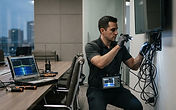
A covert recorder behind a conference room television: the OpenAI bugging case is the TSCM argument
Federal prosecutors say a former engineer planted an encrypted recording device behind a television in an executive conference room. It was found during an internal physical security sweep.
· Albina Bieci