
Devices went into Faraday bags on Air Force One. That is what a post-travel sweep looks like at any altitude

By Albina Bieci, Staff Writer
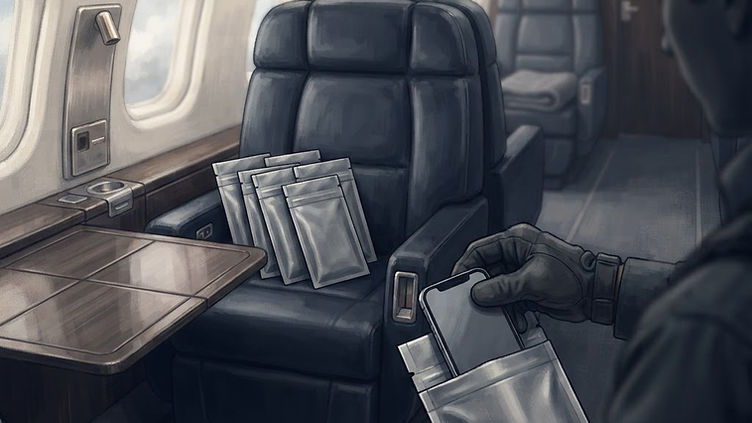
Journalists and staff returning from China sealed the phones they used on the trip into radio-frequency-blocking bags until landing, and spare devices were collected for wiping or destruction. The protocol is standard at the top and rare everywhere below it.
JOINT BASE ANDREWS, Md.
Security officials aboard Air Force One ordered journalists and staff returning from a trip to China to seal the mobile devices they had used during the visit inside radio-frequency-blocking Faraday bags until the aircraft landed in the United States, according to The Jerusalem Post, citing CBS White House pool reporting.
Crew members also collected spare phones that executive staff had used during the visit, for data wiping or physical destruction.
The measure is not improvisation. It is the visible end of a Technical Surveillance Countermeasures protocol that governments have run for years and that most private organizations still do not have in any form.
What has been confirmed
The report states that journalists and executive staff returning from China were required to seal devices used during the trip in RF signal-blocking Faraday bags until landing in the United States. Spare phones used by executive staff during the visit were collected for data wiping or physical destruction. The stated purpose was to mitigate potential spyware implants and passive cellular or RF eavesdropping.
The reporting available at publication does not state how many devices were involved, whether any device was found to be compromised, which agencies directed the protocol, or whether the practice is now standard for all presidential travel. Those details will be added here if they are released.
Why a bag, and not a software fix
The instinct of a corporate security team is to reach for software: a mobile threat defense agent, an endpoint detection app, a factory reset. Those tools are useful and they do not solve the problem this protocol addresses.
A phone has several radios and a baseband processor that runs its own firmware, and the baseband operates below the level at which a phone's operating system can see what it is doing. A compromised device can therefore transmit when the user believes it is idle, and it can do so on a schedule set by whoever controls it. Passive collection is the other half: a device that transmits at all can be located, identified and correlated by nearby receivers, whether those are commercial cell-site simulators or equipment in a building across the street.
A Faraday bag addresses both by removing the radio link entirely. No transmission means no beaconing, no command channel, no data exfiltration and no location reporting. It is the only measure that works regardless of what is running inside the device, which is exactly why it is used on an aircraft carrying the people whose movements are of most interest to a foreign service.
What "sealed until landing" actually buys
The detail that matters in the reporting is the duration. Sealing devices until landing means the containment is continuous through the entire return flight, which is the period when a compromised device would otherwise report its position and its presence on a specific aircraft.
It also means the devices are contained while the aircraft is on the ground at intermediate stops, where the density of collection equipment is highest. An aircraft on a ramp in a foreign country is a device-rich environment: the passengers' phones, the crew's phones, the aircraft's own systems, and whatever equipment is nearby.
A bag that comes off in the cabin and goes back on at the gate has already given away everything the protocol was designed to withhold.
Wiping versus destroying, and why the spare phones went first
The reporting describes two dispositions: wiping and physical destruction. The distinction is practical rather than philosophical.
A wipe is appropriate when the device is known to be clean or when the risk is limited to data at rest. It is not a reliable remedy for a device suspected of firmware-level compromise, because a wipe reinstalls the operating system from an image while leaving bootloader, baseband and other low-level components untouched. A determined implant can survive it.
Destruction is the only disposition that ends the question, and it is expensive enough that it is normally reserved for devices with the highest exposure: the ones carried into sensitive meetings, used for communications during the visit, or issued as spares precisely so the primary device can stay in a safe.
The spare phones are the tell. An organization that issues travel devices expects them to be exposed, plans for them to be disposable, and does not want the primary device in the room at all.
The corporate version of the same protocol
Most companies send an executive to a high-risk country with the phone that holds their email, their messaging, their two-factor authenticators and four years of photographs. That device is the single richest target the traveler carries, and it comes home and joins the corporate network.
The protocol that mirrors what happened on the aircraft is not complicated, and it fits on one page.
Issue a clean travel device with the minimum applications required. Leave the primary device at home or in a locked safe. Enroll the travel device in management so it can be wiped remotely. Prohibit personal accounts on it. Carry a Faraday bag and use it in meetings, in vehicles and in hotel rooms, not only in transit. On return, do not connect the device to the corporate network. Hand it to security for examination, then wipe or destroy it according to what the examination finds.
The last step is the one that gets skipped. A device that comes home and connects to the office Wi-Fi has already delivered whatever it carried.
Where Faraday bags fail
A bag is a simple object and it fails in predictable ways, which is why the protocol is a procedure rather than a purchase.
Seams and closures leak. A bag that is not fully folded and fastened at the top is an antenna aperture. A phone that is switched on inside a bag with a compromised closure will find the leak. Pouches with windows, pouches that have worn through at a corner, and pouches used to carry keys and cables alongside the device all degrade.
Size matters too. A bag rated for a phone may not contain a tablet, and a laptop with a metal chassis needs a pouch designed for it. And a bag does nothing about a device that was already transmitting before it went in, which is why the procedure has to begin before the traveler enters the country rather than on the return leg.
Testing is cheap: put a phone in the bag, call it, and see whether it rings. Organizations that use these pouches regularly should be doing that check on a schedule, because a failed pouch is indistinguishable from a working one until it is tested.
What a mid-size company should write into policy
Three paragraphs, and the first one is the important one.
Define the countries and circumstances that trigger a travel device protocol, so the decision is not made by an assistant at the gate. Define the device: issued, clean, minimal, managed. Define the return procedure, including who receives the device, where it goes before it touches the corporate network, and who decides between wiping and destruction.
Then name the person accountable for it. A protocol without an owner is a document.
Why the cabin is the hardest room in the aircraft
An executive aircraft in flight is a sealed metal tube, which sounds like an ideal place to control emissions and is not. The cabin is full of devices that were never part of the security plan: passenger phones, crew tablets, the inflight connectivity system, the entertainment screens, and the wireless access point that ties them together.
That access point is the problem. A cabin Wi-Fi network gives every device aboard a path to the internet, and the traffic it carries is not inspected by anyone. A phone that has been compromised in a foreign city can therefore keep reporting while the aircraft is at altitude, on a link that the passengers assume is private because it belongs to the aircraft.
Bagging the devices removes them from that network. It is the only step in the protocol that works without trusting anything inside the phone, and it is why the containment begins on the ground rather than after landing.
Related coverage
The Watchline has reported on the same problem at boardroom scale. In one case, a covert recorder behind a conference room television showed how far an insider can get with commercially available equipment. In another, Manhattan details began sweeping every room and vehicle before an executive arrives.
The service connection
USPA Nationwide Security provides technical surveillance countermeasures inspections and executive travel security programs, including pre-travel device review, room and vehicle sweeps at destinations, and post-travel examination of issued equipment. Requests can be made through the TSCM and bug sweep page, the executive protection page, or by calling (800) 214-1448.
Sources and status
Reporting on the protocol is attributed to The Jerusalem Post, citing CBS White House pool reporting. The number of devices, the directing authority and any findings of compromise remain open. Technical references include CISA and NSA mobile device guidance.
Sources
About the reporter
Staff Writer
Staff writer for the USPA Nationwide Security newsroom. Receives newsroom tips, corrections and editorial inquiries.
Author biography and credentialsMore from The Watchline


Executive Protection
The Secret Service moved a cabinet secretary out of his Georgetown home. Residential protection starts with the address
Citing intelligence on physical threats and concerns about the geo-location exposure of a private residence, the Secret Service relocated Treasury Secretary Scott Bessent to a military installation.
· Albina Bieci

Executive Protection
A covert recorder behind a conference room television: the OpenAI bugging case is the TSCM argument
Federal prosecutors say a former engineer planted an encrypted recording device behind a television in an executive conference room. It was found during an internal physical security sweep.
· Albina Bieci

Executive Protection
Beyond the Velvet Rope: Why Insider Bugging and Publicized Movements Define Art Basel Miami Beach Security
Three incidents this autumn, a concealed recorder in a corporate conference room, an arrest at a Brentwood estate and a threat on a Manhattan sidewalk, describe the exposures that Art Basel Miami Beach concentrates into one week.
· Mike Edwards
