
Beyond the Velvet Rope: Why Insider Bugging and Publicized Movements Define Art Basel Miami Beach Security

By Mike Edwards, VIP Security Director, USPA Nationwide Security
Three incidents this autumn, a concealed recorder in a corporate conference room, an arrest at a Brentwood estate and a threat on a Manhattan sidewalk, describe the exposures that Art Basel Miami Beach concentrates into one week.

MIAMI BEACH, Fla.
Art Basel Miami Beach opens at the Miami Beach Convention Center on Dec. 4 for three public days, with VIP previews on Dec. 2 and 3. The protection plans being written for that week are being written against a difficult autumn, and three incidents in three cities have landed close enough to the fair to serve as a planning document rather than background.
On Oct. 9 the FBI arrested an OpenAI employee accused of planting a concealed audio recorder in one of the company's conference rooms in San Francisco. OpenAI's technical surveillance countermeasures team had found the device on Sept. 30, plugged into a USB port behind a television and wrapped in a small piece of toilet paper, according to the U.S. Attorney's Office for the Northern District of California. Prosecutors described a recorder built with encryption, live listening capability and a data-transfer method designed to evade monitoring. In Los Angeles this month, police arrested a man on suspicion of felony stalking after private security on the property spotted him on the surveillance system at LeBron James's Brentwood estate; officers had been called there on a burglary report. On the evening of Aug. 10, a man confronted Roc Nation chief executive Desiree Perez outside the company's West 26th Street headquarters in Chelsea and, according to law-enforcement sources cited by the New York Post, told her she was going to die.
None of the three happened in Miami Beach. Each describes a condition the fair reproduces inside a few square miles: a concentration of principals whose movements are published weeks ahead, a supply of private rooms that belonged to somebody else seven days earlier, and an arrival route that narrows to a sidewalk.
What the week actually concentrates
Art Basel's Miami Beach edition is one of the largest annual gatherings of the international art trade in the Americas, and its schedule is public by design. The main fair runs at the convention center from Dec. 2 through Dec. 6. Around it, satellite fairs, gallery dinners, brand activations and private collection viewings fill South Beach, Wynwood and the Design District, and a substantial share of the week's business happens in spaces rented for the occasion.
The geography is unusually tight. Miami Beach sits on a barrier island reached by a handful of causeways, with Collins Avenue and Washington Avenue carrying most of the local traffic and Alton Road handling the approach from the MacArthur and Julia Tuttle. While the fair is running, the island's road network sits at its practical limit for several hours a day, and a principal's vehicle spends part of that time stationary in a queue.
Two consequences follow. The first is that the calendar is knowable. A gallery opening, a yacht reception at a marina berth, a private dinner at an oceanfront hotel: each appears in a press release, an invitation or a social post, which means a person with a fixation has the same itinerary a protection detail has. The second is that the last thirty feet of every movement happen in public, in front of photographers and crowds, at the hour when the street is busiest.
The insider problem: a device behind a television
The OpenAI case is the clearest recent demonstration that a corporate room can be compromised without anyone forcing a door. The recorder was placed behind a television, powered from the set's own USB port, and hidden with material that would pass a casual look. It ran encrypted, and prosecutors described a transfer mechanism built to avoid detection. The material at risk, as described in the filings and the company's own statements, was the kind that carries a market price: research direction, product plans, business development, nonpublic information about strategy, capabilities and commercial relationships.
The Miami Beach version of that room is not a conference room. It is a leased villa on the Venetian Islands, a suite on Collins Avenue, a yacht cabin at a marina berth, a pop-up gallery with temporary partitions and rented connectivity. Each of those spaces has a landlord, a housekeeping schedule, a maintenance contractor and a previous occupant. None was designed with a security perimeter. A principal who takes a confidential call in a rented living room on Dec. 3 is relying on controls that were not in place when the room was furnished.
Professional countermeasures work in that gap. A technical survey of a temporary space looks at the radio frequency spectrum, the physical environment, and the network and cabling. A device can sit behind a television, inside a smoke detector, in a lamp base, in a charger left in a wall socket, or in a piece of furniture delivered that morning. The sweep is scheduled before the principal arrives, repeated after any turnover of staff or furnishings, and paired with a written report that records what was found and what was tested. Florida law adds a constraint worth stating plainly: under Florida Statutes section 934.03, a private conversation may not be recorded without the consent of all parties, so the equipment and methods used in a lawful sweep have to sit inside that framework.
For a fair-week itinerary the sequence is a survey of the residence or suite 24 to 48 hours before check-in, a second pass after the room has been serviced or the walls dressed, and a third before any meeting that involves pricing, a consignment, a settlement or a departure. USPA conducts TSCM bug sweeps in Miami on that schedule, and the national TSCM practice sets out the survey and reporting standard in detail.
The residence problem: the house left behind and the house borrowed for a week
The Brentwood arrest points at the other half of a travel week. A residence that is empty while its owner is at a fair remains a target, and the fact that a principal has announced, by attending, that the house is dark for six days is useful information to whoever is watching it. In the Los Angeles case the property's cameras and private security produced the sighting that led to an arrest on suspicion of felony stalking. The estate worked as designed. Most leased properties in Miami Beach are not designed at all.
Two property types matter during the fair. The first is the principal's own residence in another city, which has to stay staffed on its normal footing while the principal travels: gates, cameras, alarm response, a named supervisor on the account and a schedule for anyone who holds a key. The second is the short-term rental in Miami Beach, where a principal sleeps during the week and where the security baseline is lowest. Star Island, the Sunset Islands, North Bay Road and the oceanfront blocks of South Beach all carry houses that are leased for fair week, and a lease does not arrive with a vetting file on the household staff, a camera map or a written gate procedure.
The workable arrangement treats the two as separate posts under one supervisor. The residence keeps its coverage and its reporting. The rental is hardened before arrival: cameras placed and tested, gate and door procedures written, staff identified and checked, alarm codes changed from whatever the last tenant used, and a check-in survey completed before the principal's car reaches the island. On a leased property that work needs the owner's cooperation in writing, which is far easier to obtain three weeks out than on the afternoon of arrival. USPA's estate security program covers the permanent residence and the seasonal arrangement together, and executive protection in Miami handles the detail that moves with the principal between the two.
The curb-to-door problem
The Roc Nation confrontation happened on a sidewalk outside a headquarters building at 7:30 in the evening, in a part of Manhattan where a person can stand near a door without attracting attention until they do something. The account comes from law-enforcement sources speaking to the New York Post, and the confrontation is the part of the story that is documented. The lesson is structural. The door is the boundary a protection detail controls, and the twenty or thirty feet between the vehicle and that door belong to whoever happens to be standing there.
Miami Beach makes that distance longer. During fair week cars are held in queues on the approach to the convention center, garages fill, and drivers are routinely directed to drop points a block or more from the entrance. A principal walked from an SUV to a gallery door through a crowd of photographers and guests has been exposed for perhaps forty seconds. That is enough time for a determined person to close the gap, and enough time for a fixated individual who has read the schedule to be waiting at the right corner.
Advance work reduces the exposure. A route reconnaissance at the hour the movement will actually happen identifies where congestion forms and which entrance can receive a car cleanly. Venue coordination establishes who meets the principal inside the door, so the walk ends at a person and not at a threshold. A second entrance, a service corridor or an interior connection between buildings removes one street crossing from the plan. The detail's brief covers the greeting, the hand-off and the decision rule for a deviation, so the response to an approach does not depend on improvisation in traffic.
What the plan should contain
For a principal or a corporate host working toward Dec. 2, four decisions cover most of the exposure.
Book the countermeasures survey before arrival, and again after turnover. A single sweep at check-in leaves the room unexamined for the rest of the week, which is when the confidential meetings actually happen. The room changes hands during the fair: catering staff, installers, drivers and housekeepers all pass through it.
Run the residence and the rental as two posts under one supervisor. The empty house is a live assignment and the leased house is an unhardened one. Splitting coverage between them without a single reporting line produces gaps at both ends.
Rehearse the arrival at the hour it will occur. A route that works at 9 a.m. on a Tuesday is not the route that works at 7 p.m. on the Friday of fair week, and the difference is measured in minutes of standing still.
Vet the temporary staff and write the credential scheme. Caterers, installers, drivers and housekeepers enter the same rooms the principal does. A list, a check and a badge are ordinary controls that a rented venue rarely supplies on its own.
One further item belongs beside those four. Someone has to own the incident log for the week, record what happened in the order it happened, and hold the contact list for the venue, the detail and the property manager in one place. That file is what an insurer and a client read afterwards, and it separates a managed event from a second-hand version of events.
What this reporting establishes, and what it does not
The OpenAI matter is a federal criminal case in which the defendant is presumed innocent, and the company has said it found no indication that model weights, source code or customer data were accessed. The Brentwood arrest is a suspicion of felony stalking rather than a conviction, and the reporting available describes an arrest that followed a surveillance sighting. The Roc Nation account rests on law-enforcement sources quoted by the New York Post, and the company has not confirmed the details publicly. None of the three establishes that corporate espionage is routine at art fairs, and this article does not claim that it is.
What the three do establish is narrower and more useful. A concealed device in a corporate room is a real, prosecuted event with a documented method. A publicized absence is a real risk to a residence, with an arrest on the record. A sidewalk outside a controlled door is a real place for a threat to be delivered, with a police account behind it. Art Basel Miami Beach assembles the conditions that make all three cheaper to attempt than at any other point in the year, and the countermeasures that answer them are procedural and have to be scheduled in advance.
Principals, galleries and corporate hosts planning for the fair can review event security in Miami Beach and the national event security practice for the staffing side of the week, and the Miami Beach executive protection page for the detail that travels with a principal.
Services in Miami Beach, FL
Sources
- U.S. Attorney's Office, Northern District of California: Saudi national arrested for installing surreptitious recording device at OpenAI
- Fortune: FBI arrests OpenAI employee accused of planting secret recording device in conference room
- New York Post: Roc Nation CEO confronted outside Manhattan headquarters
- TheGrio: LeBron James says family is safe after stalking arrest at Los Angeles property
- Art Basel: Miami Beach, December 4-6, 2026
About the reporter
VIP Security Director, USPA Nationwide Security
Mike Edwards directs VIP protection details at USPA Nationwide Security, including the selection and supervision of close protection personnel.
Author biography and credentialsMore from The Watchline

Executive Protection
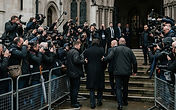
What the Russell Brand courthouse detail shows about running a principal through a crowd
Footage from Southwark Crown Court shows a close protection team working a media gauntlet in front of a principal — a textbook illustration of the chokepoint problem in executive protection.
· Albina Bieci

Executive Protection
AirTag in a Wheel Well Leads to Aggravated Stalking Arrest in Miami-Dade
A business owner found the tracker during a physical inspection of the car, a discovery that put the case on a parked vehicle rather than on a phone.
· Albina Bieci

Executive Protection
Manhattan Details Now Sweep Every Room and Vehicle Before an Executive Arrives
Corporate security departments have made technical and physical pre-advance sweeps a daily requirement after trackers and covert listening devices were found in financial-district work spaces.
· Albina Bieci
