
A covert recorder behind a conference room television: the OpenAI bugging case is the TSCM argument

By Albina Bieci, Staff Writer
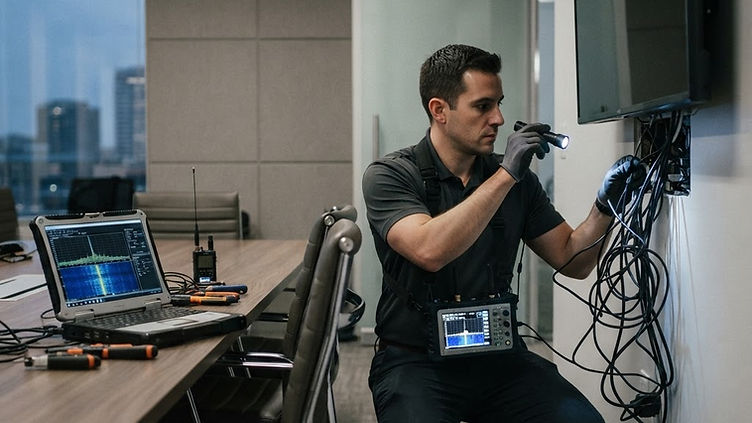
Federal prosecutors say a former engineer planted an encrypted recording device behind a television in an executive conference room. It was found during an internal physical security sweep.
SAN FRANCISCO
SAN FRANCISCO — A covert audio and video recording device, encrypted and hidden behind a television in an executive conference room, is the center of a federal espionage case against Abdulrahman Alfozan, a former OpenAI engineer arrested by the FBI, according to The Washington Post. Ahead of Tuesday's scheduled court proceedings, his lawyers filed motions challenging federal detention and the espionage claims.
The legal fight is about the charges. The security lesson is about where the device was found, and by whom.
The device was not found by a network monitoring platform, an endpoint detection tool, or an insider risk analytics dashboard. It was found during an internal physical security sweep. In an organization that spends enormous sums on digital security, the countermeasure that detected a hostile collection device was a person looking at a wall.
What this case actually demonstrates
Four facts about the alleged device are worth isolating, because each one maps to a control that most companies do not have.
It was placed in a room that the company controlled. Not a hotel suite, not a borrowed boardroom, not a restaurant. Executive conference rooms are the most sensitive space in a corporation and, as a rule, the least physically inspected.
It was hidden behind AV equipment. A television or a display mounted on a wall creates a natural cavity: a metal box, a power source, and cabling that no one looks behind. Wall-mounted displays, ceiling speakers, floor boxes, conference table grommets and the underside of chairs are the standard concealment points for exactly this reason.
It was encrypted. An encrypted device changes the recovery problem. Interception of the traffic is not the remedy; physical discovery is. That pushes the entire burden onto the sweep.
The person who allegedly placed it had legitimate access. Insider threat is not a perimeter problem. Badge access, familiarity, and a plausible reason to be in a hallway defeat almost every physical control a facility installs, which is why the sweep has to assume an insider rather than an intruder.
What a technical surveillance countermeasures sweep is
A TSCM survey is an instrument-based search for active and passive collection devices, conducted in a defined space, on a defined scope, with a written report. On a corporate executive suite, the standard scope includes the boardroom, adjacent private offices, executive assistants' work areas, the AV rack room and any space that shares a wall, floor or ceiling with the boardroom.
The instruments matter, and so does the method:
- Broadband radio frequency detection across the spectrum, from the low bands through the microwave region, with a sensitivity that has to be established rather than assumed.
- Non-linear junction detection, which finds semiconductor junctions in a wall or object even when the device is powered off or dormant.
- Physical inspection of AV equipment, displays, furniture, ceiling voids, floor boxes and above-ceiling spaces, because a passive or hard-wired device may emit nothing at all.
- Thermal and acoustic inspection where a device's heat signature or a cavity behind a surface warrants it.
- Network and cabling review, since a device that sits on the corporate network or draws power from a building circuit is caught by neither of the above.
The output is a report. Not a verbal assurance, not a "we found nothing," but a document that states the scope, the instruments used, the areas inspected, the findings and the limitations. Boards and insurers ask for it, and it is the only artifact that shows a company exercised the control.
What good physical security hygiene looks like between sweeps
A sweep is a point-in-time control. Between sweeps, four habits close most of the gap:
- Control the AV. Keep an inventory of every display, speaker and conference device with its serial number, mounting date and who installed it. Any unrecorded change behind a television is worth investigating.
- Restrict and log after-hours access to executive floors. The case turns on an insider, and access logs are what turn a vague suspicion into a name.
- Vary the routine. Sweeps on the same date every quarter are a schedule an adversary can work around.
- Sweep on trigger events, not only on calendar. A departure, a termination, a litigation hold, an acquisition, a board cycle involving material information. Every one of those is a reason to sweep out of sequence.
The executive protection dimension
Physical collection against a principal's office and collection against a principal's residence are the same problem in two locations. A close protection detail that has not considered the client's conference room, and a corporate security program that has not considered what a plain-clothes detail walks into, leave the same seam. Where the principal is a founder or a chief executive whose private conversations move markets, the physical space is the collection target, and audio is the default sensor.
USPA Nationwide Security conducts TSCM sweeps and executive suite surveys in San Francisco and across the country, with a written findings report for every engagement and dispatch at (877) 246-4253.
Services in San Francisco, CA
Sources
About the reporter
Staff Writer
Staff writer for the USPA Nationwide Security newsroom. Receives newsroom tips, corrections and editorial inquiries.
Author biography and credentialsMore from The Watchline


Executive Protection
The Secret Service moved a cabinet secretary out of his Georgetown home. Residential protection starts with the address
Citing intelligence on physical threats and concerns about the geo-location exposure of a private residence, the Secret Service relocated Treasury Secretary Scott Bessent to a military installation.
· Albina Bieci

Executive Protection
Beyond the Velvet Rope: Why Insider Bugging and Publicized Movements Define Art Basel Miami Beach Security
Three incidents this autumn, a concealed recorder in a corporate conference room, an arrest at a Brentwood estate and a threat on a Manhattan sidewalk, describe the exposures that Art Basel Miami Beach concentrates into one week.
· Mike Edwards

Executive Protection
What the Russell Brand courthouse detail shows about running a principal through a crowd
Footage from Southwark Crown Court shows a close protection team working a media gauntlet in front of a principal — a textbook illustration of the chokepoint problem in executive protection.
· Albina Bieci
