
The Secret Service moved a cabinet secretary out of his Georgetown home. Residential protection starts with the address

By Albina Bieci, Staff Writer
Citing intelligence on physical threats and concerns about the geo-location exposure of a private residence, the Secret Service relocated Treasury Secretary Scott Bessent to a military installation.
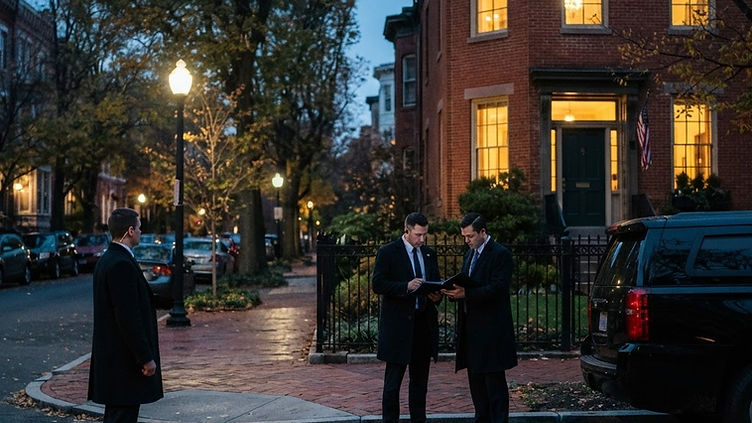
WASHINGTON
WASHINGTON — U.S. intelligence reporting on potential physical threats against senior administration officials prompted the Secret Service to move Treasury Secretary Scott Bessent out of his private residence in Georgetown and onto a secure military installation, according to CNN and TIME, which also reported concerns about the geo-location exposure of the home.
A cabinet secretary losing the use of his own house is a significant operational decision, and it is worth reading carefully. Relocating a principal out of a private residence is what a protective service does when it concludes that the residence cannot be held at an acceptable level of risk. That is a conclusion about the address, not about the threat alone.
The residence is the hardest post in protection
A protective detail can control a building it chooses. It cannot choose where a principal lives, and a private home in a historic neighborhood is close to the worst physical case: narrow streets, dense neighbors, alley access, sightlines from other buildings, public sidewalks, and a house that has been photographed, listed in property records and discussed online for years.
Four structural weaknesses show up in residential protection repeatedly:
- The approach. A rowhouse on a street with parked cars on both sides offers an arriving principal no standoff distance. Everything happens at walking pace, at close quarters, with bystanders present.
- The neighbors. Adjacent occupants are not screened, their visitors are not screened, and their windows overlook the principal's garden.
- The predictable schedule. Home to office, office to home, on a pattern. Protection is a contest over predictability, and a residence fixes the two ends of the day.
- The address itself. Property records, voter files, court filings, delivery photographs and a decade of social media together produce an exact location. The aggregation is inexpensive and largely lawful.
What geo-location exposure actually means
The reporting frames the concern as the principal's home location. Operationally, that is not one fact but a family of them: the address, the floor plan, the entrances, the vehicle, the route, the arrival time, and the absence of a protective detail at 6 a.m.
Open-source research on a residence is not an exotic technique. It is a routine opening move, and what it produces is a package: where the principal sleeps, when the house is empty, which door the family uses, whether a car is parked in the alley, and what the response time is. A protective intelligence function's job is to reconstruct that package from the adversary's side and then subtract from it.
For a private client, the practical mitigations are unglamorous and effective:
- Remove the address from where it can be removed. Property records can often be held in a trust or an entity with a registered agent. Voter registration, utility accounts and delivery accounts can be separated from a public name where state law allows.
- Reduce the photography. Geotagged images of a home, a street sign or a view from a window are the most common self-inflicted disclosure. Strip metadata and stop posting the view.
- Map the property the way an adversary would. Entrances, sightlines, parking, refuse collection, utility access, the neighbor's side yard. Then fix what can be fixed: lighting, gates, camera coverage, a hardened arrival point.
- Vary the pattern. Routes, times, vehicles. A detail that runs the same route twice a day is providing its own surveillance package.
What a rapid relocation requires
The decision to move a principal is a decision that has to have been planned before it is made. The elements that determine whether a relocation is smooth or chaotic are all pre-positioned: a destination that has been surveyed, a protective detail that has walked it, a communications plan, a list of what actually gets carried, and an understanding with the household staff about who tells the family and when.
An organization that has not thought about it will lose hours on questions of logistics while the threat is live. That is why residential surveys and relocation planning belong in the standing protective intelligence product rather than in the incident response.
The residual problem: the house stays
Relocating a principal resolves the immediate risk. It does not resolve the property. A vacated private residence whose address is publicly associated with a senior official becomes a building that needs watching, for the same reasons any vacant property does: it is empty, its schedule is known, and it is of interest to people who have already demonstrated an interest in the principal.
Residential posts during an absence run on the same discipline as any other protective assignment: documented rounds, a controlled arrival point, camera verification, and a reporting chain that reaches a person rather than a voicemail.
USPA Nationwide Security provides residential executive protection, protective intelligence support and vacant-residence security in Washington and nationwide, with dispatch at (877) 246-4253.
Services in Washington, DC
Sources
About the reporter
Staff Writer
Staff writer for the USPA Nationwide Security newsroom. Receives newsroom tips, corrections and editorial inquiries.
Author biography and credentialsMore from The Watchline

Executive Protection
A covert recorder behind a conference room television: the OpenAI bugging case is the TSCM argument
Federal prosecutors say a former engineer planted an encrypted recording device behind a television in an executive conference room. It was found during an internal physical security sweep.
· Albina Bieci

Executive Protection
Beyond the Velvet Rope: Why Insider Bugging and Publicized Movements Define Art Basel Miami Beach Security
Three incidents this autumn, a concealed recorder in a corporate conference room, an arrest at a Brentwood estate and a threat on a Manhattan sidewalk, describe the exposures that Art Basel Miami Beach concentrates into one week.
· Mike Edwards


Executive Protection
What the Russell Brand courthouse detail shows about running a principal through a crowd
Footage from Southwark Crown Court shows a close protection team working a media gauntlet in front of a principal — a textbook illustration of the chokepoint problem in executive protection.
· Albina Bieci