
USDA shut down its mapping and payment systems after a breach, and the food sector's watchdog says the gap is preparedness

By Albina Bieci, Staff Writer
Farm Production and Conservation systems went offline for the better part of a week while a GAO report published the same week found USDA and FDA only partially met the sector's emergency-preparedness requirements.
WASHINGTON
The U.S. Department of Agriculture's Farm Production and Conservation mission told staff on Monday that a security breach had reached all of its Geographic Information System mapping, payments and contracting, and that the systems were shut down until further notice, ABC News reported Friday. Under Secretary Richard Fordyce confirmed that the department had suffered a cybersecurity incident. By Friday the disruption was in its fifth day.
The disclosure landed in the same week as a Government Accountability Office report on the sector the department regulates. GAO found that USDA and the Food and Drug Administration met most of the 16 cybersecurity requirements Congress set in the fiscal 2021 defense authorization act, but only partially met or did not meet five of them, in the areas of information sharing and emergency preparedness. Both agencies told auditors that staffing and resources limited their work.
What is known
- USDA's Farm Production and Conservation mission reported a security breach involving GIS mapping, payments and contracting.
- Systems were shut down until further notice; Under Secretary Richard Fordyce confirmed a cybersecurity incident.
- The disruption was in its fifth day as of Friday, Nov. 20.
- GAO published a report the same week finding USDA and FDA only partially met or did not meet five of the sector's 16 cybersecurity requirements.
- No attribution, no confirmed data loss, and no confirmed link to any physical incident at a food facility.
Containment is a shutdown, and the shutdown has a physical side
When an agency or a company takes systems offline to contain an intrusion, it is not pausing a website. It is removing the layer that building operators have spent a decade moving their monitoring into.
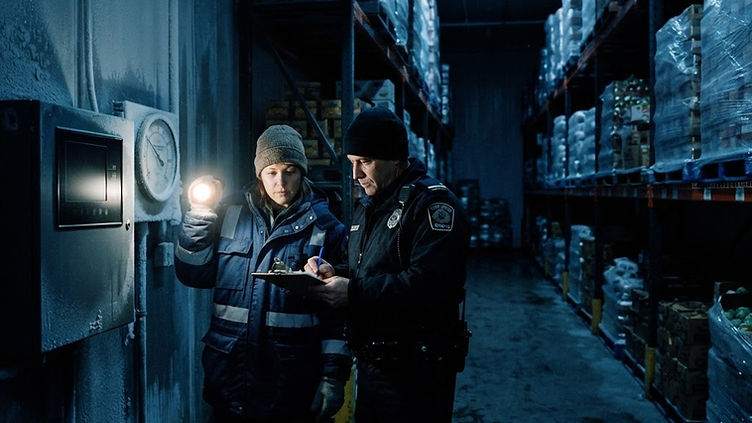
In a food facility, that layer now includes refrigeration controls, temperature alarms, access control, camera recording, and in many buildings the fire alarm's central station connection. Cold storage has a temperature window measured in hours. The alarm that tells a night manager a compressor has failed often rides the same network as everything else in the building. A five-day outage is longer than most continuity plans assume.
The same is true of a required fire protection system. Under the model fire code most jurisdictions enforce, IFC Section 901.7, an owner must notify the fire code official when a required fire protection system is out of service and provide an approved fire watch until it is restored. If a network outage takes alarm monitoring with it, the question of whether the system is "out of service" belongs to the fire code official, not to the facilities department.
What manual mode looks like
Facilities that keep operating through an outage do it on paper and on foot, and the pattern is consistent:
- Temperature and equipment rounds on a fixed interval, with readings written in a log that names the time and the person.
- Physical patrols of dock doors, coolers, compressor rooms and utility entries, because the electronic access log is no longer recording who came in.
- A fire watch with documented rounds through occupied areas, if suppression or alarm monitoring is impaired and the authority having jurisdiction requires it.
- Contractor and visitor logging on paper, with escort, because badge records are unavailable.
- A printed contact list for the fire department, the alarm company and the on-call engineer, because the app that holds those numbers is down.
The GAO's finding is about federal agencies. The operational lesson is not. A facility that has never drilled a shift without its building management system will discover the gap on the night it needs it, and the discovery is usually a spoiled product load or a missed alarm rather than a headline.
USPA Nationwide Security provides fire watch and industrial security guards for food processing, cold storage and distribution facilities. The company publishes The Watchline.
Services in Washington, DC
Reference and services
Sources
About the reporter
Staff Writer
Staff writer for the USPA Nationwide Security newsroom. Receives newsroom tips, corrections and editorial inquiries.
Author biography and credentialsMore from The Watchline


Guard Operations
Corpus Christi fields hundreds of intrusion attempts a day, and the port's fail-safe is still a person at the gate
The Port of Los Angeles blocked about 120 million attempts in August. What decides whether a port keeps working is what happens to the gate, the cameras and the suppression sensors when one gets through.
· Brian Fitzgibbons


Guard Operations
CENTCOM warned that a ship-to-ship transfer with an Iran-loaded vessel is a blockade case, and the insurers moved first
A new maritime advisory says commercial vessels transferring cargo at sea with ships loaded at Iranian ports will be treated as evading the naval blockade. MARAD memos point to rising war-risk premiums and lost capacity after a Panama-flagged bulker was disabled.
· Albina Bieci

Guard Operations
An armed officer stopped a gunman inside a Tampa campus gate, and the footage shows how little time the perimeter bought
Law enforcement released footage showing how an armed corporate officer confronted a man who had already passed the campus perimeter gate with 90 rounds of ammunition and threatened the company's legal staff.
· Albina Bieci