
CENTCOM warned that a ship-to-ship transfer with an Iran-loaded vessel is a blockade case, and the insurers moved first

By Albina Bieci, Staff Writer
A new maritime advisory says commercial vessels transferring cargo at sea with ships loaded at Iranian ports will be treated as evading the naval blockade. MARAD memos point to rising war-risk premiums and lost capacity after a Panama-flagged bulker was disabled.
WASHINGTON
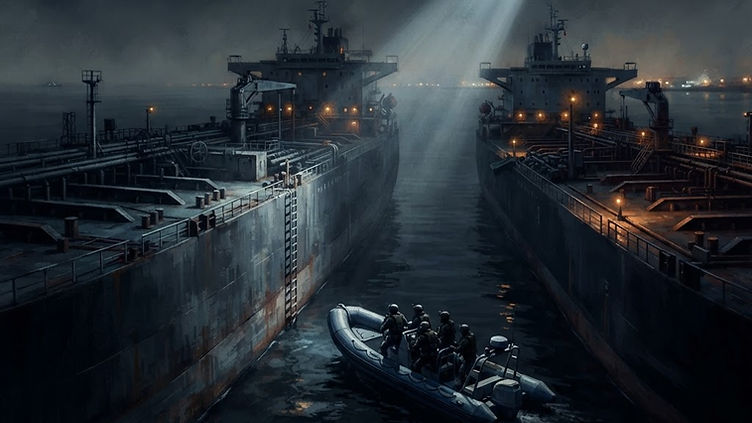
U.S. Central Command issued a maritime advisory warning that any commercial vessel conducting ship-to-ship cargo transfers at sea with vessels loaded at Iranian ports will be treated as evading the U.S. naval blockade and targeted for interdiction, according to reporting by Homeland Security Today and Al Jazeera.
Separately, internal Maritime Administration memos reported the same day flagged rising war-risk insurance premiums and reduced cargo capacity after naval forces disabled a Panama-flagged bulk carrier that was attempting to breach the perimeter.
For the commercial side of the industry, the advisory changes what a routine operation now costs. A transfer that was a commercial arrangement two weeks ago is an enforcement trigger today, and the parties who will feel it first are not the navies. They are the masters, the charterers, the underwriters and the embarked security teams.
What has been confirmed
CENTCOM published a maritime advisory stating that commercial vessels conducting ship-to-ship cargo transfers at sea with vessels loaded at Iranian ports will be treated as evading the blockade and subject to interdiction. MARAD internal memos, as reported, identified rising war-risk insurance premiums and reduced cargo capacity following the disabling of a Panama-flagged bulk carrier that attempted to breach the perimeter.
The reporting available at publication does not name the bulk carrier, does not describe the manner in which it was disabled, does not state whether any crew were injured or detained, and does not quantify the premium increases or capacity loss. It does not identify specific geographic coordinates covered by the advisory beyond the Persian Gulf and Strait of Hormuz. Those details will be added here as they are released.
What a ship-to-ship transfer is, and why it became the target
A ship-to-ship transfer is exactly what it sounds like: two vessels come alongside each other, usually at anchor or drifting in a designated area, and cargo moves between them through hoses or cranes. It is a legitimate and heavily used commercial practice. It is how crude gets from a very large carrier that cannot enter a shallow port into a smaller vessel that can, and it is how cargo changes hands when a buyer and a seller want the transfer to happen away from a terminal.
It is also, for that reason, the standard method for obscuring origin. A cargo loaded at an Iranian terminal and transferred at sea to a vessel with clean paperwork arrives at its destination with a documentary trail that begins in the transfer area rather than at the loading berth.
That is the logic behind the advisory. If the enforcement problem is origin concealment, then the transfer itself is the chokepoint, and the practical effect of the warning is to make the transfer the moment of legal risk rather than the arrival.
For a master, that changes the calculation. A transfer at sea involves a decision made in a shipping office and executed by a crew. The advisory puts the crew's vessel, and the crew themselves, on the wrong side of a naval enforcement action if the counterparty's cargo originated in Iran, whether or not the master knew it.
The insurance market repriced before the navies published
The more consequential line in the reporting may be the MARAD memo, not the advisory. War-risk premiums are how the commercial shipping market prices exactly this kind of exposure, and they move faster than policy does.
Marine hull and machinery policies exclude war risks by default. Cover for those perils is bought separately as war-risk insurance, and it is priced against a set of listed areas that underwriters review continuously. When a region is listed or re-rated, three things happen at once. The premium rises, sometimes by multiples rather than percentages. Conditions attach, including notice requirements before a vessel enters the area and additional premium payable per transit. And cover can be withdrawn entirely for vessels that breach the conditions, which is the clause that matters most to an owner, because a hull worth tens of millions becomes uninsured at the moment it is most at risk.
A single vessel disabled while attempting to breach a perimeter is precisely the event that forces a re-rating. Underwriters do not need a fleet of losses to move a rate. They need one event that shows the previous rate was wrong.
The capacity figure follows the premium. When the cost of a voyage rises and the risk of detention or damage rises with it, owners decline fixtures, charterers pay more, and tonnage that was available for the route is redeployed elsewhere. The MARAD memo's reference to reduced cargo capacity is that mechanism operating, not a separate problem.
What "disabled" means to a master and an owner
The reporting says naval forces disabled a bulk carrier attempting to breach the perimeter. The word covers a range of outcomes, from a mechanical intervention that stops the vessel to fire directed at a propulsion space or steering gear, and the specific method has not been disclosed.
What a master needs to understand is the decision tree that leads to that outcome. A vessel that ignores warnings and continues toward a closed area is making a series of choices, each of which is a documented opportunity to turn around. Naval forces typically broadcast warnings on multiple channels, attempt bridge-to-bridge contact, and may place a boarding team before escalation. The escalation ladder is deliberate and it is recorded.
An owner who instructs a master to test that ladder is exposing the vessel, the cargo and the crew, and is doing it in a way that will be reconstructed later from radio logs, AIS tracks and the vessel's own voyage data recorder.
The boarding risk that embarked teams now carry
Private maritime security teams have been part of Gulf and Indian Ocean shipping for two decades, and the advisory changes their operating environment in a specific way.
A team embarked for anti-piracy work is trained to deter a small boat approaching with ladders and hooks. The threat profile the advisory creates is different: state naval forces, or vessels acting at their direction, conducting an authorized boarding of a commercial ship. A private team's rules for the use of force almost never contemplate resisting a warship, and they should not. The correct posture is compliance, documentation and communication, with the team's value coming before the boarding rather than during it.
That means the security officer's job shifts upstream. Confirm the voyage plan and the transfer arrangements in writing before the vessel sails. Verify the counterparty in a transfer. Keep a record of the AIS history, the communications log and the cargo documents. Brief the master on what to say and to whom. And make sure the team's own weapons and equipment are declared properly, because an undeclared weapon found during a boarding turns a compliance inspection into an incident.
What documentation a vessel should be able to produce on demand
The advisory makes paperwork a security function. A vessel boarded in the Gulf should be able to produce, without delay: the charter party and voyage instructions, the cargo documentation including the certificate of origin, the last port clearance, the transfer agreement and counterparty identity if a transfer is planned, the crew list and passports, the ship's security plan and the record of security drills, and the embarkation records for any security personnel including firearms permits and the flag state's authorization.
None of that prevents an interdiction. What it does is determine whether the boarding ends with a vessel continuing its voyage or with a detention that runs for weeks.
What port and terminal operators inherit
Ports at the receiving end of these voyages get a second-order problem. A cargo whose origin cannot be documented cleanly becomes a cargo that cannot be discharged into a terminal with a compliance program, and a vessel that has been boarded and released carries a record that follows it.
Terminal operators with sanctions screening obligations are already asking for documentation earlier in the process. The advisory shortens the window between a voyage being planned and the point at which that documentation has to exist.
Related coverage
The Watchline has reported on the maritime enforcement environment this month. In Florida, the Coast Guard cutter Tahoma offloaded 3,622 pounds of cocaine at Port Everglades. USPA also published a Port of Baltimore maritime navigation risk analysis as the Coast Guard reviewed channel access.
The service connection
USPA Nationwide Security provides maritime security officers, embarked security teams and port facility access control in U.S. ports and at overseas terminals, including vessels operating under heightened boarding and interdiction risk. Engagements cover pre-voyage documentation review, watchkeeping and access control at the gangway, and liaison with the master and the agent. Requests can be made through the maritime security services page, the port and terminal coverage page, or by calling (800) 214-1448.
Sources and status
Reporting on the advisory is attributed to Homeland Security Today and Al Jazeera. The identity of the disabled vessel, the method of disabling, casualty information and the scale of the premium and capacity changes remain open pending release by CENTCOM, MARAD and the insurance market. Technical references include the U.S. Maritime Administration and the International Maritime Organization.
Services in Washington, DC
Sources
About the reporter
Staff Writer
Staff writer for the USPA Nationwide Security newsroom. Receives newsroom tips, corrections and editorial inquiries.
Author biography and credentialsMore from The Watchline

Guard Operations
An armed officer stopped a gunman inside a Tampa campus gate, and the footage shows how little time the perimeter bought
Law enforcement released footage showing how an armed corporate officer confronted a man who had already passed the campus perimeter gate with 90 rounds of ammunition and threatened the company's legal staff.
· Albina Bieci


Guard Operations
Two suspicious packages, one gridlocked District
The Secret Service Uniformed Division and D.C. police ran back-to-back package responses within hours, closing streets around the White House corridor twice. The protocol held; the city absorbed the cost.
· Albina Bieci


Guard Operations
A guard was fired. The perimeter is still the story.
An intruder passed the exterior checkpoint at 30 Rockefeller Plaza, reached the live set and confronted Craig Melvin before being arrested on felony burglary and hate crime charges. The officer's dismissal answers the staffing question and leaves the structural one open.
· Albina Bieci
