
USPA publishes a Port of Baltimore navigation risk analysis as the Coast Guard inquiry moves to public comment

By Albina Bieci, Staff Writer
The monograph separates authorized, maintained and operationally available channel dimensions, treats tug escorts as a feasibility question rather than a mandate, and sets the February 28, 2027 comment deadline against a 12-scenario planning register.
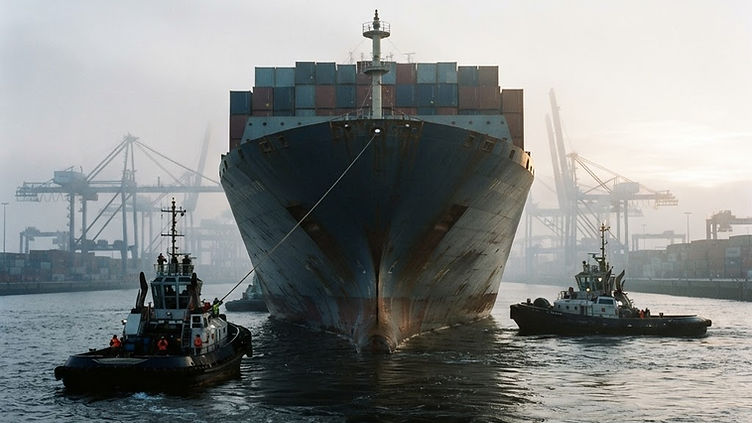
BALTIMORE, Md.
USPA Nationwide Security on Thursday published a public-source risk analysis of the Port of Baltimore's maritime infrastructure and navigation exposure, a 9,226-word monograph that reads the loss of the Francis Scott Key Bridge as a systems problem rather than a single accident and sets the Coast Guard's February 28, 2027 comment deadline against the decisions ports, bridge owners and terminal operators still have open.
The paper, "Port of Baltimore Maritime Infrastructure & Navigation Risk Analysis," is credited to Michael Evans Jr., the company's Associate Manager of Maritime Operations. It runs 24 sections with 14 tables, three diagrams and 26 cited sources, and it carries a 12-scenario planning register covering bridge protection, tug capability, channel assumptions, berth handoffs, salvage capacity and cross-sector disruption.
The sequence the investigation established
On March 26, 2024, the 984-foot containership Dali lost electrical power and then propulsion and steering near the bridge, struck Pier 17 and brought down the central span. Six highway workers were killed. The National Transportation Safety Board's final report, released November 18, 2025, traced the initiating blackout to a loose signal-wire connection created by improperly placed wire-label banding, with the available recovery time, bridge vulnerability and warning limitations contributing to the outcome.
The Coast Guard's Ports and Waterways Safety Act Board of Inquiry, released September 4, 2026, widened the question from one bridge to the framework behind it. It describes assessments of 11 ports, engagement with 41 Captain of the Port zones and 20 recommendations for systemic improvement, with stakeholder comments open through February 28, 2027 ahead of an anticipated August 2027 Commandant's Final Action Memorandum.
The analysis is precise about what those dates are. They govern a federal review process. They do not, on their own, impose new universal tug-escort or bridge-retrofit obligations on private operators, and the paper says so before anything else in the document.
Authorized, maintained and operationally available
The central technical point is that a channel has three dimensions, and they are not interchangeable. The Fort McHenry Channel is 800 feet federally authorized, historically maintained at 700 feet wide and 50 feet deep, and narrower still in practice once draft, squat, bank effects and traffic are accounted for. A risk assessment built on the authorization rather than the maintained dimension is built on a number no pilot can use.
On tug escorts, the monograph treats feasibility as the precondition for mandate. Two tugs in an unfavorable configuration can deliver less useful control authority than a properly specified arrangement, and a tether introduces hazards of its own. Whether escorts should be triggered by bridge proximity, ship dimensions, machinery status, environmental conditions or some combination is a hydrodynamic and operational question that has to be answered with the local pilotage rules, vessel categories and fleet capacity in view.
The same discipline applies to the bridge itself. The replacement structure has a different geometry and an evolving project record, so protection options, vessel dimensions and channel data have to be represented accurately rather than carried forward from the span that fell.
What the analysis does not claim
Every scenario in the register is ranked by consequence type and evidence sufficiency, with probability scores deliberately left unassigned rather than estimated. The document states its limits: it is not a Coast Guard determination, a bridge-engineering certification, a vessel survey, a pilotage instruction, a commissioned site assessment or a legal compliance opinion. Charges cited from Department of Justice litigation remain allegations unless a case record establishes otherwise, and no incident probability or response time is asserted.
The register is a set of planning scenarios, not reported vulnerabilities at any active facility, and the ninety-day preparation program it proposes is an editorial recommendation for organizing stakeholder input rather than an official Coast Guard submission template.
Who it is written for
Maritime operations leaders, port facility executives, bridge owners, pilots' organizations, Harbor Safety Committees, insurers, general counsel and public authorities who have to translate the inquiry's findings into action they can defend. The practical value is in the sequencing: which observations belong in a comment, which require engineering study, and where an owner has to accept a risk position before funding work.
Stakeholders intending to comment should verify current Coast Guard instructions before transmitting material and keep confidential security information out of the record.
The full analysis is published at uspasecurity.com/port-of-baltimore-maritime-infrastructure-navigation-risk-analysis, alongside the companion Port Houston maritime cyber-physical analysis. Evans's professional record and maritime assignments are listed on his management profile.
Port operators and terminal managers working through the inquiry's findings can reach USPA's maritime and port security desk, including Baltimore coverage, to discuss waterside and gate-side planning at the marine-land interface and the corporate risk intelligence practice behind the research series.
Services in Baltimore, MD
Sources
- National Transportation Safety Board · Contact of Containership Dali with Francis Scott Key Bridge, MIR-25-40
- U.S. Coast Guard · Ports and Waterways Safety Board of Inquiry
- U.S. Army Corps of Engineers, Baltimore District · Fort McHenry Federal Channel
- NTSB · Recommendation that 68 bridges be evaluated for vessel-strike collapse risk
- USPA · Port of Baltimore Maritime Infrastructure & Navigation Risk Analysis
About the reporter
Staff Writer
Staff writer for the USPA Nationwide Security newsroom. Receives newsroom tips, corrections and editorial inquiries.
Author biography and credentialsMore from The Watchline


Regulation & Codes
USPA publishes a free national reference on hot work fire watch regulations and NFPA 51B
A 40-page reference sets the three federal hot work standards beside NFPA 51B and the adopted fire code, and the complete edition is free to anyone who asks for it.
· Albina Bieci

Regulation & Codes
USPA publishes a Port Houston maritime cyber risk analysis with the 2027 Coast Guard deadline in view
The monograph separates regulatory applicability from port geography and treats the 2027 Cybersecurity Assessment, Plan and Officer requirements as separate obligations with separate evidence.
· Albina Bieci

Regulation & Codes
A candle, a common hallway, and one death in Gloucester Township
A three-alarm fire in Building C at Autumn Ridge displaced more than 100 residents and killed one, and the investigation points to the shared egress corridor as the place where the building lost.
· Albina Bieci