
Corpus Christi fields hundreds of intrusion attempts a day, and the port's fail-safe is still a person at the gate

By Albina Bieci, Staff Writer
The Port of Los Angeles blocked about 120 million attempts in August. What decides whether a port keeps working is what happens to the gate, the cameras and the suppression sensors when one gets through.
HOUSTON, Texas
The Port of Corpus Christi, the largest U.S. gateway for crude oil exports, is absorbing hundreds and sometimes thousands of attempted intrusions into its computer systems every day, its chief executive said. Kent Britton told the Financial Times that attackers are probing port networks for vulnerabilities and impersonating senior executives in fraudulent messages designed to gain access to sensitive systems.
The Port of Los Angeles, the busiest container port in the country, said it blocked roughly 120 million attempted cyberattacks in August, nearly double its monthly average in 2023. The U.S. Coast Guard recorded a 17 percent increase in maritime cyber incidents in 2025.
What is known
- Port of Corpus Christi reports hundreds to thousands of attempted intrusions daily; it handles about 2.3 million barrels per day.
- Attackers are probing networks and impersonating senior port executives in fraudulent messages.
- Port of Los Angeles blocked about 120 million attempts in August, nearly twice its 2023 monthly average.
- Coast Guard maritime cyber incidents rose 17 percent in 2025.
- No confirmed breach of terminal operations or safety systems in either port.
The attempt count is not the exposure
A port that blocks 120 million attempts in a month is describing automated scanning, credential stuffing and commodity attack traffic, most of it stopped by filtering. The number that matters operationally is one: a single success against a terminal operating system, a gate controller or a monitoring network.
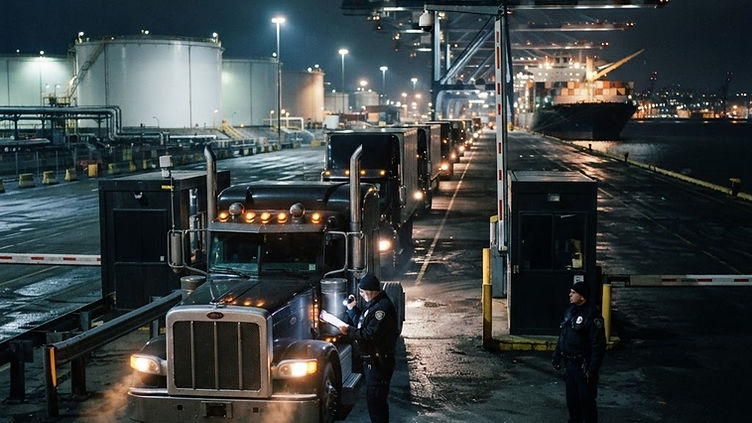
Those systems are concentrated at the points where a port physically works. Automated terminal gates decide which truck enters and which lane it takes. Perimeter cameras and access control decide who walks the fence line and the tank farm. Hazard monitoring covers tank gauging, gas detection and the suppression systems that protect fuel and chemical storage.
Take any one of them down for containment and the port does not stop. It reverts to a version of itself that needs people.
MTSA does not pause because a network is down
Facilities regulated under the Maritime Transportation Security Act operate to an approved Facility Security Plan, with access control, screening, monitoring and a designated facility security officer, under 33 CFR Part 105. Nothing in that plan is suspended by a cyber incident.
The substitution is manual, and it has to be documented:
- Gate operations on paper, with photo identification checked by a guard and a manifest verified against a printed appointment list.
- Physical posts at the gates and roving patrols of the tank farm, pipeline manifolds and berth approaches while cameras and access logs are unavailable.
- A fire watch with documented rounds wherever suppression or fire alarm monitoring is impaired, with the determination of whether the system is out of service left to the authority having jurisdiction under IFC Section 901.7.
- Coordination with the Coast Guard Captain of the Port, who controls waterway and facility security decisions during an incident.
A crude terminal that cannot meter its gate traffic also cannot keep trucks off the public road. The queue becomes a community safety problem within an hour, which is why the gate is usually the first place a facility feels a network outage.
Impersonation is a physical access problem
The Corpus Christi detail that deserves attention is not the volume of scans. It is executives being impersonated in messages aimed at staff. A convincing message from the chief executive to a terminal supervisor, a contractor or a finance officer is how an intruder gets a credential, a payment, or a person to hold a door.
The countermeasures are procedural and cheap: a callback to a known number for any unusual instruction, a shared verification phrase for high-value requests, dual approval on vendor and payment changes, and a rule that no one grants physical access on the strength of an email. Executive protection teams handling maritime and logistics principals should assume the principal's name is already in circulation.
USPA Nationwide Security provides maritime and port security and fire watch for regulated facilities. The company publishes The Watchline.
Services in Houston, TX
Reference and services
Sources
About the reporter
Staff Writer
Staff writer for the USPA Nationwide Security newsroom. Receives newsroom tips, corrections and editorial inquiries.
Author biography and credentialsMore from The Watchline

Guard Operations
USDA shut down its mapping and payment systems after a breach, and the food sector's watchdog says the gap is preparedness
Farm Production and Conservation systems went offline for the better part of a week while a GAO report published the same week found USDA and FDA only partially met the sector's emergency-preparedness requirements.
· Brian Fitzgibbons


Guard Operations
CENTCOM warned that a ship-to-ship transfer with an Iran-loaded vessel is a blockade case, and the insurers moved first
A new maritime advisory says commercial vessels transferring cargo at sea with ships loaded at Iranian ports will be treated as evading the naval blockade. MARAD memos point to rising war-risk premiums and lost capacity after a Panama-flagged bulker was disabled.
· Albina Bieci

Guard Operations
An armed officer stopped a gunman inside a Tampa campus gate, and the footage shows how little time the perimeter bought
Law enforcement released footage showing how an armed corporate officer confronted a man who had already passed the campus perimeter gate with 90 rounds of ammunition and threatened the company's legal staff.
· Albina Bieci