
Tampa has no four-hour alarm grace period, a new regulatory volume on fire watch and hot work finds

By Brian Fitzgibbons, Director of Operations, USPA Nationwide Security
The 24-page edition examines how Tampa Fire Rescue handles alarm and sprinkler impairments, the code transition scheduled for 31 December 2026, and the separate obligations that attach to hot work.
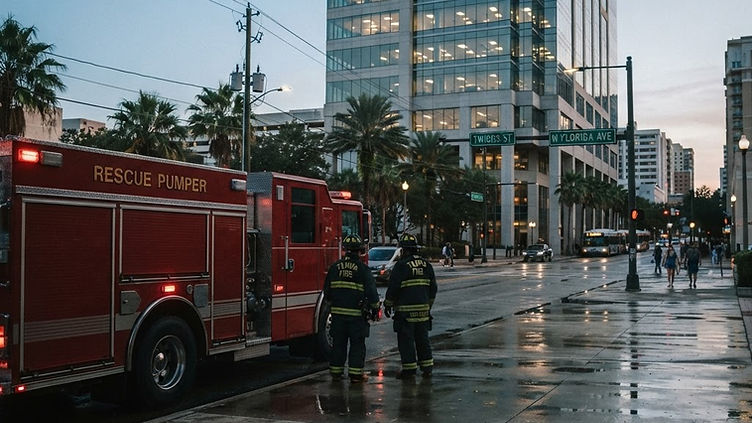
TAMPA
USPA Nationwide Security published a regulatory volume on Friday that sets out how fire watch and hot work obligations actually reach a commercial property inside Tampa city limits, and its central finding corrects a figure that circulates widely in contractor packets and property-management checklists. Tampa Fire Rescue does not grant a four-hour grace period after a fire alarm fails, and it does not grant a ten-hour grace period after a sprinkler system is shut down.
The volume, Tampa Fire Watch & Hot Work Regulations, is the fourteenth title in the company's fire watch Knowledge Base. It runs thirty chapters across twenty-four pages and roughly 9,400 words, and it rests on twenty-one cited primary documents: Florida Statutes 633.202 and 633.208, Florida Administrative Code rules 69A-60.002 and 69A-60.005, the State Fire Marshal's code page, the City of Tampa's adopted-code chart and permit procedures, the National Fire Protection Association standards the state incorporates, and the federal hot work rules in 29 CFR 1910.252 and 1926.352. Brian Fitzgibbons, the company's director of operations, reviewed and approved the text. The company is releasing it at no cost, as a two-page field brief and a complete edition delivered by email.
The interval that gets read as permission
The four-hour and ten-hour figures are real numbers inside the standards Florida enforces. What the volume disputes is their use as waiting allowances. A property manager who reads them that way concludes that a failed alarm buys four hours before anyone has to act, and that a closed sprinkler valve buys ten. Neither conclusion survives contact with the adopting code.
The document states the finding directly: "The four-hour and ten-hour figures are decision points inside the referenced standards, not waiting allowances, so the interval that governs a specific building has to come from the adopting code and the fire official's order."
Ten hours in a twenty-four-hour period appears in NFPA's impairment commentary as a threshold that may support an approved watch, an evacuation, a temporary water supply or another risk-reduction programme, depending on the occupancy and the authority's direction. It is a decision point, which means somebody has to decide, and the decision belongs to the fire official for that property. The volume reports that no universal four-hour alarm rule could be verified for the city at all, and it says so rather than repeating the shorthand as settled practice.
The distinction matters commercially. An impairment that runs eight hours with nobody watching is not a paperwork problem once a fire occurs. It is an unprotected building, and the record of what the property knew and when tends to arrive in front of an insurer and a plaintiff's counsel together.
Two authorities inside one mailing address
The volume's second correction is geographic. A Tampa postal address does not establish that a building sits inside the municipal boundary. The City of Tampa Fire Marshal's Office, part of Tampa Fire Rescue, performs plans review, code enforcement and inspection for city property. Hillsborough County Fire Rescue runs a separately constituted Fire Marshal's Office for unincorporated parcels, and facilities such as licensed healthcare, port operations and government property may carry an additional regime on top.
For a general contractor working a renovation near the boundary, borrowing the contact details from an older permit packet is the ordinary way this goes wrong. The volume recommends a short verification sequence: record the address and parcel number, pull the issuing agency from the fire inspection or permit record, confirm the current prevention contact, and note any facility-specific jurisdiction. A patrol route approved by the wrong authority can look thorough on paper and leave the actual impaired zones uncovered. Property owners unsure which office governs them can work from the Tampa fire marshal office summary before committing to a coverage plan.
The edition clock runs toward December 2026
Florida enforces the 8th Edition of the Florida Fire Prevention Code, effective 31 December 2023, built on Florida-amended NFPA 1 and NFPA 101 as the state has adopted them. The State Fire Marshal's office publishes a 9th Edition effective date of 31 December 2026. The volume treats that date as a project-planning constraint rather than a footnote.
A shutdown, a phased occupancy or a capital project that crosses December will be designed under one edition and operated under another. The document recommends maintaining a written change log that names which edition governed design approval, which governs operation at the time of the work, and which local amendments are in force. It also warns against the two opposite errors: applying the later edition early as though it were already law, and letting an outdated city subpage that still lists 1990s NFPA editions displace the formally adopted state code. Tampa's own adopted-code chart identifies the 2023 edition, which settles the question for now.
Staffing comes from the building
The volume refuses the arithmetic that circulates in vendor proposals, in which headcount is derived from floor counts or a fixed guard-to-occupant ratio. No Tampa authority publishes such a formula. Coverage follows verified exposure instead: which zones lost protection, which spaces hold ignition sources, how long a defensible round actually takes given storage height, machinery and locked doors, and which occupied areas a watch member must be able to reach and warn.
The defensible record, in the document's account, is the approved route, the number of positions, and a contemporaneous log with exact round times. A completion ticket from a repair contractor is likewise treated as the start of restoration verification, not the end of the obligation. The system gets tested, the monitoring account gets checked, affected managers get notified, and the watch ends when the authority or its stated conditions permit it. The company's emergency fire watch dispatch covers the interim period when a system is out and the property has to stay occupied.
Hot work answers to a different rulebook
A watch assigned to an impaired sprinkler system does not authorize welding in the same building. OSHA restricts welding and cutting in sprinklered structures while protection is impaired, and the volume makes the point in operational terms: the fire permit, the OSHA regime and the authority's direction all have to be satisfied before heat-producing work proceeds.
The hot work watch also has to be staffed for what it actually is. A fire watch member walking an impairment route cannot simultaneously maintain continuous observation of the ignition zone around a torch or a grinder, and the document warns against combining the two duties to save a position. For construction sites where the two problems arrive together, the hot work fire watch programme sets out how the watches are separated and sequenced.
Tampa Fire Rescue's New Construction Division reviews protection plans, tests and renovation work while incomplete protection coexists with temporary partitions, packaging and stored materials. The volume devotes a chapter to that interface and recommends a daily meeting between the general contractor, property manager, suppression subcontractor, alarm technician and watch supervisor, plus redlined drawings updated with the active impairments and current permits.
Public assemblies use a different instrument
The city operates a Fire Watch Personnel Request service that places uniformed inspectors at public assemblies, and the volume distinguishes it from an impairment patrol in plain terms. An event standby answers to a special-event permit and a published fee schedule. An impairment watch answers to the fire official's order on a building whose protection has failed. A promoter holding an event permit has not thereby satisfied an impairment order, and a property manager with a patrol in place has not thereby obtained event standby coverage.
The distinction has become more visible in Tampa as storm seasons lengthen. Extended power loss, pump failures and post-storm repair cycles tend to produce impairments in cascades, and a building can lose alarm transmission and water supply in the same week. The volume's storm-season chapter treats that pattern as the planning assumption for the region rather than an exceptional case.
What a property manager can do this week
The volume closes with the sequence it argues for from the first chapter. Establish what function was lost, in which zones, and who has authority to authorize compensating measures. Decide whether the building stays occupied, because evacuation is a legitimate control and a watch is a compensating measure rather than an equal replacement for detection or suppression. Set the route from the impaired zones outward to occupied egress, test the communication channel from inside the building rather than in the lobby, and open a log before the first round rather than reconstructing one afterward.
For readers who want the underlying standards rather than a summary, the company's fire watch white paper covers NFPA 601 and the national framework the state codes build on. Properties facing an active impairment, or a lender or insurer asking for a coverage plan, can request a written quote with the address, the affected system and the date coverage has to begin.
Availability
The two-page field brief is downloadable without registration. The complete 24-page edition is delivered free by email through the volume page, and the same record carries the four figures reproduced from the publication. Editions are revised against the State Fire Marshal's code page, the Florida Administrative Code and City of Tampa publications at each quarterly review, with changes recorded against the source and its first effective date.
Only published, approved volumes are released. The Tampa edition is approved edition 1.0, with the 9th Edition transition of 31 December 2026 flagged for recheck at the next revision.
Disclosure: The Watchline is published by USPA Nationwide Security, which produced this volume. No USPA personnel responded to, or were retained for, any incident described in the underlying research.
Services in Tampa, FL
Sources
- Florida Division of State Fire Marshal, Florida Fire Prevention Code (8th and scheduled 9th editions)
- City of Tampa, Fire Marshal's Office — Prevention Division
- City of Tampa, Adopted Codes chart
- Florida Statutes section 633.202 (State Fire Marshal adoption)
- Florida Statutes section 633.208 (minimum firesafety standards and local enforcement)
- Florida Administrative Code, Rule 69A-60.002
- Florida Administrative Code, Rule 69A-60.005
- City of Tampa, Fire Watch Personnel Request (public-assembly service)
- City of Tampa, Fire Alarm Plan Review and Permit Procedures
- U.S. Occupational Safety and Health Administration, 29 CFR 1910.252
- U.S. Occupational Safety and Health Administration, 29 CFR 1926.352
- Hillsborough County, Fire Marshal Inspection Services
- NFPA, Sprinkler Deficiencies and Impairments (technical explanatory article)
About the reporter
Director of Operations, USPA Nationwide Security
Brian Fitzgibbons directs fire watch and guard force operations at USPA Nationwide Security. He is a U.S. Marine Corps veteran of Operation Iraqi Freedom.
Author biography and credentialsMore from The Watchline

Regulation & Codes
USPA publishes a free national reference on security services in fire loss prevention and NFPA 601
A 35-page reference sets the published scope of NFPA 601:2025 beside the federal rules that actually bind an employer, and the complete edition is free to anyone who requests it.
· Albina Bieci


Regulation & Codes
USPA publishes a free national reference on hot work fire watch regulations and NFPA 51B
A 40-page reference sets the three federal hot work standards beside NFPA 51B and the adopted fire code, and the complete edition is free to anyone who asks for it.
· Albina Bieci


Regulation & Codes
USPA publishes a Port of Baltimore navigation risk analysis as the Coast Guard inquiry moves to public comment
The monograph separates authorized, maintained and operationally available channel dimensions, treats tug escorts as a feasibility question rather than a mandate, and sets the February 28, 2027 comment deadline against a 12-scenario planning register.
· Albina Bieci
