
Hot Work Fire Watch for Tampa, FL Steel Operations
Dedicated hot work fire watch personnel for Tampa-area steel mills, processing plants and the contractors supporting them. Welding, cutting, grinding and torch work staffed to NFPA 51B and OSHA requirements, with documented rounds, 24-hour dispatch and coverage staged from Tampa.
- 21+ Years in Business
- A+ Rated
- Veteran Owned and Operated
- Licensed and Insured
- 24/7 Dispatch
Hot work scheduled at a Tampa plant today?
Call the dispatch line with the address, the work schedule and the permit conditions, and coverage is confirmed before the crew begins. Same-day starts are routine from the Tampa market.
Hot work fire watch in Tampa
Tampa hosts the United States headquarters of one of the country's largest rebar and merchant bar producers. The American business runs an extensive network of electric arc furnace mills, including Midlothian, Texas, Charlotte, North Carolina, Knoxville, Tennessee and St. Paul, Minnesota, plus downstream rebar fabrication and a large recycling operation across the Southeast. Between the mills and the fabrication plants, hot work runs continuously across the footprint.
A documented fire watch is required for that work while it runs and for the post-work interval under NFPA 51B, the standard for fire prevention during welding, cutting and other hot work, OSHA 29 CFR 1910.252, welding, cutting and brazing and the Florida Fire Prevention Code. Mill maintenance windows, fabrication floor work, recycling yard repairs and emergency change-outs are all scheduled against permit requirements, and the fire watch is scheduled with them.
USPA Nationwide Security provides dedicated hot work fire watch personnel for the Tampa Bay steel and fabrication economy and the contractors supporting them, staffed 24 hours a day. Officers patrol the control zone during the work, monitor the post-work period, and close the assignment with a documentation file written for the plant's safety organization, the fire official and the insurer.
Tampa and the surrounding steel market
The company built its American business through acquisitions of legacy Southeastern mills and operates on an electric arc furnace model: recycled scrap melted into rebar and merchant bar, rolled continuously, and consumed by the downstream fabrication plants it also runs. Its U.S. headquarters in Tampa anchors a Southeast-focused production and recycling network.
The Tampa Bay market around the headquarters carries a dense steel-adjacent economy: rebar fabrication yards, service centers, the Port of Tampa's industrial corridor, and the construction economy consuming reinforcing steel across the region's growth, from Ybor City to the port districts and out through Lakeland. Hot work in that economy spans fabrication floor work, torch cutting in service centers, tank and equipment repairs, and construction-phase structural work.
The buying pattern follows the project and the permit. Mills book turnaround coverage in advance; fabricators and contractors book coverage for work outside hot work cells; recycling operations book coverage for yard work. Florida's hurricane calendar adds storm-driven emergency repairs across the region, which are staged the same day from officers already working in Tampa Bay.
What makes hot work at a steel facility different
A rebar mill's hot work profile is built around the melt shop, caster and rolling line: hot surfaces, hot material transport, ladles, cranes and mobile equipment share the floor with welding crews. The officer is briefed on the mill's traffic plan, exclusion zones and control-room communication before the shift begins.
Fuel accumulations concentrate in lubricant-soaked cellars, hydraulic systems, conveyor galleries, cable trenches and packaged rebar storage. A weld near a cable trench or a cut through a conveyor gallery ignites hazards the operator cannot see, and NFPA 51B's control zone extends the watch to cover those exposures.
Fabrication yards carry their own signature exposures: shear and bender lines, torch cutting of bundled rebar, welding near stored product and grinding over combustible dunnage. Spark travel into stored bundles and heat transfer through steel into packaging are the exposures fabrication watches are written around.
Florida's climate adds a regional discipline: hurricane season brings wet materials, temporary power and congested access to post-storm repairs, and the watch plan accounts for those conditions explicitly rather than treating them as ordinary work.



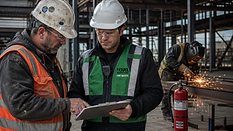


NFPA 51B: the governing hot work standard
NFPA 51B structures every assignment: a permit authorizing individual inspects the area, marks the control zone, confirms combustibles are removed or protected and authorizes the work in writing. The fire watch is a defined role under the permit, required during the work wherever spark, flame or heat could reach combustible material and wherever the work is out of the operator's direct view.
The fire watch performs no other duties while hot work is underway, and the officer USPA posts is held to that standard by post orders: observation, communication, escalation and the log.
The post-work watch runs a baseline of one hour after work stops under the 2024 edition, extended by the permit authorizing individual for torch-applied work, dust-laden spaces and concealed combustibles. USPA writes post-work coverage into the plan from the permit and the conditions found in the pre-work review.
OSHA requirements for welding and cutting in steel plants
Inside mills and fabrication plants, OSHA 29 CFR 1910.252 requires protection of combustibles beneath and adjacent to hot work, extinguishing equipment immediately available, and a fire watch where combustible exposure is more than ordinary or where hot work continues after hours. Sections 29 CFR 1910.253, oxygen-fuel gas welding and cutting and 29 CFR 1910.254, arc welding and cutting govern the gas and arc welding equipment, and the officer's monitoring includes those conditions.
For construction-phase work, including structural erection across the region's growth corridors, OSHA 29 CFR 1926.352, fire prevention for welding and cutting in construction requires extinguishing equipment within reach and additional personnel assigned to guard against fire during the work and a sufficient period after, including on the opposite sides of walls and floors where heat transfer creates a hazard.
Recycling operations add their own disciplines: mixed materials, mobile equipment traffic and compressed gas storage mean hot work in a yard is scoped as its own assignment with the yard's inventory in the pre-work review.
FL fire code and the local authority
Florida enforces the Florida Fire Prevention Code, which is built on NFPA 1, the Fire Code and NFPA 101 rather than the International Fire Code, a distinction that matters when reading a permit: the state's hot work provisions run through NFPA 1's chapter on hot work operations, which requires a permit, continuous attendance and a fire watch during and after the operation.
Locally, Tampa Fire Rescue administers the code in the city, and the surrounding counties and municipalities enforce it through their own officials. The company's other states, Texas, North Carolina, Tennessee and Minnesota, each enforce IFC-based or state fire codes through local authorities, and USPA writes every watch plan to the instructions of the authority where the property stands.
What the coverage includes
USPA hot work fire watch coverage for the Tampa Bay market includes mill maintenance welding and torch cutting, melt shop and caster repairs, fabrication floor work outside hot work cells, rebar processing and torch cutting of bundled stock, torch-applied roofing, recycling yard work, plant expansions, and the post-work watches that follow each. Officers are briefed on the facility's permit system, traffic plan and contacts before every shift.
Coverage reaches across Tampa Bay, from Downtown and Ybor City to the port districts, Gibsonton, Riverview, Brandon and Lakeland, and it extends to the company's mills in Texas, North Carolina, Tennessee and Minnesota under the same documentation standard.
Staging and response
Dispatch answers 24 hours a day. Planned turnarounds and fabrication work are booked in advance with the watch plan written to the permit; emergency repairs and storm-driven work are staged the same day, often within hours, from officers already working in Tampa Bay.
Coverage continues until the work is complete, the post-work interval has run and the permit authorizing individual releases the watch, and the completed file closes with that release entry, which is what the next outage books.
Tampa hot work fire watch questions
Does USPA provide hot work fire watch for the Tampa Bay rebar mills and fabricators?
Yes. Coverage covers the Tampa Bay headquarters market and extends to the company's mills in Texas, North Carolina, Tennessee and Minnesota, all under the same NFPA 51B documentation standard written to each jurisdiction.
Is a fire watch required for torch cutting of bundled rebar?
Yes. Spark travel into stored bundles and heat transfer into combustible packaging make bundled-stock cutting a permit-controlled operation with a fire watch during the work and a post-work watch scaled to the conditions.
How long does the post-work watch run at a rebar mill or fabricator?
NFPA 51B's baseline is one hour after work stops, extended by the permit authorizing individual for dust-laden spaces, packaged storage and concealed combustibles. USPA writes the post-work coverage into the plan from the permit.
How fast can coverage start in Tampa or at a Southeast mill?
Same day for most assignments, often within a few hours. For an emergency repair weld, emergency fire watch dispatch answers 24 hours a day with the address, schedule and permit conditions.
Does Florida use a different fire code for hot work?
Yes. Florida's Fire Prevention Code is built on NFPA 1 rather than the International Fire Code, and its hot work chapter requires a permit, continuous attendance and a fire watch during and after the operation. USPA writes the watch plan to the state's provisions.
What does hot work fire watch coverage cost?
Pricing follows the assignment: officers, the interval, hours and the control zone's size. A mill turnaround and a fabrication yard watch are different scopes. Request a quote with licensing and insurance documentation included.
Research · Hot work · Volume 12
Hot Work Fire Watch: NFPA 51B, OSHA, and Fire Prevention Engineering
A national regulatory and engineering reference on ignition pathways, permit authorization, fire-watch staffing and post-work controls. A national, source-cited reference on permit authorization, the three OSHA frameworks that govern hot work, the three-dimensional exposure behind the 35-foot figure, impaired fire protection, tank and process-line vapor, and the post-work watch each rule actually specifies. 40 pages, 16 cited sources. Not a substitute for the authority having jurisdiction.
Rated 4.9 by the clients we protect
Reviews are collected from real assignments across the country. Read them directly on Google before you call.
I have their pricing to be very affordable and competitive. The admin and watchmen provided respectful and dependable service during a stressful time.
William BeesleyGoogle reviewVerify This Review
Questions before you commit? Call (800) 214-1448 and ask for references on assignments like yours.
Request hot work fire watch coverage
Give dispatch the facility, the work schedule and the permit conditions, and the watch plan is written to the permit before the crew begins.