

Emergency Fire Watch in Boulder, Colorado (Open 24 hours)
24/7 Dispatch: (800) 214-1448
Highly Rated: 4.9 Google Rating, a trusted name in Boulder’s fire watch services.
Decades in business: Offering 500,000 hours of fire watch services annually.
Seasoned Professionals: Lead by military veterans & former Navy SEAL’s
Community Support: A portion of our earnings goes to supporting the rescue of missing individuals.
NFPA Compliance: Fully compliant with Boulder, NFPA & Fire Marshal regulations, ensuring top-tier fire safety.
Certified & Insured: Boulder Fire Watch Guards are OSHA certified.
USPA Nationwide Security provides a 24/7 fire watch service near Boulder. As an A+ rated company with the Chamber of Commerce, we provide fire watch services to construction sites, hotels, apartment buildings and businesses.
In a Rush? Here’s the Key Insights:
Fast Online Estimates, 24/7.
Team of Fire Safety Experts, Keynote Speakers, Authors in the realm of Fire Safety.
USPA donates to our Nonprofit: Proceeds aid missing girls’ rescue.
USPA adheres to Boulder Fire Marshal regulations.
We are fully Insured & OSHA-certified.

 Christopher LeeApril 24, 2023
Trustindex verifies that the original source of the review is Google.
Absolute pleasure to work with this group of professionals. Anyone looking for protective or security services would do well to hire USPA or their contractors. Jason CantieApril 20, 2023USPA Nationwide Security Was there for us at a desparate time! Their service was fast and professional! I Highly recommend them!
 Kerry RodierMarch 30, 2023Mike Evans and USPA there are very little words that would convey my gratitude to you and your company in the search for my son Séamus. Without your selflessness and compassion I would not have been able to get through this tragic time. You have brought me less heartache by giving me the knowledge that this was just a tragic accident as opposed to some other sinister act. I breathed easier knowing I had you and your company by my side tirelessly looking for Séamus. Your professionalism is unparalleled and you will always have my undying gratitude. Sincerely, Kerry Rodier Gray
 Allison KiddFebruary 21, 2023This company embodies integrity and hard work.
 Kendall EdwardsFebruary 21, 2023These guys are amazing! They are true professionals, they also spend their free time rescuing missing children. You can’t beat an organization like this.
 Monika KamardinovJanuary 17, 2023I was invited to a party last week where USPA Security guys were our bodyboards. They were very professional and made sure that we all felt safe during our gathering. I would definitely hire them for my events!
 Jurate LuckaiteJanuary 17, 2023I hired USPA Security company and I could not be any happier. Not only I received the most professional bodyguard team led by Navy Seals and Army Rangers, but I also received close protection for me and my girlfriends. The team is super professional. They actually care and go above and beyond to make sure you feel safe and protected. I was provided with VIP Aircraft and limo services to and from the airport. I received the VIP treatment in every step. I highly recommend USPA Nationwide Security team because they respect their client and their service is exceptional. It is an honor and pleasure to work with the team.
 Malan Best SecurityDecember 9, 2022Our company has been fortunate enough to work with USPA extensively over the last year and we cannot voice our appreciation enough. USPA has kept us steadily busy with work and we look forward to working with them for a very long time. Each representative of USPA we’ve been in contact with thus far has been a pleasure to work with and lastly, knowing that some of their profits are donated to some great causes is an incentive to continue working closely with this company. Thank you guys again. MBS TEAM
 Strong SecurityDecember 9, 2022I AM A PROUD CONTRACTOR WITH THIS ORGANIZATION AND ALL I CAN SAY IS I WILL BE HELPING THEM GET TO THE HIGHEST HEIGHTS POSSIBLE!!! President Manning of USPA has to be one the most honest and genuine men I've met in this industry!!! Marc E Singletary, MBA (DBA 2024)
 Nick POctober 10, 2022I have been using USPA as my security contractor for a few years now and their service is exceptional. Dan and Brian are extremely attentive and always able to help with our last-minute projects that fall outside of our main service contract. They provide exceptional oversight, and their communication could not be better. I would fully endorse USPA for any project, whether it be short or long term. This company has excellent values and always adheres to them. You will not be disappointed.
Fire Safety Expert Manages our Fire Watch Service

Director of Fire Watch & Security
Brian Fitzgibbons
24/7 Dispatch: (800) 214-1448
– Emergency Fire Watch
– Hot Work (NFPA Compliant)
– Construction Site (OSHA Certified)
– Fire Suppression System Maintenance
– Scheduled Fire Watch
– Event Fire Guards
USPA Nationwide Security: Media Recognition and Industry Leadership
Over the past decade, USPA Nationwide Security has garnered critical acclaim and extensive media coverage, including features in prominent outlets such as Yahoo News, Forbes, MSN, and “Crime Stories with Nancy Grace.” The company’s dedication to excellence in security and fire watch services has made headlines, highlighting their innovative approaches and significant contributions to safety and security. From protecting high-profile events to participating in rescue operations, USPA’s expertise and commitment have been widely recognized and celebrated across various media platforms.
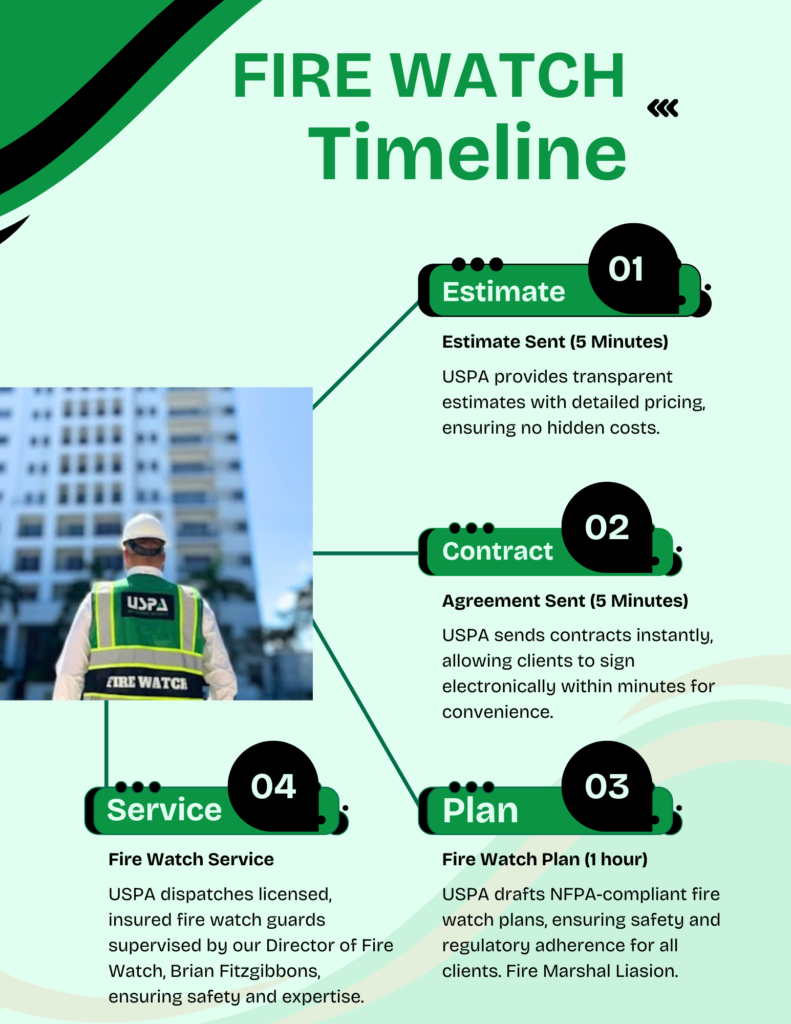
Comprehensive Fire Watch Timeline Steps
Step 1: Estimate
USPA offers immediate and transparent estimates. These estimates are detailed and clearly outline the pricing, ensuring clients face no hidden costs. This swift estimate process sets the stage for an efficient and seamless engagement.
Step 2: Contract
Upon approval of the estimate, USPA sends out contracts instantaneously. Clients can review and sign these contracts electronically within minutes, ensuring convenience and swift progression to the next phase.
Step 3: Plan
USPA develops comprehensive fire watch plans that comply with NFPA standards. These plans are tailored to meet regulatory requirements and ensure safety. USPA acts as a liaison with the Fire Marshal, ensuring that all safety protocols are meticulously followed and documented.
Step 4: Service
USPA deploys fully licensed and insured fire watch guards. These guards are supervised by Brian Fitzgibbons, the Director of Fire Watch. This step guarantees that all fire watch services are carried out with the highest level of expertise and adherence to safety standards.
Trusted Fire Watch Services in Boulder, Colorado
USPA Nationwide Security boasts an impressive 4.9 Google rating, solidifying its reputation as a trusted provider of fire watch services in Boulder, Colorado. With decades of experience in the industry, USPA delivers over 500,000 hours of fire watch services annually. This extensive service history highlights their commitment to safety and reliability, ensuring that businesses and properties in Boulder are well-protected and compliant with all fire safety regulations.
NFPA Guidelines for Fire Safety in Boulder, Colorado
NFPA 1: Fire Code – This guideline ensures comprehensive fire prevention and protection protocols across various building types, enhancing overall fire safety in Boulder.
NFPA 13: Installation of Sprinkler Systems – Critical for the design, installation, and maintenance of automatic sprinkler systems to control or extinguish fires in residential and commercial properties.
NFPA 72: National Fire Alarm and Signaling Code – Mandates the installation, testing, and maintenance of fire alarm systems for early detection and prompt emergency response.
NFPA 25: Inspection, Testing, and Maintenance of Water-Based Fire Protection Systems – Ensures regular inspection and maintenance of sprinkler systems, fire hydrants, and other water-based fire protection equipment.
Top 5 Most Practiced Fire Codes in Boulder, Colorado
1. IFC Section 503: Fire Apparatus Access Roads Boulder requires all properties to have unobstructed access roads for fire apparatus. This ensures that fire trucks and emergency vehicles can reach the scene quickly and efficiently. Fire apparatus access roads must be constructed to withstand the weight of fire trucks and provide adequate maneuvering space.
2. IFC Section 903: Automatic Sprinkler Systems Boulder mandates the installation of automatic sprinkler systems in various types of buildings. These systems are crucial in controlling or extinguishing fires before they spread. The requirements ensure that the sprinklers are designed, installed, and maintained to provide optimal fire protection in accordance with the International Fire Code (IFC) Section 903.
3. IFC Section 907: Fire Alarm and Detection Systems This section focuses on the implementation and maintenance of fire alarm and detection systems. Boulder enforces strict adherence to IFC Section 907, which includes guidelines for the installation of fire alarms in buildings, periodic testing, and maintenance to ensure they function properly in the event of a fire. These systems provide early warning, facilitating timely evacuation and response.
4. IFC Section 605: Electrical Equipment, Wiring, and Hazards The city follows IFC Section 605 to prevent fire hazards related to electrical equipment and wiring. This includes proper installation and regular inspections of electrical systems to prevent malfunctions that could lead to fires. Boulder ensures compliance with these guidelines to minimize risks associated with electrical fires.
5. IFC Section 609: Commercial Kitchen Hoods Boulder enforces strict regulations for commercial kitchen hoods under IFC Section 609. This includes requirements for proper ventilation and fire suppression systems in kitchens to prevent grease fires. Regular cleaning and maintenance of hoods, ducts, and filters are mandated to reduce the risk of fire, ensuring a safer environment in commercial kitchens.
Can Employees Serve as Fire Watch Personnel?

Key Insights on Utilizing Employees as Fire Watch
Specialized Training Essential: Fire watch duties require specific skills and training that typical employees may not possess.
Single Focus Required: Fire watch responsibilities demand undivided attention, preventing employees from handling dual roles effectively.
Regulatory Compliance: Approval from fire code officials and adherence to stringent training standards are mandatory for fire watch personnel.
Legal and Safety Risks: Using untrained employees can lead to severe legal and safety repercussions, emphasizing the need for dedicated fire watch services.
Guidance for Fire Safety and Fire Watch in Boulder, Colorado
Key OSHA Fire Protection Guidelines for Boulder, Colorado Construction Sites
Fire Brigade Requirement: Employers must provide a trained and equipped firefighting organization as necessary for the project to ensure life safety (OSHA 1926.150(a)(5)).
Fire Extinguisher Maintenance: Portable fire extinguishers must be periodically inspected and maintained according to NFPA 10 standards to ensure they are operational (OSHA 1926.150(c)(1)(viii)).
Training Obligations: Owners or occupants are responsible for training personnel in the proper use of fire extinguishers for various fire types, ensuring readiness for fire emergencies.
Maintenance Personnel: Fire extinguisher maintenance should be performed by trained industrial safety personnel, service agencies, or individual owners, as outlined in ANSI/NFPA Standard 10A-1970.
Comparing the International Fire Code and Boulder’s Local Fire Regulations
1. International Fire Code (IFC): The International Fire Code (IFC) establishes minimum requirements for fire prevention and fire protection systems. It covers a wide range of topics, including general fire safety requirements, emergency planning, fire service features, fire protection systems, and hazardous materials. The IFC serves as a model code that many jurisdictions adopt and adapt to fit local needs.
2. Local Fire Codes in Boulder: Boulder’s local fire codes are derived from the IFC but include additional requirements and modifications to address specific local concerns. These amendments can include stricter fire safety measures in areas prone to wildfires, additional requirements for fire department access, and specific guidelines for high-density developments and historic buildings.
3. Key Differences: a. Wildfire Risk Management: Boulder’s fire codes incorporate stringent measures for wildfire risk management, reflecting the region’s susceptibility to wildfires. This includes requirements for defensible space around buildings, fire-resistant building materials, and vegetation management.
b. High-Density Development: Local codes may impose additional fire safety requirements for high-density residential and commercial developments, ensuring adequate egress routes, fire department access, and fire protection systems.
c. Historic Buildings: Boulder has specific fire safety requirements for historic buildings to balance preservation with safety. This can include exemptions or alternative methods to comply with fire safety standards while maintaining the building’s historical integrity.
4. Compliance and Enforcement: Local enforcement agencies in Boulder are responsible for ensuring compliance with both the IFC and local amendments. This includes regular inspections, issuing permits, and providing public education on fire safety practices.
Understanding the interplay between the IFC and Boulder’s local fire codes is crucial for developers, property owners, and fire safety professionals to ensure comprehensive fire protection and compliance with all applicable regulations.
Legal Implications of the Boulder Junction at Depot Square Development Fire (2019)
Background of the Incident In 2019, a fire broke out at the Boulder Junction mixed-use development during its construction phase. The fire caused significant damage to the property and posed a risk to public safety.
2. Legal Proceedings The developers faced legal proceedings for failing to provide adequate fire watch services. The lawsuit underscored the importance of maintaining continuous fire watch during high-risk construction activities to prevent such incidents.
3. Fire Watch Responsibilities The case highlighted the legal responsibilities of developers to ensure fire safety compliance. It stressed the necessity of adhering to fire watch protocols as mandated by fire safety codes and regulations.
4. Impact on Future Development Projects The outcome of the case led to stricter enforcement of fire watch services in construction projects within Boulder. Developers are now more vigilant in implementing fire watch measures to avoid legal repercussions and ensure the safety of their developments.
5. Lessons Learned The Boulder Junction fire serves as a critical reminder of the importance of fire watch services in safeguarding construction sites. It emphasizes the need for developers to prioritize fire safety to protect both property and public welfare.
Main Hot Spots that Require Fire Watch Services in Boulder
University of Colorado Boulder The University is a sprawling campus with numerous buildings that host various events and activities. Fire watch services are essential here during large events, construction projects, and maintenance of fire protection systems to ensure the safety of students, staff, and visitors.
Pearl Street Mall As a major retail and entertainment hub, Pearl Street Mall frequently undergoes renovations and hosts large public events. Fire watch services are necessary to safeguard public safety during these times, ensuring compliance with fire codes and preventing potential hazards.
Boulder Community Health This medical facility requires stringent fire safety measures, especially during the maintenance and upgrading of fire protection systems. Fire watch personnel ensure that any disruption in fire protection does not compromise the safety of patients, healthcare workers, and visitors.
Industrial Areas in East Boulder These areas are hotspots for industrial activities such as welding, cutting, and other hot work. Fire watch services are crucial to monitor these high-risk activities, preventing industrial fires and ensuring compliance with safety regulations.
Boulder Junction at Depot Square This mixed-use development area combines residential, commercial, and retail spaces, often undergoing construction and development projects. Fire watch services are necessary to oversee fire safety measures during these projects, ensuring the safety of workers and the public.
In these locations, fire watch services play a pivotal role in maintaining safety standards, adhering to fire codes, and protecting lives and property from potential fire hazards.
Additional information about Boulder, Colorado
Fire Marshal Approved
You won’t have to worry about fires breaking out in your building when we’re around! We can be there within 60 minutes of receiving the call, so you know that everything will be taken care of quickly and efficiently. Plus, our guards are always courteous and friendly – they’ll make sure everyone feels safe under their supervision! And if you need them overnight, no problem – we offer 24/7 coverage as well!
Firewatch Company Boulder, Colorado
Are you looking for a fire watch service? USPA Nationwide Security is the best choice for your fire watch needs. We are Fire Marshal approved and can provide professional fire watch services to protect your property from fires. Our security guards will be on-site within 60 minutes of being called, so you don’t have to worry about any fires breaking out at your business or home! Call (800) 214-1448 or email dmanning@uspasecurity.com today for an instant quote on our services!
(800) 214-1448 – Fire Watch Service Boulder, CO. Hot Work Fire Guards Boulder. Fire Marshal Approved. Firewatch Company Boulder, Colorado
Frequently Asked Questions about Fire Watch in Boulder, Colorado
Who should I call for Fire Watch in Boulder, Colorado?
Call (800) 214-1448 for Boulder, Colorado Fire Watch
Are Recreational Fires Allowed Within City Limits in Boulder?
Yes, recreational fires are allowed within the city limits of Boulder, but they must comply with specific safety regulations to ensure the safety of the community and prevent fire hazards.
Safety Regulations:
Distance from Structures and Combustible Materials: Recreational fires must be conducted at least 25 feet away from any structure or combustible material. This distance helps prevent accidental spread to buildings or other flammable items.
Condition Elimination: Any conditions that could cause the fire to spread within the 25-foot distance must be addressed and eliminated prior to ignition. This includes removing flammable debris, ensuring the area is clear of overhanging branches, and keeping the ground around the fire clear.
Constant Attendance: The fire must be constantly attended by a responsible adult until it is completely extinguished. This ensures immediate action can be taken if the fire starts to spread or becomes unmanageable.
Fire-Extinguishing Equipment: Appropriate fire-extinguishing equipment, such as a portable fire extinguisher, dirt, sand, a water barrel, garden hose, or a water truck, must be available for immediate use. This equipment is crucial for quickly addressing any flare-ups or unexpected spread of the fire.
Permits and Authorization: Depending on local regulations, a permit may be required for certain types of fires, such as bonfires or fires for land management purposes. It is essential to check with the Boulder Fire Department or local fire code official to determine if a permit is necessary for your recreational fire.
By following these regulations, residents can safely enjoy recreational fires while minimizing the risk of fire spread and ensuring the safety of their property and neighbors. Always refer to the Boulder Fire Department’s official guidelines for the most up-to-date and detailed information.
What is the process for obtaining a permit for open burning in Boulder?
To obtain a permit for open burning in Boulder, follow these steps:
Application Submission: Submit an application to the local fire code official. This is required for activities such as silvicultural practices, wildlife management, disease control, pest prevention, and bonfires.
Owner Authorization: Only the landowner or an authorized representative can apply for the permit.
Compliance with Regulations: Ensure that the burning complies with state or local air and water quality management regulations. Obtain any additional necessary approvals.
Permit Issuance: Once all conditions and requirements are met, the fire code official will issue the permit.
Key Points
Permit Needed: For open burning, including bonfires and land management.
Application Required: Submit to the local fire code official.
Authorization: Only landowners or their representatives can apply.
Regulation Compliance: Must comply with air and water quality regulations.
What Are the Key Fire Watch and Fire Safety Requirements in Boulder According to Chapter 5 of the IFC?
Chapter 5 of the International Fire Code (IFC) addresses fire service features for buildings, structures, and premises, including access roads, building openings, and roof access, premises identification, key boxes, fire protection water supplies, fire command centers, and emergency responder communications enhancement systems. These features are essential for ensuring the safety of both the public and emergency responders during fire incidents. Compliance with these requirements helps maintain efficient and effective emergency response capabilities.
For fire watch services in Boulder, it is critical to ensure that fire apparatus access roads are maintained, fire protection systems are operational, and emergency responder communications systems are in place and tested regularly. Proper site safety plans and adherence to construction document requirements are also vital.
Key Sections:
Fire Apparatus Access Roads (503): Specifications for road dimensions, surface, turning radius, and maintenance.
Access to Building Openings and Roofs (504): Requirements for exterior door access and stairway access to roofs.
Premises Identification (505): Address identification and signage for emergency response.
Key Boxes (506): Installation of key boxes for immediate access by firefighters.
Fire Protection Water Supplies (507): Requirements for water supply and fire hydrant systems.
Fire Command Center (508): Specifications for fire command centers in large buildings.
Emergency Responder Communications Systems (510): Installation and maintenance of communication systems for emergency responders.
Are fire watch services covered by insurance in Boulder?
Fire watch services in Boulder might be covered by your insurance policy, particularly under commercial property insurance. Coverage typically depends on the circumstances leading to the need for fire watch services, such as a fire alarm system malfunction or required maintenance, and whether these are considered insured perils under your policy. It is crucial to review your specific insurance policy and consult with your insurance provider to determine if fire watch services are included and under what conditions. This will help ensure you have the necessary protection and understand your coverage limits.
Boulder, Colorado Fire Codes and the Fourmile Canyon Fire: A Case Study
By Brian Fitzgibbons
About Brian Fitzgibbons: Brian Fitzgibbons is a distinguished fire safety expert with extensive experience in fire codes, fire watch, and fire safety measures. As a keynote speaker and author, he has contributed significantly to the field, educating professionals nationwide on essential fire safety practices. USPA Nationwide Security has been a trusted provider of security and fire watch services for nearly 20 years. With a 4.9 Google rating and an A+ rating from the Chamber of Commerce, USPA Nationwide Security is committed to delivering top-quality services to its clients.
Boulder, Colorado, has faced significant challenges in maintaining effective fire safety measures, highlighted by the catastrophic Fourmile Canyon Fire in 2010. This case study examines Boulder’s fire codes, focusing on Chapter 5 of the International Fire Code (IFC) related to fire service features. Additionally, it explores how inadequate fire watch practices contributed to the disaster and how stricter adherence to fire codes could mitigate future risks.
The Importance of Fire Codes
Fire codes ensure public safety by setting minimum standards for fire prevention and protection, covering aspects of building design and maintenance. In Boulder, adopting and enforcing these codes is critical, given the city’s susceptibility to wildfires.
Chapter 5 of the IFC: Fire Service Features
Chapter 5 of the IFC focuses on the fire service features required for buildings and premises to ensure that emergency responders can effectively manage and mitigate fire hazards. Key areas covered include the requirements for fire apparatus access roads, access to building openings and roofs, premises identification, and the installation of key boxes for emergency access. Additionally, it addresses the necessary fire protection water supplies, the establishment and maintenance of fire command centers, and the enhancement of emergency responder communication systems within buildings. These provisions aim to enhance the operational efficiency of fire services and ensure timely and effective responses to emergencies.
The chapter outlines detailed specifications for the design, installation, and maintenance of these features, ensuring they meet the operational needs of fire departments. This includes standards for road dimensions, surface conditions, marking, and the installation of gates or barricades where necessary. The chapter also mandates the identification and accessibility of fire protection and utility equipment, ensuring that such equipment is readily available and operational during emergencies. By adhering to these standards, communities can significantly improve their fire safety infrastructure and enhance the overall effectiveness of their emergency response capabilities.
The Fourmile Canyon Fire and Its Legal Implications
The Fourmile Canyon Fire of 2010 caused significant property damage and highlighted deficiencies in local fire watch practices. This case resulted in lawsuits filed by affected property owners against Boulder County and other entities. The plaintiffs argued that better fire watch and mitigation efforts could have prevented the extensive damage. This case underscores the need for stringent fire safety measures and proactive fire watch services in high-risk areas.
Legal Brief: Correlation to IFC Chapter 5
Chapter 5 of the IFC outlines critical fire service features essential for effective fire safety management. The Fourmile Canyon Fire case demonstrated the consequences of inadequate fire watch practices and insufficient compliance with fire service features. Key components such as fire apparatus access roads, fire hydrant systems, and emergency responder communications systems were found lacking during the incident, exacerbating the damage and response efforts.
Key Points of the Legal Case: Fourmile Canyon Fire Lawsuit
The Fourmile Canyon Fire lawsuit emphasized the importance of adhering to fire codes, particularly those outlined in Chapter 5 of the IFC. The lack of adequate fire apparatus access roads hindered the fire department’s ability to reach affected areas promptly. Additionally, insufficient fire hydrant systems and poor emergency responder communication further impeded firefighting efforts. These deficiencies highlighted the need for stringent enforcement of fire codes to ensure comprehensive fire protection and response capabilities.
The legal outcomes of this case reinforced the necessity for proactive fire watch services and rigorous compliance with established fire safety standards. By implementing the requirements set forth in Chapter 5 of the IFC, communities like Boulder can significantly enhance their preparedness for fire emergencies, thereby reducing the risk of extensive damage and loss of life in future incidents.
Related Fire Watch Links
Introduction to Fire Watch eBook
Fire Watch Plans
Construction Site Fire Watch
Fire Watch Seminar
NFPA 601: Fire Watch Regulations
Fact Check: International Fire Code
Patrol Duties for Fire Watch
Chapter 7: International Fire Code
Disaster Recovery
For more information hire the A+ Rated Fire Watch Service in Boulder, Colorado