
Maritime Security · Miami
Superyacht Security in Miami
Gangway and tender control, overnight marina watch and guest protection for yachts berthed in Miami-Dade and Broward, coordinated with the captain and yacht manager so coverage fits the crew's routine instead of interrupting it.
- 21+ Years in Business
- A+ Rated
- Veteran Owned and Operated
- Licensed and Insured
- 24/7 Dispatch
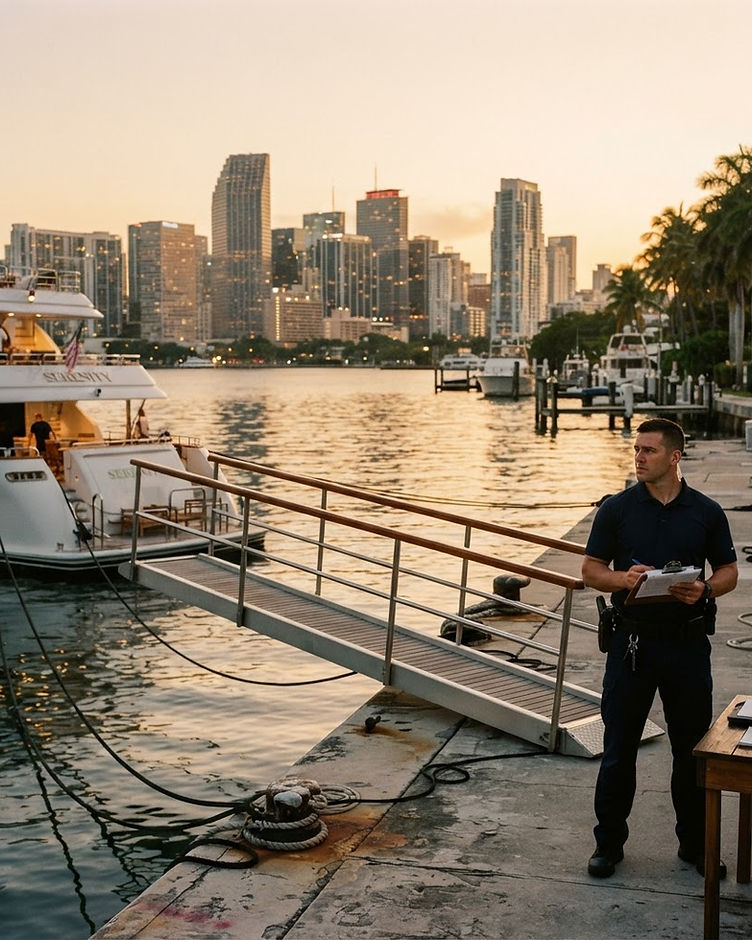
Gangway control, overnight watch and guest cover in Miami-Dade and Broward.
Vessel needs coverage now?
Dispatch answers at any hour. Call with the marina, the berth, the dates and the posture the captain wants, and coverage can often be staged for the same evening.
Research · Subsea cables · Systemic risk
Subsea Communication Cable Protection & Physical Interception
A Systemic Risk Analysis of Maritime Infrastructure, Acoustic Sensing, and Enterprise Connectivity. A public-source monograph on anchor damage, acoustic sensing, landing-station exposure and repair bottlenecks on the cable routes that carry enterprise connectivity. 21 sections, 13 tables, 24 cited sources. Not a carrier or cable-owner assessment.
A yacht in a working city
Miami is one of the few places in the United States where a yacht sits in a working city. A vessel berthed at Miami Beach Marina is a few minutes from a causeway, a public promenade and a hotel lobby full of people who can see the aft deck. Dinner Key in Coconut Grove puts a 150-foot motor yacht beside a public park and a dinghy dock. The Miami River puts hulls in refit against a street full of machine shops. In each case the vessel's exposure is decided less by the water than by what surrounds it.
That is the assignment: managing the boundary between the yacht and everything within walking distance of it. Access runs through the gangway, the tender and the crew, and the people who create risk usually arrive from land. USPA staffs Miami yacht assignments around that reality, and the work is planned with the captain and yacht manager before the first watch.
Coverage is local rather than national in how it is priced and staffed. A single night alongside in Miami Beach, a season of standing coverage for an owner who keeps a boat in Coconut Grove, a protective detail for a charter week, and travel cover through the Bahamas crossings are four different assignments, and each is quoted from the vessel, the berth and the dates rather than from a rate card.
Four shapes of Miami yacht work
Coverage is sized to what the vessel is actually doing: a quiet berth, a full guest list, a yard period or a passage.
Overnight watch alongside
A documented presence at the berth from evening until release, with rounds between the vessel and the dock gate.
Gangway and tender control
Visitor verification against a list agreed with the captain, contractor checks and control of the boarding point.
Owner and guest protection
Discreet coverage at the dock, ashore and during tender movements, including arrival and departure legs.
Charter and event cover
Guest flow, credentialed access and late-night arrivals while the vessel operates as a venue.
Refit and yard coverage
Contractor verification, tool and equipment control and property protection during Miami River or Broward yard periods.
Transit and destination cover
Officers travelling with the vessel or staged at the destination marina before arrival.
The vessel and the shore are two different problems
Aboard, access is a physical sequence: the passerelle or gangway, the swim platform, the tender, the crew passage. Officers work from a visitor list agreed with the captain, verify deliveries and contractors at the dock before anyone boards, and stand the boarding point during tender movements. The objective is that no one reaches a guest deck without having been expected by name.
Ashore, the risk profile is different. Guests arrive by car and by tender, drivers stage along the seawall, photographers work the public promenade at a marina like Miami Beach Marina, and the walk from the parking structure to the gangway is often the longest unpoliced stretch of an owner's evening. Shore coverage is planned as its own leg: vehicle staging, the arrival route, a position at the gate, and a decision made in advance about how visible the presence should be.
The two halves have to be run by one plan. When they are not, the classic failure is a well-controlled gangway and an unmanaged driveway, or a driver who parks in an unlit lot because nobody told him where to stage. Our officers work to written post orders that cover both, and the captain sees the document before it goes live.
What a Miami yacht assignment covers
Most Miami work falls into one of four shapes. The first is the overnight watch alongside: a berth in a busy marina, a high-value vessel, and a quiet, documented presence from evening until the owner or captain releases the post. The second is guest coverage during an owner's stay, where the exposure is arrivals, dinners ashore and the movement between vessel and car.
The third is charter and event coverage, where the vessel is effectively a venue and the guest list changes daily. The fourth is transit and destination cover, where an officer travels with the vessel or is staged at the destination marina before arrival. Coverage can move between these shapes during a single stay, which is why the assignment is reviewed with the captain rather than fixed for a month.
Marinas, yards and ports we staff in South Florida
Assignments are staffed across the marine districts of Miami-Dade and Broward rather than at a single address. That matters for a vessel that moves during a stay: a yacht that leaves a berth on the Miami River for a marina on Miami Beach should not require a new vendor, a new briefing and a new set of post orders.
Berths at Miami Beach Marina, Sunset Harbour and the Collins Canal area sit within a short walk of public promenades, so shore-side positioning gets as much attention as the gangway. Watson Island and the deep-water berths off the MacArthur Causeway carry their own approach pattern, with vehicle traffic arriving from two directions. Dinner Key and the Coconut Grove marinas sit beside parkland that is open to the public at all hours. Fisher Island, Key Biscayne and the Crandon Park berths are reached through controlled entries, which changes the shape of the coverage rather than removing the need for it.
On the mainland, the Miami River yards handle refit and repair work, and those assignments are contractor-heavy: welders, riggers, technicians and surveyors moving on and off the vessel all day, with equipment and personal property aboard. PortMiami and the Government Cut channel bring cruise and cargo traffic, Coast Guard presence and a facility security regime that governs the water around the berths. In Broward, Fort Lauderdale and the New River carry the largest concentration of refit and charter activity in the region, with Bahia Mar, the Lauderdale Marine Center district and the 17th Street corridor as regular locations, and Port Everglades as the other major inlet for offshore passages.
North of that, assignments continue through Palm Beach and the inlets that lead to the Gulf Stream, and south through Key Largo for vessels staging before a crossing. None of this is a coverage claim measured in vehicles. It is a statement about where personnel can be briefed, staged and supervised within a working day, which is the part that decides whether a watch actually holds.
Working with the captain, the crew and the yacht manager
A yacht already has a security structure. The captain controls access, the chief stewardess manages guest flow, the chief engineer controls the technical spaces, and the yacht manager holds the owner's instructions. An outside team that ignores that structure creates friction on a vessel where privacy and routine are the product.
Our officers report to the contact the owner designates, normally the captain or the manager, and procedures are written to fit the crew's watch schedule. Guest privacy expectations are briefed before the first watch. If an owner does not want uniformed presence on the dock, the post is run in plain clothes; if a marina requires an identifiable officer at the gate, the captain is told before that changes.
The same discipline applies to documentation. Visitor lists, contractor sign-ins, incident notes and shift handovers are written, and the captain or manager receives them. When an owner asks what happened on a Tuesday three weeks ago, the record exists rather than depending on someone's memory of the night.
Charter season, boat shows and event weeks
Miami's marine calendar concentrates the work. The winter charter season runs roughly from November into April, and with it comes a transient population of owners, guests and crew who are in the region for a few weeks and whose routines are unfamiliar to the marina.
The Miami International Boat Show in February and the Fort Lauderdale International Boat Show in the fall both draw large public crowds to the waterfront, and Art Basel Miami Beach in December brings the kind of private hospitality that puts guests on and off vessels late at night. During those weeks the dock is no longer a quiet place, and a vessel that is normally protected by obscurity is protected by procedure instead.
Brokers and charter managers usually know the schedule well in advance. Booking coverage for a show week or a charter party early is the difference between an officer who has been briefed on the vessel and one who is meeting the crew at the gate.
Hurricane season and storm preparation
Atlantic hurricane season runs from June 1 to November 30, and in South Florida it shapes how yachts are kept. Before a named storm, vessels either move, haul out or are made fast with extra lines in a berth the marina considers survivable, and the days around that decision are when a marina becomes crowded, contractors appear without warning and equipment sits exposed on the dock.
Coverage around a storm is practical rather than dramatic: verifying who is aboard and who is working on the vessel, watching staged equipment and tenders, controlling access while the marina fills with unfamiliar faces, and documenting the condition of the vessel and its surroundings before and after. After the storm passes, the same problems that affect buildings affect marinas, including power interruptions that leave fire protection systems offline. Where that happens ashore, USPA coordinates emergency fire watch so the property can remain occupied while the system is out.
Arranging the arrangement before the season starts is the reliable approach. A standing agreement identifies the vessel, the berth, the captain's contact and the posture required, so activation is a phone call to dispatch rather than a contract negotiated in a hurricane watch.
Armed coverage on the dock and aboard
Most Miami yacht assignments are unarmed, and that is usually the right posture: a professional presence at the gangway, a verified visitor list and a documented watch do more for a berthed vessel than a firearm on a dock full of guests. Where an owner or manager wants armed coverage, the decision has to survive three tests at once.
The first is Florida licensing. Armed security officers in Florida work under the statewide firearms license requirements of Chapter 493, Florida Statutes, and the officer has to hold that authorization in addition to the state security officer license. The second is the vessel: flag state rules, the captain's own instructions and the owner's policy all apply aboard, and a marina may impose its own conditions on armed personnel at a berth. The third is the itinerary, because an officer who travels from Florida to the Bahamas is subject to a different legal regime at the destination.
Our recommendation is written into the quote with the reasoning attached, so an owner, a manager or a risk adviser can see why a posture was proposed. Where the answer is unarmed, we say so.
How a Miami yacht assignment is built
The process starts with a short briefing from the captain or yacht manager: vessel, berth, dates, guest profile, crew routine and any instructions from the owner. From there the post orders are written, the officers are briefed before the first watch, and supervision checks the post in person rather than assuming it. Reporting closes the loop at the end of each shift.
Step 01
Brief
Vessel, berth, dates, guest profile and the owner's instructions, taken from the captain or yacht manager.
Step 02
Advance
The berth, the approach routes, the marina's own rules and the shore-side staging points are checked before arrival.
Step 03
Post orders
A written document covering access, contractor rules, patrol and the escalation path, approved before the first watch.
Step 04
Watch and record
Supervised shifts, visitor and contractor logs, and a written handover at every change of watch.
What superyacht security costs in Miami
Pricing is quoted per assignment. The variables that move the number are the length of the watch, whether the post is overnight or daytime, the number of boarding points that need coverage, whether officers travel with the vessel, whether the posture is armed or unarmed, and how much shore-side coverage the arrival and departure pattern requires. Holiday weeks, boat show weeks and Art Basel draw from the same pool of experienced personnel as every other assignment in the city, and rates reflect that.
Standing coverage for a season is priced on a schedule rather than night by night, which is usually cheaper per night and keeps the same officers on the same vessel. A single overnight watch is quoted as a one-off. Both come with the licensing documentation, insurance certificate and written scope before the post opens.
South Florida marine districts
One team and one set of post orders follow the vessel when it changes berth.
Miami Beach
Miami Beach Marina, Sunset Harbour, Collins Canal berths, Government Cut.
Downtown and Watson Island
Miamarina at Bayside, MacArthur Causeway approaches, deep-water berths.
Coconut Grove and Key Biscayne
Dinner Key, Crandon Park and the controlled entries at Fisher Island.
Miami River
Refit and repair yards, contractor traffic and street-side exposure.
PortMiami
Cruise and cargo terminals, Coast Guard presence and facility security rules.
Fort Lauderdale
Bahia Mar, New River, the 17th Street corridor and Port Everglades.
Palm Beach and the inlets
Berths north of the county line and staging before a Gulf Stream crossing.
The Bahamas routes
Destination cover at Bimini, Nassau and the Out Islands on request.
Yacht coverage in the field

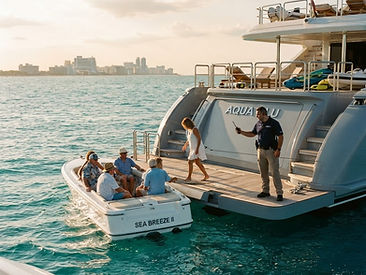
Tender and swim platform control during an owner's stay off Miami Beach.

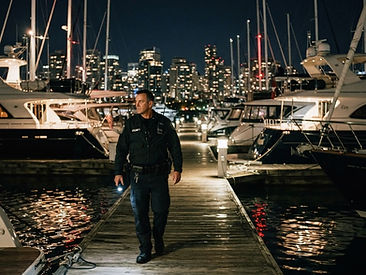
Overnight rounds between the berths and the shore-side gate.
Superyacht security questions
Do you provide yacht security in Miami Beach and Fort Lauderdale?
Yes. Miami-Dade and Broward are the core of the coverage: Miami Beach Marina, Sunset Harbour, Watson Island, Dinner Key, the Miami River yards, PortMiami, and the Fort Lauderdale and Port Everglades marine district. Personnel are briefed on the berth and the marina's own rules before the first watch rather than arriving cold.
Which marinas do you cover in South Florida?
Berths across Miami Beach, downtown Miami, Coconut Grove, Key Biscayne, the Miami River, PortMiami, Fort Lauderdale, Palm Beach and the inlets leading to the Gulf Stream. Coverage does not depend on a fixed list: if a vessel is berthed within a working day of Miami, an officer can be briefed and staged. Request a quote with the marina and dates.
How much does overnight yacht security in Miami cost?
Pricing is quoted per assignment, because the drivers vary: overnight versus daytime hours, the number of boarding points, armed or unarmed posture, whether officers travel with the vessel and how much shore-side coverage the arrival pattern needs. Standing season coverage is priced on a schedule rather than night by night. Request a quote with the vessel, berth and dates for a written scope and price.
Can officers travel with the vessel to the Bahamas or the Keys?
Yes, where the destination permits it. Transit cover and destination coverage at Bimini, Nassau and the Out Islands are arranged on request, and destination coverage is staged before the vessel arrives so the officer has already seen the marina. Legal conditions differ by country and are checked as part of the advance, not assumed.
Do you work directly with the captain and crew?
Always. Coordination with the captain and yacht manager is the starting point of every assignment. Procedures are written to fit the crew's watch schedule, officers report to the contact the owner designates, and guest privacy expectations are briefed before the first watch. The written handover goes to the captain or manager at the end of each shift.
Can you cover guests during charters and Art Basel week?
Yes. Charter guest coverage and event movements ashore use the same access control structure applied on land, adapted to the vessel's layout. During boat show and Art Basel weeks the waterfront is busier than usual, so booking early matters: the personnel who know how to work a guest list on a yacht are the same personnel everyone else is trying to book that week.
Do you provide armed officers on yachts in Florida?
Armed coverage is available, but it is never the default. Florida armed officers work under the statewide firearms licensing requirements of Chapter 493, Florida Statutes, and aboard a vessel the flag state rules, the captain's instructions and the owner's policy also apply. Marinas may impose their own conditions. Most Miami yacht assignments are better served by an unarmed, well-briefed presence.
What should be arranged before hurricane season?
A standing agreement that identifies the vessel, the berth, the captain's contact and the posture required, so activation is a call to dispatch rather than a contract negotiated during a watch. Atlantic hurricane season runs from June 1 to November 30, and the days before a named storm are when marinas fill, contractors appear and equipment sits exposed.
Services requested alongside yacht assignments
A vessel rarely has one exposure. These are the services owners and managers pair with it.
Maritime and Port Security
Terminal, cruise pier and waterside coverage under facility security plans.
Executive Protection
Close protection and advance work for owners and guests ashore.
Secure Transportation
Trained security drivers for airport, marina and residence movements.
Event Security
Staffing and access points for yacht parties and waterfront events.
Rated 4.9 by the clients we protect
Reviews are collected from real assignments across the country. Read them directly on Google before you call.
I have their pricing to be very affordable and competitive. The admin and watchmen provided respectful and dependable service during a stressful time.
William BeesleyGoogle reviewVerify This Review
Questions before you commit? Call (800) 214-1448 and ask for references on assignments like yours.
Request superyacht security in Miami
Give the operations desk the vessel, the marina and berth, the dates and the posture the captain wants. The written scope, licensing documentation, insurance certificate and quote follow before the first watch.
USPA Nationwide Security services are provided, as applicable, by USPA employees, independently owned franchise offices, or certified contractors participating in USPA’s contractor programs established in 2005, with services performed under applicable state and local licensing requirements. USPA is managed by Kingsman Philanthropic Corp., a nonprofit organization whose mission since 2005 has included locating and assisting missing and trafficked girls. Kingsman’s work has been featured on Crime Stories with Nancy Grace.