
The Decarbonization Dilemma: Solar Arrays, EV Chargers, and New Fire Risks
October 13, 2026· Dan Manning
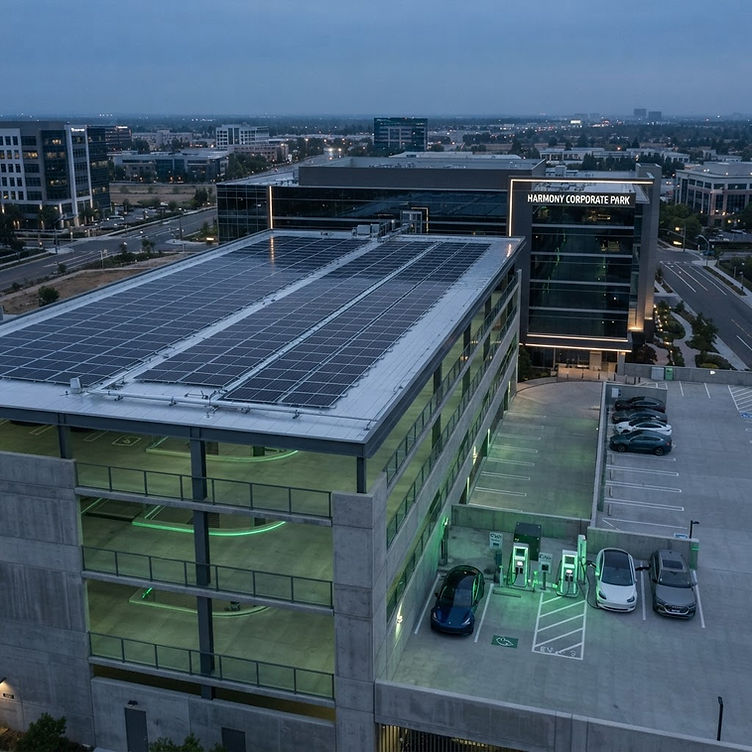
The Collision Between Climate Goals and Fire Code Reality
The commercial real estate sector has spent the better part of a decade absorbing the message that decarbonization is no longer optional. Municipal benchmarking ordinances, state-level building performance standards, and corporate net-zero pledges have pushed rooftop solar photovoltaic arrays and electric vehicle charging infrastructure from pilot projects into standard features of new construction and building retrofits. The pace of adoption has been remarkable. What has not kept pace is the fire protection architecture required to manage the hazards these systems introduce.
This is the central tension that property owners, building engineers, and urban planners are now confronting: decarbonization infrastructure carries a distinct fire risk profile that diverges fundamentally from the combustion hazards traditional suppression systems were engineered to handle. High-voltage DC electrical fires in photovoltaic arrays do not respond to conventional wet-pipe sprinkler suppression the way a contents fire does. Lithium-ion battery thermal runaway events in battery energy storage systems can reignite hours or days after apparent extinguishment. Multi-level EV charging garages concentrate high-voltage charging hardware in enclosed spaces where thermal events can escalate with limited egress options for responding crews. And the firefighting community, for all its professional capability, is being asked to work in environments where the hazard characteristics were not fully anticipated when the structures were permitted.
The thesis of this piece is direct: decarbonization goals and advanced fire suppression engineering must be co-developed from the earliest design phases, not sequenced one after the other. When they are sequenced — when the solar array goes on the roof and the charging stations go in the garage and the fire protection review happens at the end — the result is a building that meets its energy targets and fails its safety obligations. That failure is not hypothetical. It is showing up in insurance actuarial data, in municipal fire department incident reports, and in an emerging body of loss history that the commercial property insurance market is beginning to price aggressively.
What the Codes Currently Require — and Where the Gaps Are
The regulatory framework for green energy infrastructure fire safety exists, but it is fragmented, unevenly adopted, and in several respects still catching up to the technology it governs.
For rooftop solar photovoltaic installations, the primary federal reference is NFPA 70, the National Electrical Code, which includes rapid shutdown system requirements designed to protect emergency responders by de-energizing conductors in PV arrays when firefighters are on or near the roof. The rapid shutdown provisions address a genuine hazard: PV panels continue generating dangerous DC voltage as long as they are exposed to light, which means a roof fire does not eliminate the electrical hazard the way shutting off a breaker would in a conventional building. The NEC rapid shutdown requirements have been updated in successive code cycles, but adoption is governed at the state and local level, and not every jurisdiction has adopted the most current cycle. Buildings permitted under older code versions may have arrays that do not meet current rapid shutdown standards, and retrofits often occur without triggering a full re-evaluation of the existing electrical protection scheme.
For energy storage systems — the battery banks that capture solar generation for later use — the UL 9540A standard establishes a thermal runaway fire propagation test methodology intended to evaluate whether a battery storage installation can contain a thermal event within a defined boundary. UL 9540A is a testing standard, not a prescriptive installation code, but it informs system design and is referenced in model code language for battery energy storage. The core hazard it addresses, thermal runaway, is a chain reaction within lithium-ion cells that once initiated generates its own heat and off-gases flammable and toxic compounds. Suppressing a thermal runaway event with water can manage surface temperatures but does not halt the internal electrochemical reaction, which is why incidents involving battery storage systems have produced fires that appeared controlled and then re-ignited. The gap in current practice is that many commercial installations have been permitted and built before jurisdictions formally adopted model code language referencing UL 9540A, leaving the question of isolation, ventilation, and suppression to the discretion of the design team and the plan reviewer.
For indoor and structured parking EV charging banks, the International Fire Code's Chapter 12 provisions on energy systems address space separation, ventilation, suppression, and detection requirements for certain energy system configurations. The operational challenge in commercial retrofits is that structured parking garages were rarely designed with the electrical load, thermal hazard, or suppression infrastructure that a dense EV charging installation requires. A garage that was built for passive parking and retrofitted with Level 2 or DC fast chargers may technically pass plan review under a reading of the current adopted code cycle while still presenting conditions — inadequate detection sensitivity, insufficient drainage for suppression discharge, limited ventilation for off-gas dispersion — that fire protection engineers would identify as deficiencies in a purpose-built facility.
The Insurance Market Is Already Responding
Property casualty insurers are actuarial institutions. When a category of risk begins generating losses, the pricing response follows the data, usually with a lag measured in years rather than months. The commercial property insurance market appears to be moving into that pricing response phase for green energy infrastructure now.
Industry reporting has noted increases in commercial property insurance premiums for buildings with rooftop solar arrays and battery storage, with some market commentary citing rate increases in the range of 20 to 25 percent for buildings perceived to have unmitigated solar-related fire exposure. It is worth being precise about the sourcing here: the figure of a 25 percent rate increase cited in the editorial brief for this piece could not be independently verified against a specific published market index or underwriter disclosure at the time of writing. The directional claim — that insurers are pricing green energy infrastructure as an elevated risk — is consistent with publicly available commentary from commercial insurance brokers and underwriters, but readers should treat the specific percentage as an industry estimate rather than a confirmed actuarial benchmark. What can be stated with confidence is that underwriters are now asking detailed questions about PV array age, installation contractor qualifications, rapid shutdown compliance, battery storage specifications, and fire department pre-incident planning access as part of commercial property underwriting. A few years ago, those questions were not routine.
The FM Global Property Loss Data Sheet 1-15, cited in the source material for this piece as noting a 45 percent increase in commercial property fire losses from improper PV installation, is a reference that could not be independently verified at the specific citation detail provided. FM Global does publish property loss prevention data sheets, and the organization has published guidance on PV system fire risks, but the specific statistic and document version cited here should be confirmed against the current FM Global data sheet library before it is repeated in a regulatory or legal context. This caveat is noted not to dismiss the underlying point — improper PV installation has been documented as a fire cause in commercial settings — but because precision in citing loss data matters when the figures may be used to inform underwriting, code advocacy, or litigation.
The Engineering Response: Co-Design, Not Compliance Theater
The path forward for property owners and developers is not to slow the pace of green energy adoption. The business case for solar generation and EV charging infrastructure is durable across most commercial real estate categories, and regulatory pressure in many jurisdictions will only increase. The path forward is to treat fire protection engineering as a design co-equal, not a downstream review step.
In practical terms, this means several things. For rooftop PV installations, it means engaging a fire protection engineer alongside the electrical and structural engineers from the schematic design phase to evaluate rapid shutdown system configuration, roof access provisions for firefighting operations, separation between array coverage and roof penetrations, and the interaction between the array and any existing suppression systems that serve the occupied floors below. It means confirming the jurisdiction's current adopted code cycle and identifying whether the proposed installation will meet the most current NEC rapid shutdown requirements or only the version in force at the time of permit. It also means establishing a pre-incident plan with the responding fire department before the system goes live, not after the first incident.
For battery energy storage installations, it means specifying systems that have been tested under UL 9540A and reviewing the test data to understand what thermal propagation boundary the test established. A system that passed UL 9540A testing under one set of installation conditions — spacing, enclosure type, ventilation rate — does not automatically provide the same protection when installed under different conditions. The installation context matters, and a fire protection engineer reviewing the as-built conditions against the test parameters is a reasonable precaution that many project teams skip in the interest of schedule.
For EV charging in structured parking, it means conducting a gap analysis of the existing garage against current IFC Chapter 12 provisions before permit applications are submitted, with particular attention to suppression system coverage, drainage capacity, detection type and placement, and ventilation. Level 2 charging may present a different risk profile than DC fast charging at high amperage; the distinction is relevant to suppression system design and should not be collapsed into a single permitting category.
None of this is exotic engineering. It is the application of established fire protection methodology to a new infrastructure category, and the professional community has the tools to do it well. The problem is not knowledge — it is process. When decarbonization projects are driven by energy goals and cost timelines with fire protection treated as a permit hurdle, the co-design discipline breaks down.
The Liability Landscape for Property Owners
Property owners who commission green energy retrofits without adequate fire protection co-design are not simply accepting an abstract risk. They are making a decision that has identifiable consequences in at least three domains: insurance coverage adequacy, tort liability, and code enforcement exposure.
On coverage adequacy, the combination of rising premiums and tighter underwriting language means that a property owner who does not disclose the full character of a PV or battery storage installation at renewal may find that a loss is contested on the grounds of material misrepresentation. The coverage question in a large commercial fire loss involving a solar array or battery storage system is likely to turn on whether the installation met applicable code requirements, whether the suppression system was appropriate for the hazard, and whether the owner took reasonable precautions given the known risk profile of the technology. These are not questions with easy answers in litigation, but they are much easier to answer favorably when the design record shows that a qualified fire protection engineer reviewed the installation.
On tort liability, the emerging loss history for green energy infrastructure fires is creating a factual record that will inform negligence standards in commercial property litigation. As that record develops, courts and juries will have a clearer basis for evaluating what a reasonable property owner should have known about the fire risks of rooftop solar and EV charging infrastructure at the time a given installation was completed. The window during which ignorance of these hazards functions as a practical defense is closing.
On code enforcement, the gap between currently adopted code cycles and model code developments means that a building can be technically compliant with the local adopted code and still present conditions that a post-incident investigation will characterize as inadequate. Fire marshals and insurance adjusters do not evaluate fire protection in isolation from what current best practice requires; a building that was permitted under a 2018 code cycle may be evaluated against 2021 or 2024 standards when a loss occurs.
Decarbonization Done Correctly
The argument here is not that green energy infrastructure should be slowed or that net-zero building targets are misguided. Commercial real estate's contribution to urban carbon emissions is significant, and the sector's role in the energy transition is legitimate and important. The argument is that the engineering disciplines supporting decarbonization must be allowed to work together rather than in sequence, and that fire protection is one of those disciplines.
The buildings that will navigate this period well are the ones where the developer or building engineer insisted on a fire protection review at design development rather than at permit submission, where the battery storage specification included a meaningful review of UL 9540A test data, where the EV charging retrofit included a structured gap analysis against current IFC provisions, and where the insurance renewal was supported by a current pre-incident plan and documentation of suppression system adequacy. These are not extraordinary measures. They are the standard of care that the risk profile of this technology warrants.
The buildings that will generate the loss cases, the contested insurance claims, and the eventual code revisions are the ones where the energy targets drove the schedule and the fire protection review was treated as a formality. The commercial real estate industry has seen this pattern before with other infrastructure categories. The opportunity to respond differently this time is present, and the professional and regulatory tools to do so already exist.
For building engineers, urban planners, and real estate developers working through decarbonization programs, the practical implication is to treat fire protection co-design not as an additional cost but as the condition under which the green energy investment can be made responsibly. The liability that accumulates when that condition is skipped is real, and it is beginning to show up in ways that are difficult to ignore.
Related Reading
Questions about fire watch, executive protection or guard coverage for your property? Request a quote or call our dispatch line.
More from the blog


Breaking News
Subtropical System Threatens East Coast with High Winds and Coastal Flooding as NHC Monitors Development
The National Hurricane Center is tracking a non-tropical area of low pressure off the Carolina coast with a 40 percent chance of subtropical storm development. Regardless of whether it organizes, the system is expected to produce dangerous surf, coastal flooding, and high winds along the U.S. East Coast this week.


Breaking News
Three-Alarm Fire at Morristown Restaurant Triggers Apartment Evacuations on Spring Street
A three-alarm fire broke out Monday evening at Mega BBQ on Spring Street in Morristown, New Jersey, forcing the evacuation of residential tenants above the restaurant and drawing mutual-aid companies from three neighboring communities. No injuries were reported. Investigators have not yet confirmed a cause, though preliminary indications point to an exhaust chute near the restaurant's stove.

Breaking News
Four Units Damaged in Overnight Apartment Fire Near Loop 410 and Starcrest on San Antonio's Northeast Side
Two units were damaged by fire and two by water in an overnight apartment fire near Loop 410 and Starcrest Drive on San Antonio's Northeast Side on Oct. 5. No injuries were reported, and the cause is under investigation by the San Antonio Fire Department.