
The Ghost in the Server: How AI-Driven Tailgating Is Defeating Automated Turnstiles
October 28, 2026· Dan Manning
The Vulnerability Hidden in Plain Sight
Every morning, thousands of employees stream through automated optical turnstiles in corporate lobbies, data centers, government facilities, and financial institutions. The credential read happens in milliseconds. The flap panels retract. A person passes. The system logs the event and resets. From the outside, this looks like security functioning exactly as intended.
What the log entry does not capture is the second body that slipped through on the same credential event. Tailgating, in its crudest form, is as old as the first locked door. A determined individual waits for a legitimate employee, times their approach, and walks through before the barrier closes. Awareness campaigns, signage, and employee training have addressed this version of the problem for decades with modest but measurable results.
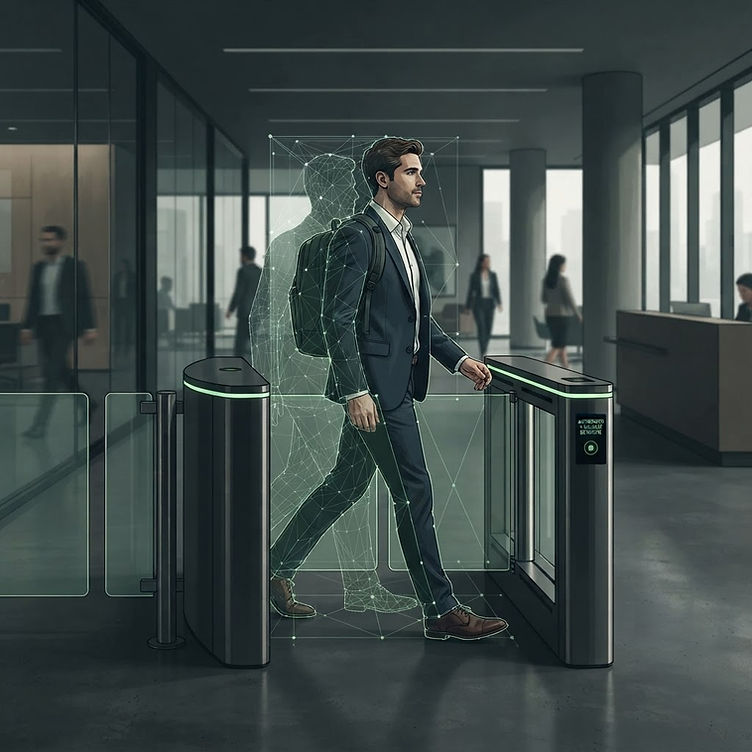
The version of the problem that currently confronts corporate security professionals is something substantially more calculated. Over the past several years, physical security teams at technology headquarters, pharmaceutical research campuses, and financial trading floors have documented intrusion incidents in which bad actors used precisely timed, coordinated movement patterns to defeat optical turnstile sensors. These actors did not guess. They tested. They mapped sensor geometry, identified blind spots in infrared beam arrays, and exploited the gap between the speed at which a human body clears a detection zone and the speed at which the lane resets. The result is a category of physical breach that the standard optical turnstile was never engineered to prevent.
The central argument of this piece is straightforward: organizations that rely on single-plane optical sensing and volume-counting algorithms are operating access control infrastructure that sophisticated actors now know how to defeat by design. Closing that gap requires a fundamental architecture shift toward stereoscopic three-dimensional spatial sensing combined with real-time AI shape-separation analytics. This is not an incremental upgrade. It is a reclassification of what a turnstile is supposed to do.
How the Modern Exploit Actually Works
To understand why the fix requires a different sensing paradigm, it helps to understand the precise mechanics of the exploit.
Conventional optical turnstiles rely on infrared beam arrays or single-plane time-of-flight sensors positioned at the lane entrance and exit. The logic is fundamentally a count: one credential event should correspond to one object passing through the detection zone. The system measures interruption of beams or changes in proximity readings, and if the interruption pattern suggests two objects, an alarm triggers.
The vulnerability lies in what the sensor cannot resolve. Standard single-plane infrared arrays are exceptionally good at detecting a single human profile walking upright through the center of a lane. They are measurably less reliable when two individuals compress their profiles, synchronize their stride cadence, and position themselves so that the trailing person's body geometry falls within the sensor shadow of the leading person at the precise moment of detection sampling. The beam array reads one interruption profile because, from the sensor's perspective, that is what the physics of the arrangement produces.
This is not a theoretical concern derived from laboratory conditions. Corporate physical security incident reports reviewed in post-breach forensic analyses have identified exactly this pattern at technology sector headquarters. Investigators reconstructing entry logs against CCTV footage have found credential events where the time-stamped sensor reading corroborates a single entry while video evidence shows two individuals clearing the lane within the same gate cycle. Because the security information and event management (SIEM) system ingested the turnstile log as a clean single-person event, no alert was generated, and no security operations center analyst had reason to investigate further until after the downstream compromise was discovered.
The downstream compromise matters enormously here. Physical tailgating is increasingly documented as an initial access vector for data breaches. When an unauthorized individual reaches a workstation floor, a server room anteroom, or an unattended endpoint without triggering any access control event, they inherit the level of implicit trust that the physical security perimeter was supposed to confer. Network monitoring tools calibrated to detect anomalous credential behavior have no baseline reason to flag the session that follows, because as far as every upstream system knows, the door opened for a credentialed employee.
What the Security Industry's Own Data Shows
The Security Industry Association has tracked access control technology adoption and performance benchmarks across enterprise deployments. Its research has consistently noted that while the installed base of optical turnstile technology is large and growing, a significant portion of deployed units operate on sensing architectures that predate current adversarial testing methodologies. The gap between what the installed base can detect and what current threat actors can execute has been a persistent finding in the physical security benchmarking literature.
ASIS International, through its Physical Security Council, has addressed the convergence of physical and cyber threats in its guidance frameworks. The council's position briefings acknowledge that physical intrusion is increasingly treated as a precursor tactic rather than an end in itself: unauthorized physical presence enables credential harvesting, device implantation, and lateral network access in ways that purely digital attack vectors cannot replicate as efficiently. This framing is consequential because it reorders how organizations should think about the cost-benefit of access control infrastructure investment. A turnstile that fails against a sophisticated physical intruder is a facilities management problem with direct cybersecurity consequences.
The regulatory dimension compounds this. OSHA's General Duty Clause under Section 5(a)(1) of the Occupational Safety and Health Act of 1970 requires employers to provide a workplace free from recognized hazards that are causing or likely to cause serious physical harm. While OSHA enforcement actions specifically citing turnstile inadequacy are not the dominant pattern in the enforcement record, the agency has pursued General Duty Clause citations in workplace violence cases where employers knew of a recognized threat and failed to implement feasible protective measures. As physical intrusion risks become more explicitly documented and more widely recognized across the security industry, the argument that deploying known-vulnerable access control infrastructure constitutes a recognized unaddressed hazard becomes legally substantive.
The Architecture That Changes the Calculus
Stereoscopic three-dimensional sensing works on fundamentally different principles than single-plane infrared arrays. A stereoscopic sensor system uses two or more image capture elements separated by a calibrated baseline distance, generating disparity data from which depth information can be computed in real time. The output is not a beam interruption count; it is a spatial point cloud that describes the three-dimensional geometry of every object in the detection volume.
When AI spatial analytics are applied to that point cloud, the system can perform shape separation: identifying distinct human silhouettes as independent volumetric objects even when they are in close physical proximity, partially overlapping from a two-dimensional perspective, or moving in coordinated patterns designed to present a single profile to simpler sensors. The detection event is no longer a binary interruption flag. It is an object-level classification decision: how many distinct human-shaped volumes passed through this gate cycle, and does that count match the credential event count?
Patent filings submitted to the United States Patent and Trademark Office in the 2024 to 2026 period reflect substantial commercial investment in exactly this architecture. Multiple applicants in the physical access control space have filed claims covering multi-sensor fusion approaches that combine stereoscopic depth sensing with millimeter-wave radar, thermal imaging, or LiDAR to produce redundant object-count determinations that are resistant to the profile-synchronization exploits that defeat single-plane sensors. The existence of active patent competition in this specific functional area is itself an indicator of where the commercial security engineering community believes the threat frontier lies.
It is important to be precise about what AI spatial analytics can and cannot guarantee. These systems significantly raise the technical difficulty of successful tailgating. A well-calibrated stereoscopic system with real-time shape separation will detect the compressed-profile synchronized-stride technique that defeats conventional sensors in controlled testing environments. However, no deployed system operates in perfectly controlled conditions. Lighting variations, lane geometry constraints, crowd density during peak ingress periods, and sensor calibration drift all affect real-world detection reliability. Organizations evaluating these systems should demand independent third-party testing data rather than vendor-supplied accuracy claims, and they should specify the conditions under which testing was conducted.
The Counterargument That Deserves a Serious Answer
Critics of the position advanced here will point to cost and complexity. Upgrading an enterprise access control infrastructure from conventional optical turnstiles to stereoscopic AI-enabled systems across a large facility portfolio is a capital-intensive undertaking. They will also argue that the tailgating exploit described above, while technically real, is operationally demanding for an attacker. The synchronized-profile technique requires reconnaissance, testing, and coordination that raises the cost and risk of the intrusion attempt. On this view, the threat is real but narrow, and resources might be better allocated to detective controls downstream rather than preventive controls at the perimeter.
This counterargument has merit in specific contexts. For a low-sensitivity general office environment without server infrastructure or regulated data, the cost-risk calculus may genuinely favor downstream monitoring over perimeter hardware upgrades. The argument weakens substantially, however, in proportion to the sensitivity of what the physical perimeter protects. A data center, a pharmaceutical research lab, a financial trading floor, or any facility where a single unauthorized visit can produce irreversible harm should not rely on the assertion that sophisticated adversaries will find the technique too operationally demanding. The documented incidents at technology headquarters show that when the potential value of access is high enough, adversaries will invest in the technique.
There is also a temporal dimension to the counterargument that often goes unexamined. The synchronized-profile technique currently requires specialized knowledge and coordination. AI-driven tools that can analyze and map sensor blind spots from publicly available architectural drawings and technical specifications are already present in adjacent threat domains. The difficulty level of this exploit will almost certainly decrease as tooling improves, which means the window during which organizations can treat this as a narrow edge-case threat is finite.
Practical Recommendations for Security and Facilities Leadership
Organizations assessing their current exposure should begin with a sensor audit that goes beyond vendor-provided specifications. The relevant question is not what the turnstile's data sheet says about detection capability; it is what independent testing against adversarial movement patterns shows. Commissioning a red team engagement specifically focused on access control evasion is a reasonable first step for high-sensitivity facilities, and the findings should be documented and reviewed at the executive level given the cybersecurity convergence implications.
For new construction and major renovation projects, specifying stereoscopic depth sensing and AI shape-separation capability in access control procurement documents is a straightforward way to ensure the installed base does not arrive outdated. Security directors participating in design-phase conversations with architects and facilities managers should push for lane geometry that supports sensor baseline separation adequate for reliable depth computation, since physical lane design affects the performance ceiling of the detection system regardless of sensor quality.
Existing installations present a more complex retrofit path. Some manufacturers offer sensor upgrade modules for lane frames that remain structurally serviceable, which can reduce capital expenditure compared to full lane replacement. Organizations should evaluate whether their current lane infrastructure can support sensor head replacement before committing to a full rip-and-replace procurement cycle.
Integration with SIEM platforms and video management systems deserves explicit attention in any upgrade specification. The value of AI-driven tailgating detection is significantly reduced if the alert it generates enters a queue that security operations center staff cannot action in real time. Defining clear escalation protocols for tailgating detection events, including the specific role of on-site or remote security personnel in responding to an alert, should be part of the technology deployment plan rather than an afterthought.
The Convergence Imperative
Physical security and information security have been treated as organizationally separate disciplines for most of the history of both fields. That separation made administrative sense when the two domains did not interact in ways that created compound risk. The documented pattern of physical tailgating as an initial access vector for network compromise makes the case that the separation is now operationally costly.
Chief information security officers who do not have visibility into physical access control performance metrics are operating with an incomplete threat picture. Physical security directors who do not understand how an unlogged physical intrusion propagates into a cybersecurity incident are missing the consequence model that justifies their infrastructure investment. The organizations that have closed these gaps are treating physical access control as a layer in a unified security architecture, with the same rigor applied to sensor validation and detection logic that would be applied to network intrusion detection.
The ghost in the server room did not arrive through a software vulnerability. It walked through a turnstile that was not equipped to see it clearly. The sensing technology to change that outcome exists, the standards bodies have documented the problem, and the regulatory framework creates increasing accountability for organizations that leave recognized hazards unaddressed. The decision to act on that information is a judgment call for security and executive leadership; the information itself is no longer ambiguous.
USPA Nationwide Security provides professional security staffing and physical security consulting services across the United States. To discuss access control gap assessments or on-site security solutions for your facility, contact us at (800) 214-1448 or visit our services page.
Related Reading
Questions about fire watch, executive protection or guard coverage for your property? Request a quote or call our dispatch line.
More from the blog


Breaking News
More Than 100 Firefighters Battle Miami Apartment Fire; 15 Residents Displaced, 2 Hospitalized
Miami Fire Rescue deployed more than 100 firefighters to a five-story residential building on NW 7th Street early Tuesday after fire broke out on the fourth floor, displacing 15 residents — including wheelchair-bound and bed-confined occupants — and hospitalizing two in stable condition. The building's elevator was damaged, and the cause remains under investigation.

Opinion
Securing the Subsea Cable Landings: The Vulnerable Chokepoints of Global Data
The entire digital economy transmits roughly 95 percent of international data through undersea fiber-optic cables, yet the physical points where those cables make landfall remain among the least protected nodes in global critical infrastructure. This op-ed argues that the security community's fixation on digital perimeters has left a concrete, addressable vulnerability largely unguarded.

Breaking News
Fire Crews Battle Vacant Apartment Building Fire in Kansas City's Wabash Block
Kansas City fire crews responded Sunday morning to a reported apartment building fire in the 2800 block of Wabash, where they encountered smoke and fire coming from a vacant two-story structure. Interior operations were conducted, searches came back all clear, and no injuries were reported. The cause remains under investigation.