
The Drone Threat to Commercial Airspace and Corporate Headquarters Privacy
October 17, 2026· Dan Manning
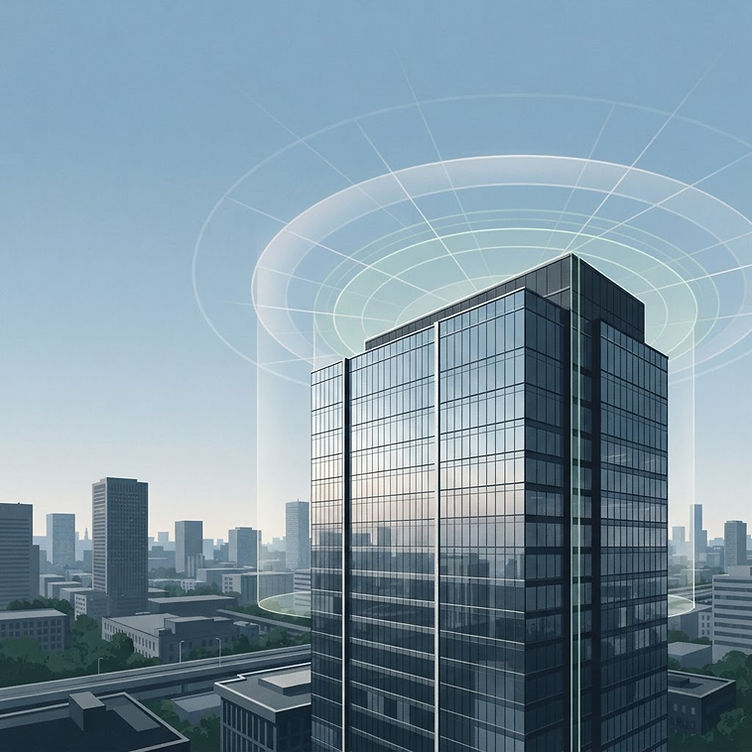
The Perimeter Has a Ceiling Now
For decades, the physical security profession organized itself around a horizontal logic. Fences, access-controlled doors, lobby protocols, parking barriers, and guard patrols defined the perimeter. The threat model, broadly speaking, traveled on the ground. That logic is now structurally incomplete.
Entering 2027, consumer and commercial drone registrations with the Federal Aviation Administration have reached all-time highs. According to FAA registration data, commercial drone fleets grew approximately 35 percent year-over-year through 2026 — a rate of proliferation that outpaces nearly every other category of technology entering commercial and consumer markets. These are not experimental devices restricted to hobbyists. They are capable platforms equipped with high-resolution optical sensors, thermal imaging, and in some configurations, payload capacity sufficient to deliver small packages or, in adversarial hands, improvised materials.
The disruptions are no longer hypothetical. High-profile incidents at critical infrastructure facilities — airports, energy facilities, and large-scale public events — have made clear that the low-altitude airspace above a property is a real attack surface. What has not received equivalent attention is the exposure of corporate campuses and commercial high-rises to a quieter but equally serious category of threat: aerial surveillance, competitive intelligence gathering, and targeted harassment of executives and employees who believe they are operating within a secured environment.
The thesis of this piece is direct: the majority of corporate facilities in the United States are operating with a security posture that is structurally mismatched to the aerial threat environment of 2027, and the gap is widening. Closing it requires vertical perimeter thinking, integrated detection technology, disciplined coordination with law enforcement and regulatory bodies, and an honest accounting of what private security providers are legally permitted to do — and what they are not.
What the Data Suggests About Corporate Preparedness
A Security Industry Association operational review, cited in the source material for this piece, found that approximately 72 percent of corporate headquarters lack active aerial surveillance capability or radio-frequency drone detection systems. That figure, if accurate, means the overwhelming majority of corporate facilities that employ sophisticated ground-level security — card readers, CCTV arrays, uniformed officers — have made no parallel investment in detecting or monitoring what happens in the airspace immediately above their property.
This is not simply a technology gap. It reflects a conceptual lag in how facilities managers and corporate real estate executives have been trained to think about security boundaries. The perimeter, in the mental model most security planning documents still use, is lateral. Vertical exposure has been treated as the concern of airports, military installations, and stadium operators — not the suburban corporate campus or the urban office tower.
That assumption deserves scrutiny. A mid-rise corporate headquarters in any major metropolitan market sits beneath legally unregulated navigable airspace beginning at 400 feet above ground level, per FAA guidelines for small unmanned aircraft. Between ground level and 400 feet, the legal picture is contested and evolving. A drone operating at 150 feet above a corporate campus can deliver optical resolution sufficient to read documents through windows, identify individuals on rooftop terraces, map interior floor layouts through skylights, or monitor employee movements in outdoor areas with a degree of precision that no ground-level surveillance operation could achieve without physical trespass.
Competitive intelligence gathering via aerial platform is not a future concern. It is a present one. The question for corporate security professionals is whether they have built any capability to detect, document, and report it.
The Legal Framework: What Private Security Can and Cannot Do
Understanding the legal environment is not a secondary consideration — it is foundational to building any defensible aerial security program. And the legal environment, as of this writing, is genuinely unsettled.
Federal law governs airspace in the United States under the authority of the FAA. The agency has broad jurisdiction over navigable airspace, and that jurisdiction creates immediate constraints for private security responses. Jamming or interfering with drone radio-frequency signals is prohibited under federal law for private parties, including licensed security providers, regardless of the provocation. Physical interdiction — deploying a counter-drone device, net gun, or similar kinetic measure — occupies a similarly constrained legal space for non-federal actors.
The GAO's 2025 report on critical infrastructure protection identified specific gaps in local law enforcement authority to act against unauthorized drones over private property. Local police departments, even when willing to respond, frequently lack both the jurisdictional authority and the technical equipment to address an aerial intrusion in real time. The practical consequence is that a drone loitering over a corporate campus for twenty minutes may generate a detailed intelligence product before law enforcement has the authority, equipment, or situational awareness to intervene.
Congress has been working toward a federal framework that would address some of these gaps. The provisions codified or pending under 18 U.S. Code 40A concern airspace trespass and corporate privacy interests, though the precise scope of that framework and its implementing regulations remain a subject of ongoing legislative and regulatory development. Facilities managers and their legal counsel should be tracking these developments closely, because the statutory landscape is likely to shift, and the direction of travel — toward expanded civil liability for drone operators and potentially expanded authority for authorized entities — is discernible even if the final form is not.
The CISA UAS (Unmanned Aircraft Systems) Guide, which addresses detection and mitigation for critical infrastructure operators, recommends a multi-layered physical detection posture but explicitly notes the absence of legal kinetic mitigation authority for private security personnel. What that document implicitly endorses, and what experienced practitioners have concluded in practice, is that the private security response to drone threats must be built around detection, documentation, and rapid escalation — not unilateral interdiction.
That constraint is frustrating for security directors accustomed to having intervention options. It is also the correct legal baseline from which to build a program.
Building a Vertical Perimeter: Practical Architecture
Given the legal constraints, the practical question becomes: what does an effective aerial security program look like for a corporate campus or commercial high-rise that does not have federal law enforcement authority?
The answer lies in layered detection architecture. Radio-frequency detection systems can identify the control signal and telemetry communications between a drone and its operator, often providing not just the presence of a drone but the approximate location of the operator on the ground. This is operationally significant: the countermeasure to a drone-based surveillance operation frequently involves locating and confronting — or reporting — the human operator rather than the drone itself. RF detection technology has matured considerably in recent years and is available at price points that place it within reach of mid-market corporate security budgets.
Optical tracking systems — either dedicated drone-detection cameras or AI-assisted video analytics integrated into existing CCTV infrastructure — provide a complementary layer. RF detection is effective against drones using conventional radio protocols but can be defeated by autonomous pre-programmed flight paths that require no active radio link during the surveillance run. Optical detection captures what RF may miss. Together, they provide a detection posture considerably more robust than either system alone.
Acoustic detection, which identifies the acoustic signature of drone rotors, represents a third layer. Its utility is most pronounced in lower-noise environments and may be less reliable in dense urban settings, but it adds redundancy to a detection stack.
Documentation protocols matter as much as detection hardware. When a drone is detected over a corporate property, the security team's ability to produce a timestamped, georeferenced record of the intrusion — including sensor logs, video captures, and operator-location data if available — is what enables law enforcement follow-up, supports a civil trespass or privacy claim, and creates an evidentiary record if the incident is part of a pattern of targeted surveillance. Detection systems that generate no exportable documentation are significantly less useful than those that do.
Escalation protocols require advance work. Security teams should establish relationships with the FAA's UAS facility map coordinators, local law enforcement aviation units where they exist, and federal law enforcement field offices in jurisdictions where the facility operates. The response to an active drone intrusion is not the moment to be identifying the right phone number. Pre-established notification chains and defined escalation thresholds — based on assessed threat level, duration of intrusion, and proximity to sensitive areas — allow for a disciplined, legally defensible response rather than an improvised one.
The Corporate Real Estate Dimension
Facilities managers and commercial real estate executives face a specific complication that pure security professionals sometimes underweight: lease structures and property ownership arrangements that govern what modifications can be made to a building's exterior, rooftop, and immediate airspace environment. Installing sensor arrays on a leased building's rooftop requires landlord approval. Coordinating with neighboring property owners on a shared detection perimeter requires relationships that may not exist. In multi-tenant high-rises, defining which tenant bears responsibility for aerial security is a question most existing lease documents do not answer.
These are not insurmountable problems, but they require engagement at the real estate and legal level, not just the security operations level. Corporate security directors who bring an aerial threat assessment to a facilities management conversation, backed by the kind of documented regulatory guidance available from CISA and the FAA, are in a better position to drive building modifications and lease amendments than those who arrive with a vendor proposal alone.
There is also a duty-of-care dimension worth raising with corporate counsel. As drone surveillance of private facilities becomes more common and the legal frameworks around aerial privacy mature, the question of what a corporate occupier or property owner was reasonably expected to know and do will eventually be tested in civil litigation. The Security Industry Association data point — that nearly three-quarters of corporate headquarters lack any aerial detection capability — suggests that baseline industry practice has not yet converged on a standard. When it does, facilities that have invested in detection and documentation protocols will be in a materially different position than those that have not.
What Honest Risk Assessment Requires
Aerial threats to corporate campuses exist on a spectrum. At one end is competitive intelligence gathering — a drone operated by or on behalf of a rival, a short-seller, an activist investor, or a journalist, seeking visual access to a facility, its operations, or its personnel. This threat is real, currently underreported, and largely unaddressed by existing security programs. At the other end is the kinetic threat: a drone configured to deliver a payload or cause physical disruption. This threat is less common in the corporate context but is not theoretical, as public reporting on incidents at energy and transportation infrastructure makes clear.
Honest risk assessment requires placing a specific facility on that spectrum based on its profile, the nature of its operations, its executive population, and its geographic and political context. A pharmaceutical research campus, a financial trading floor, and a consumer products headquarters each presents a different aerial threat profile. Security programs that apply a uniform response to those different profiles are likely to be both over-resourced in some areas and dangerously under-resourced in others.
The physical security profession has mature methodologies for threat and vulnerability assessment at the ground level. Extending those methodologies into the vertical dimension — mapping the airspace exposure of a specific facility, modeling detection gaps, identifying legally available response options, and establishing proportionate countermeasures — is the analytical work that corporate security functions and their advisors should be undertaking now, before a significant incident creates pressure to act under unfavorable conditions.
A Profession at an Inflection Point
The drone proliferation data entering 2027 signals that low-altitude airspace has moved from a peripheral concern to a mainstream security challenge for corporate facilities. The regulatory framework is catching up, but it is not there yet, and the gap between technological capability and legal clarity creates a period of elevated risk for facilities that have not invested in detection and protocol development.
The security profession has navigated similar inflection points before — the integration of networked cameras, the transition to biometric access control, the response to active-threat protocols — and has generally emerged with more rigorous practices and better-defined standards. The aerial security challenge is the current version of that transition.
Facilities managers and real estate executives who treat it as an edge case, a niche concern, or a problem that belongs exclusively to airports and military installations are operating on an outdated map. The perimeter now has a ceiling, and the professional responsibility to secure what lies within it extends upward.
Related Reading
Sources
- FAA UAS Registration — Federal Aviation Administration
- GAO Report on Critical Infrastructure and UAS Authority Gaps (2025) — U.S. Government Accountability Office
- CISA UAS Critical Infrastructure Guide — Cybersecurity and Infrastructure Security Agency
- Security Industry Association — Operational Review Data
Questions about fire watch, executive protection or guard coverage for your property? Request a quote or call our dispatch line.
More from the blog


Breaking News
Subtropical System Threatens East Coast with High Winds and Coastal Flooding as NHC Monitors Development
The National Hurricane Center is tracking a non-tropical area of low pressure off the Carolina coast with a 40 percent chance of subtropical storm development. Regardless of whether it organizes, the system is expected to produce dangerous surf, coastal flooding, and high winds along the U.S. East Coast this week.


Breaking News
Three-Alarm Fire at Morristown Restaurant Triggers Apartment Evacuations on Spring Street
A three-alarm fire broke out Monday evening at Mega BBQ on Spring Street in Morristown, New Jersey, forcing the evacuation of residential tenants above the restaurant and drawing mutual-aid companies from three neighboring communities. No injuries were reported. Investigators have not yet confirmed a cause, though preliminary indications point to an exhaust chute near the restaurant's stove.

Breaking News
Four Units Damaged in Overnight Apartment Fire Near Loop 410 and Starcrest on San Antonio's Northeast Side
Two units were damaged by fire and two by water in an overnight apartment fire near Loop 410 and Starcrest Drive on San Antonio's Northeast Side on Oct. 5. No injuries were reported, and the cause is under investigation by the San Antonio Fire Department.
