
Hot Work and Fire Safety: Compliance with NFPA 101 in San Jose
September 13, 2026· Brian Fitzgibbons
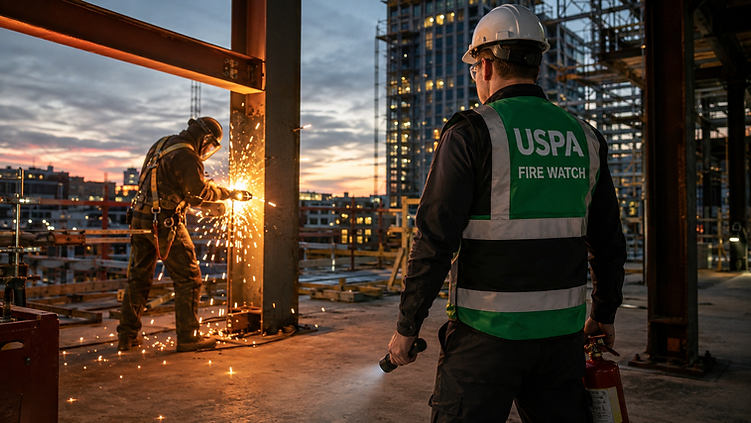
Managing hot work operations in a commercial or industrial environment requires a rigorous commitment to fire prevention. For facility managers in San Jose, the intersection of national standards and local municipal requirements creates a complex regulatory landscape that dictates how welding, cutting, grinding, and other spark-producing activities must be conducted to avoid catastrophic fire incidents.
Strict adherence to safety codes serves two purposes. First, it protects human life and physical assets from the inherent risks of thermal processes. Second, it ensures that property owners remain in full compliance with municipal fire codes, avoiding legal exposure and potential work stoppages. This guide details the essential requirements for hot work management and the implementation of effective fire watch services within the San Jose area.
I. Overview of local fire risks and regulatory compliance
San Jose presents unique challenges for fire safety due to its density of industrial sites, high-tech manufacturing, and urban construction projects. Hot work processes introduce high-temperature ignition sources into environments that may contain flammable materials or combustible building components. Without proper oversight, a single spark can ignite a fire that progresses rapidly through a facility before internal suppression systems can activate. Regulatory compliance is not merely an administrative exercise but a fundamental component of structural risk management. Facilities that fail to obtain necessary permits or ignore mandated monitoring periods face significant liability and enforcement actions from local authorities.
II. Understanding NFPA 101: Key mandates and standards
The National Fire Protection Association (NFPA 101), known as the Life Safety Code, serves as the primary benchmark for fire protection in the built environment. NFPA 101 focuses on protecting occupants based on the construction, protection, and occupancy features of a structure. When hot work is performed, the code emphasizes the importance of managing the workspace to mitigate ignition risks. Facility managers must ensure that the area is cleared of combustible materials for a minimum radius around the activity, or that adequate shielding is provided. The code also mandates that fire protection systems remain operational during maintenance and that any impairment of these systems necessitates a compensatory measure, such as a fire watch, to maintain an equivalent level of safety for occupants.
III. Local Jurisdiction Rules
The San Jose Fire Department requires a permit for hot work and a dedicated 30-minute post-work fire watch monitoring period. These requirements are specific and non-negotiable for anyone operating within the city limits. The hot work permit ensures that the facility management has documented the scope of work, identified potential hazards, and implemented specific mitigation strategies before any work begins. The requirement for a dedicated 30-minute post-work fire watch monitoring period recognizes that fires from hot work often smolder undetected for a period before transitioning into an open flame. This cooling-off window is vital for preventing delayed ignitions that occur after the workers have vacated the site.
IV. Duties of a Fire Watch Guard
A fire watch guard provides the human oversight necessary to identify hazards that automated systems might miss. Their primary responsibility is to maintain a continuous, proactive presence throughout the duration of the hot work and during the subsequent 30-minute cooling period. Guards must conduct documented patrol rounds at set intervals to inspect the work area and adjacent spaces for signs of smoke, heat, or smoldering debris. All observations, including start times, end times, and inspection findings, must be recorded in log entries in real time.
In the event of an emergency, the guard is responsible for immediate notification of the fire department and the property contact. The guard must remain on post to provide situational awareness and assist with emergency response protocols until the situation is stabilized. Furthermore, if a fire watch is required due to an impaired sprinkler or detection system, the guard must maintain coverage until the system is fully restored and verified as accepted by the responsible party or local authority. This duty ensures that the facility is never left without adequate eyes on the ground when its primary safety defenses are compromised.
V. Conclusion & Best Practices for Facility Managers
Facility managers should establish a clear internal permitting system that aligns with both NFPA 101 and San Jose Fire Department codes. This process should include verifying that all contractors carry the required permits, conducting a thorough pre-work briefing to identify fire hazards, and designating a responsible person to oversee the fire watch. Maintaining detailed records of these inspections provides an audit trail that demonstrates due diligence in the event of an inspection or inquiry. It is essential to ensure that fire watch personnel are properly trained and focused exclusively on their safety duties, rather than multitasking with other operational tasks.
USPA provides NFPA-compliant fire watch coverage in San Jose, CA and nationwide. By prioritizing these safety standards, property owners can protect their assets and ensure a safe, compliant work environment for all employees and contractors.
Sources
- National Fire Protection Association (NFPA 101 Official Standard)
- Local Municipal Code for San Jose, CA
- Occupational Safety and Health Administration (OSHA 29 CFR 1910 Compliance Directives)
Related Reading
Questions about fire watch, executive protection or guard coverage for your property? Request a quote or call our dispatch line.
More from the blog


Opinion
Retail Riots and the Death of Glass: Securing the Future Storefront
Flash-mob looting and civil disturbances have exposed plywood boarding as a symbolic gesture rather than a genuine security strategy. This op-ed argues that modern urban retail brands must invest in permanently engineered ballistic and smash-resistant glazing systems integrated into their architectural design.


Opinion
The Glass Ceiling of Corporate Privacy
Electrochromic glass systems integrated into corporate IoT networks offer architectural elegance and energy efficiency, but they also introduce a category of physical-cyber vulnerability that most enterprise security programs have yet to address: the remote, instantaneous erasure of visual privacy in executive conference spaces.


Opinion
The Ghost in the Server: How AI-Driven Tailgating Is Defeating Automated Turnstiles
Sophisticated bad actors have learned to treat optical turnstiles as a system to be gamed rather than a barrier to be overcome. Understanding the geometry of how machine-calculated tailgating works is the first step toward deploying defenses that can actually stop it.