
Fire watch services in Cincinnati, Ohio
Cincinnati builds in two directions at once: up in a compact downtown and out along hillsides that put water, frost and access in awkward places. The historic core is attached masonry that shares walls for blocks, which changes what a fire watch has to cover when a system goes down.
- 21+ Years in Business
- A+ Rated
- Veteran Owned and Operated
- Licensed and Insured
- 24/7 Dispatch
Research · Fire watch regulations · Volume 13
NFPA 601: Security Services in Fire Loss Prevention
A national management, patrol, training and operational assurance reference for the security officers who carry fire-loss-prevention duties. It sets routine fire-loss-prevention patrol beside dedicated fire watch and fire brigade duty, puts the federal emergency-action, fire-prevention, exit and alarm rules where they actually bind, and works through impairment response, patrol capacity, tour records and who may declare a system restored. 35 pages, 18 cited sources. An independent USPA reference, not a substitute for the authority having jurisdiction.
The Ohio Fire Code and the city's prevention bureau
Ohio adopts the International Fire Code with state amendments as the Ohio Fire Code, and enforcement in Cincinnati sits with the fire department's prevention bureau and its district inspectors. The Ohio Division of State Fire Marshal sets the code and licenses the contractors who repair the systems, but the inspector who visits the building is local.
That matters because the interim measure is judged locally. When suppression or detection is out of service, the property notifies, tags the impairment, and keeps protection equivalent to what was lost until the repair is proven. For most Cincinnati buildings the accepted form of that is a posted officer on a written route with a time-stamped log.
USPA writes the route with the property's own engineer, states the interval the officer will hold, and closes the assignment only on the authority's acceptance after testing.
Over-the-Rhine and the attached masonry problem
Over-the-Rhine is one of the largest surviving collections of nineteenth-century Italianate commercial and residential buildings in the country, and it is dense: three and four stories, shared party walls, timber joists sitting in masonry pockets, and rear additions that have been rebuilt several times. A fire in that fabric moves through voids a modern drawing would never show.
A watch on a single address in a block like that is only half a watch. The route has to include the shared walls, the rear courts, the alley elevations and the roof line, because the exposure that matters is the neighbor. USPA writes those posts against the block rather than the parcel.
Rehabilitation work adds a second exposure. Buildings under renovation often have partial suppression, open shafts and hot work on any given day, and the officer's instructions distinguish an impairment post from a construction standby.
Uptown hospitals and the university campus
The Uptown basin holds the University of Cincinnati, UC Medical Center, Cincinnati Children's and the associated research buildings, and those campuses renovate continuously in occupied buildings. A suppression or detection outage there is governed by interim life safety measures and by a safety office that reads the log.
Officers are badged, briefed on patient and laboratory areas and on evacuation routes, and work the route on the facility's schedule, frequently overnight in mechanical and imaging space. The record is written so a surveyor, an insurer and the facility's own safety committee can read the same document.
Where the work is hot work inside an occupied building, the standby is scoped to the permit: point of work for the duration, then the post-work period under NFPA 51B before the area is released.
Impairment open or a permit running in Cincinnati?
Dispatch answers 24/7 and stages officers across Hamilton, Butler, Warren and Clermont counties.
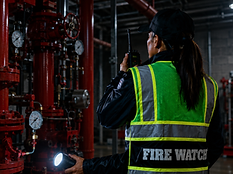
USPA fire watch guards working assignments in Cincinnati





Mill Creek, the riverfront and the hillsides
The Mill Creek valley carries the city's heavier industry: food processing, metal and machine shops, chemical and warehouse operations in Queensgate, Ivorydale and the streets around Spring Grove. Welding on tanks, conveyors, rail and building steel in those facilities runs under the operator's permit, and the watch is set by that permit rather than by us.
Down at the river, the public landing, the stadium district and the river terminals each produce their own work: event build-outs on the Banks, barge and dock repair at the terminals, and coating and welding on structures that sit in a flood plain.
On the hillsides of Price Hill, East Price Hill and Mount Adams, steep access and retaining structures make both the fire attack and the repair harder. Freeze events split pipe in exposed crawlspaces and hillside garages, and the watch runs for the length of the repair queue rather than the length of the estimate.
Authority having jurisdiction
Looking for the Cincinnati fire marshal’s office?
The division that takes the impairment notification, decides how many people an ordered watch requires and inspects the log is Cincinnati Fire Marshal / Fire Prevention Division. Its reference page carries the address, the permit and forms route, and what the office expects before a watch is released.
Request fire watch coverage
Send the property address, the impaired system or the hot work schedule, and the time coverage must begin. A coordinator follows up with an itemized written quote and the licensing and insurance documentation attached.
Rated 4.9 by the clients we protect
Reviews are collected from real assignments across the country. Read them directly on Google before you call.
I have their pricing to be very affordable and competitive. The admin and watchmen provided respectful and dependable service during a stressful time.
William BeesleyGoogle reviewVerify This Review
Questions before you commit? Call (800) 214-1448 and ask for references on assignments like yours.
Cincinnati fire watch questions
- Does Ohio require a fire watch when a sprinkler system is out?
- The Ohio Fire Code requires protection equivalent to the impaired system, and the local fire official decides how that is achieved for the building. Notification, tagging and a posted watch on a documented route is the usual answer. USPA writes the plan to the official's conditions.
- Can one post cover a row of attached buildings in Over-the-Rhine?
- Yes, and it usually should. The route is written across the shared walls, rear courts, alley elevations and roof line, because in attached masonry the neighboring building is the exposure. Pricing follows officer hours and the route, not the number of addresses.
- How long does hot work coverage last?
- NFPA 51B requires a watch at the point of work for the duration and at least sixty minutes after the work ends, and a permit can require longer for heavy sections or concealed spaces. The post is written to the permit and the release time is logged.
- Do you work in hospitals and laboratories?
- Regularly, on the Uptown campuses. Officers are badged, briefed on patient and laboratory areas and on evacuation procedure, and log rounds in a form the facility's safety office will accept.
- How fast can an officer be posted?
- Same day for most Hamilton County addresses and within hours for an emergency impairment or a fire official's order. Dispatch is answered around the clock.
The Watchline
Reporting from Cincinnati, oh
Fire watch in the markets around this one
Fact check and technical sources
The statements on this page are grounded in the standards and regulations below. Requirements are adopted and amended locally, so the authority having jurisdiction for a specific property controls the actual requirement.
- NFPA 1
Fire Code
The model fire code most jurisdictions adopt in some edition, including the impairment and hot work provisions a fire marshal cites when ordering a watch.
Official Source → - NFPA 101
Life Safety Code
Occupancy requirements for existing buildings, including the protection levels that must be maintained when a system is out of service.
Official Source → - NFPA 25
Standard for the Inspection, Testing, and Maintenance of Water-Based Fire Protection Systems
The impairment procedure: notification, tagging, interim protection while a system is down, and restoration testing before it returns to service.
Official Source → - NFPA 51B
Standard for Fire Prevention During Welding, Cutting, and Other Hot Work
Permits, control zones, extinguishing equipment and the post-work monitoring period that current editions hold at a minimum of one hour.
Official Source → - NFPA 241
Standard for Safeguarding Construction, Alteration, and Demolition Operations
Fire prevention programmes for construction, including watch requirements during phased occupancy and when protection is not yet commissioned.
Official Source → - NFPA 72
National Fire Alarm and Signaling Code
Detection and notification requirements, and the fire watch that substitutes for automatic notification when a system is impaired.
Official Source → - NFPA 601
Standard for Security Services in Fire Loss Prevention
How a fire watch is organised and performed: patrol routes and rounds, recording, reporting, and the duties of the officer on post.
Official Source → - OSHA 29 CFR 1910.157
Portable Fire Extinguishers
The federal requirement that extinguishing equipment be provided, maintained and available where a fire hazard exists during work.
Official Source → - U.S. Fire Administration
National Fire Incident Reporting System and fire loss data
Federal fire data and guidance used to describe the loss patterns a watch is intended to prevent.
Official Source → - Ohio Division of State Fire Marshal
Department of Commerce
Adopts the Ohio Fire Code, licenses contractors and inspects the buildings the state regulates.
Official Source →
Book fire watch coverage in Cincinnati
One call reaches live dispatch for impairment, hospital and industrial assignments across Hamilton County.