
A third-floor fire on Warsaw Avenue did $100,000 in damage in thirty minutes, and displaced three people

By Albina Bieci, Staff Writer
Firefighters had the East Price Hill fire under control in about half an hour and carried a dog out of the building. Three residents were displaced from a three-story walk-up whose upper floor and roof assembly now have to be inspected.
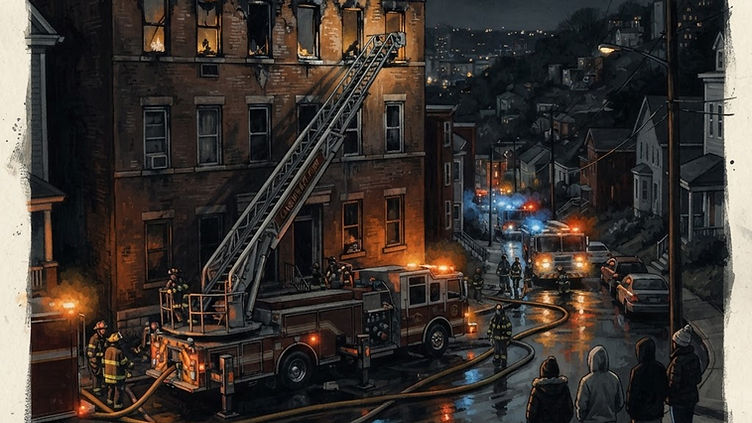
CINCINNATI, Ohio
A late-night fire on the third floor of a three-story apartment building on Warsaw Avenue in East Price Hill caused an estimated $100,000 in structural and smoke damage, displaced three residents, and was brought under control in roughly thirty minutes, according to reporting by WKRC Local 12.
Firefighters also rescued a dog from the building. The fire was reported at 11:06 p.m. Eastern the night before the report.
What has been confirmed
The fire occurred on the third floor of a three-story residential apartment building on Warsaw Avenue. Damage is estimated at approximately $100,000, described as structural and smoke damage. Crews brought the fire under control in approximately thirty minutes and rescued a dog inside. Three residents were displaced.
The reporting available at publication does not state the cause, whether anyone was injured, how many apartments the building contains, or whether the building's alarm and electrical systems are currently in service. Those details will be added here if the Cincinnati Fire Department or the property releases them.
Thirty minutes is not a small fire
A fire that is declared under control in half an hour sounds contained. In a three-story wood-frame or brick-and-joist walk-up, thirty minutes is enough to destroy a floor.
The reason is the sequence. A fire in a third-floor apartment has a fuel load of furniture, textiles and stored material, in a room with a window. Once the window fails, the fire has an unlimited air supply and a vertical path up the exterior wall into the eave. From there it enters the roof assembly, which in Cincinnati's older housing stock is a set of dimensional lumber rafters and roof boards that have dried for a century.
That is why a third-floor fire in a building like this produces a damage estimate an order of magnitude above what the visible fire would suggest. The fire room is destroyed. The attic and roof assembly above it are opened and wet down. The apartment below it takes water through the ceiling, and the second-floor ceiling assembly itself is now suspect because the joists were exposed to heat from above.
Why the top floor is the expensive floor
An upper-floor fire in a walk-up has three characteristics that drive cost.
The first is overhead exposure. There is nothing above the fire except the roof, and the roof is where the fire wants to go. Opening a roof to vent is the right tactic and it also means the building needs a roofer before it needs a drywall contractor.
The second is water. Suppression water goes down, not sideways. It collects in the ceiling assembly of the floor below, soaks insulation, and finds the light fixtures and the top plates of the walls. A second-floor apartment with no fire in it can be uninhabitable for weeks.
The third is access. A three-story building on a hillside street in East Price Hill is a narrow-site problem. Aerial placement is limited, hose stretches are long, and the stairs inside are the only reliable way to move equipment to the third floor. That geometry is why the response took the shape it did and why the crews were still working the building after the fire was out.
The animal rescue is a routine risk, not a footnote
Crews rescue pets from residential fires constantly, and it is worth understanding why. A dog or cat that is hiding will not come when called, will not be found by a primary search that is moving fast, and will be found during overhaul by a firefighter who has already doffed a mask or is working in a space with degraded air.
Departments train for it, but the risk is real and it is one of the reasons a building is not released the moment the flames are out. The secondary search, which is the one that covers the closets, under beds and behind furniture, is also the search that finds people and animals that the primary search missed.
What the building needs before anyone sleeps in it again
Three residents are displaced from a three-story building, which suggests the damage is concentrated in one or two units. The rest of the building's status is the question.
The items that have to be verified are unglamorous and specific. The electrical service to the affected unit has to be isolated, and if the panel serving it also serves other units, the isolation has to be done without leaving occupied apartments dark. The alarm system has to be tested, because devices in the fire unit are destroyed and the loop serving that floor may be open. The plumbing has to be checked, because suppression water in a wall cavity finds the supply and drain lines and freeze damage in an unheated vacant unit follows within a week.
Until those are done, the building has an impairment, and Ohio's fire code, which adopts the International Fire Code, treats an impairment as a fire watch condition.
Board-up is the part that gets skipped
An upper-floor fire leaves the building's most vulnerable openings at ground level. Windows on the fire floor are broken out. Doors were forced. And the units that are vacant are on the floor that is easiest to reach from a ladder or a rear stair.
The professional sequence is to secure the fire unit first, then the units adjacent to it, then the building's common entry. Plywood screwed over an opening is a deterrent. It is not a barrier, and it will not survive a determined attempt. What survives is a physical presence: an officer on site overnight, a documented round of the exterior and the common stair, and a light source that makes the back of the building visible from the street.
What the displaced residents should document
The three residents displaced here are the ones who will spend the next several months dealing with an insurance claim and a landlord. The documentation they collect in the first seventy-two hours determines how that goes.
Photograph every room in the unit, including rooms with no visible damage, because smoke residue is a claim that is routinely underpaid for lack of evidence. Keep the receipts for the hotel, the meals, the replacement medication and the clothing. Get the fire department's incident report number, which is the document every insurer will ask for. And ask the property, in writing, which systems serving the building are working and what specific condition has to be met before the unit can be reoccupied.
What the $100,000 figure is actually measuring
A damage estimate issued the night of a fire is not a repair quote. It is the fire department's assessment of loss, usually built from a standard formula applied to the structure and its contents, and it is useful for scale rather than for budgeting.
What the figure captures in a case like this one is the fire room and its contents, the ceiling and roof assembly above it, the water that reached the floor below, and the smoke that reached the rest of the building. What it does not capture is the part that costs the most over time. A building where one apartment is destroyed and two are smoke-damaged will sit partially vacant for months while the adjuster, the restoration contractor and the property negotiate scope. Rent stops on the vacant units. The mortgage does not. The building's policy is reviewed at renewal, and a fire loss on the record changes what the carrier will offer.
That gap between the estimate and the actual cost is why owners in this position benefit from a written scope of work within the first two weeks, rather than accepting the first contractor who offers to start drying. A scope that names the assemblies to be opened, the testing to be done and the sequence of the work is the document that keeps a partial-occupancy building from sitting half-finished into the spring.
Related coverage
The Watchline has reported on the same pattern in older housing stock this week. In Bethlehem, Pennsylvania, a duplex fire displaced several families. In South Bend, an overnight fire in a three-unit building hospitalized one man and displaced the rest of the tenants.
The service connection
USPA Nationwide Security provides fire watch, board-up security and post-fire access control for multi-family buildings in Cincinnati and the Ohio River corridor, including three-story walk-ups where an upper-floor fire has left units vacant and shared circuits or alarm loops out of service. Officers work documented rounds, hold the entry, and call the fire department directly when something is found. Requests can be made through the emergency fire watch page, the Cincinnati fire watch page, or by calling (800) 214-1448.
Sources and status
Reporting on the incident is attributed to WKRC Local 12. The cause, the injury status, the building's unit count and the condition of its alarm and electrical systems remain open pending release by the Cincinnati Fire Department and the property. Technical references include NFPA 101, Life Safety Code and the U.S. Fire Administration's residential fire loss data.
Services in Cincinnati, OH
Sources
About the reporter
Staff Writer
Staff writer for the USPA Nationwide Security newsroom. Receives newsroom tips, corrections and editorial inquiries.
Author biography and credentialsMore from The Watchline

Fire Protection
A fire confined to one bathroom at Audubon Park Apartments still took a building's plumbing and alarm loop out of the argument
Daphne police and fire crews contained the late-night fire to a bathroom with no injuries reported. Investigators are still working the ignition source, and that is the period when the unit has to be held.
· Albina Bieci

Fire Protection
Two residents were displaced by an overnight fire at Quail Oaks Apartments, and the unit is now an open, unpowered space
Petersburg Fire Rescue stopped the fire before it reached the adjoining units. The cause is still under investigation, which means the damaged unit cannot be repaired yet and has to be held.
· Albina Bieci

Fire Protection
A fire inside the wall cost four units at Park Canyon Apartments while twelve were cleared to go home
Flames moved through the concealed spaces between the upstairs and downstairs laundry areas of a 16-unit Dalton building, causing roughly $50,000 in damage. Four households went to Red Cross lodging and twelve went back in.
· Albina Bieci