
An overnight fire in a three-unit South Bend apartment building hospitalized one man and displaced the rest of the tenants

By Albina Bieci, Staff Writer
The fire started just before 1 a.m. Wednesday in a three-unit building on South 27th Street in River Park. Small multifamily buildings like this one are the hardest part of the housing stock to keep protected, and the reason is structural rather than accidental.
SOUTH BEND, Ind.
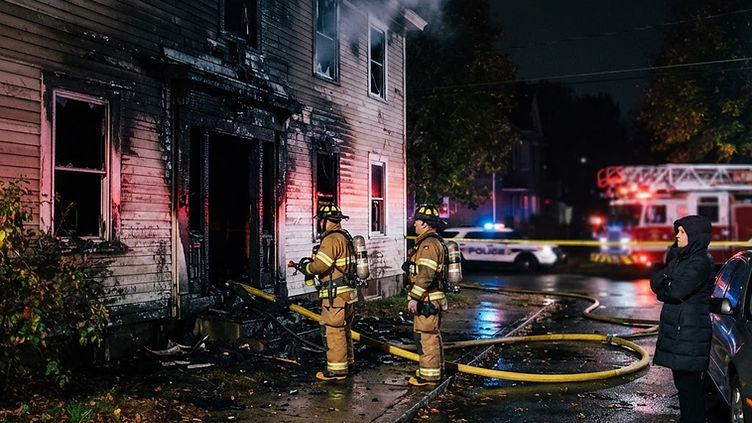
A fire broke out just before 1 a.m. Wednesday in a three-unit apartment building on South 27th Street in South Bend's River Park neighborhood, sending one man to a hospital and displacing multiple residents because of interior damage, WSBT 22 reported.
The reporting establishes the time, the building type, the location and the human cost. It does not state a cause, a damage estimate or how long the building will be out of service. Those questions are now with the fire department and the owner, and the answer to the last one usually determines how the next month goes for the tenants.
A three-unit building is the smallest category of multifamily property that still behaves like one. It has shared walls, a shared roof, a common entry and a single electrical service in most cases. When one unit burns, all three lose something.
What is confirmed
The fire was reported shortly before 1 a.m. Wednesday. The building is a three-unit apartment house on South 27th Street in the River Park area. One man was taken to a hospital. Multiple residents were displaced by interior damage. The cause remains under investigation, and no damage figure has been published.
River Park is an older residential neighborhood of predominantly pre-war housing, much of it wood-frame with converted or subdivided floor plans. Buildings of that type are commonly owner-occupied with one or two rental units, which changes how fire protection is maintained. There is no professional property manager on site, no maintenance department and, frequently, no monitored alarm.
Why small multifamily buildings burn longer before anyone is called
A three-unit building typically has a local smoke alarm system, sometimes interconnected, sometimes not, and often with a mixture of original and replaced devices. Alarms sound inside the building. They do not notify anyone who is not there.
At 1 a.m., the difference between a fire discovered by a resident and a fire discovered by a passerby is measured in minutes of free burn, and in a balloon-frame or platform-frame house of that era, minutes decide whether the fire stays in one unit. Open stud cavities run the full height of the building, and a fire that enters a wall early reaches the attic before it reaches the ceiling of the room where it started.
The result is what the reporting describes: interior damage across the building rather than a burned-out single unit. Water and smoke do the rest. A three-unit fire that is extinguished quickly can still leave two units uninhabitable because of smoke residue, wet insulation and a service panel that has to be replaced before power can be restored.
The displacement problem is a security problem
Once the tenants leave, the building changes character. It is unoccupied, its doors have been forced by firefighters, its windows may be open for ventilation, and its power is off. In a residential neighborhood, an empty three-unit building with no lighting and no alarm is a target within days.
Theft of copper and mechanical equipment is the common loss. Squatting is the second. Both create fire risk in a structure that has already demonstrated it burns, and both complicate an owner's insurance claim if the property was left unsecured after the fire department released it.
Indiana's fire code, adopted from the International Fire Code with state amendments, requires a fire watch when a required fire protection system is out of service, and the obligation continues until the system is restored and tested. On a building this size, that requirement is easy to overlook because the systems are minimal to begin with. The obligation still applies to whatever the code required the building to have.
What the owner of a small building should do this week
Secure the structure first, with plywood and locks rather than caution tape, and document the securing with dated photographs for the insurer. Arrange a licensed electrician's assessment before power is restored, because a partially burned service is a fire hazard in its own right. And decide who is checking the building, on what schedule, and with what written record.
South Bend's fire watch coverage requirements set out what a post-fire watch on a small multifamily property involves, including overnight rounds and an entry log that satisfies an insurer's request for evidence of due care.
Related coverage
South Bend has seen this pattern twice in two weeks. A kitchen fire in a West Washington Street apartment building emptied the whole building even though the fire was confined to one unit, because the smoke collected in the entryway residents use to get out. The lesson in both fires is the same: the unit that burns and the building that closes are rarely the same thing.
For properties where a system impairment is the reason for coverage rather than a fire, the national fire watch reference explains the impairment-and-restoration cycle in detail.
Two longer references are useful on a building of this age. USPA's NFPA 601 reference on security services in fire loss prevention covers the watch itself, and the fire watch white paper sets out the technical basis for patrol intervals and documentation.
The part that does not get reported
A displaced tenant's next month is determined by insurance, and most renters in buildings of this size do not carry it. The owner's policy covers the structure. It does not cover a tenant's belongings, temporary housing or the cost of replacing a winter coat and a week of work. That gap is why small-building fires produce long tail consequences in a neighborhood, and why the fire department's public education work on working smoke alarms and closed bedroom doors keeps returning to buildings like this one.
Why three-unit buildings fall outside the inspection rhythm
Commercial property is inspected on a schedule. Assembly occupancies are inspected annually in many jurisdictions. Apartment complexes above a certain size see routine code enforcement, because there is a management entity to serve notices on and a business license that depends on compliance.
A three-unit building sits outside most of that. It is often owner-occupied, which exempts it from the rental inspection programs that cover larger properties in many Indiana municipalities. It may have been converted from a single-family house decades ago under a permit that no longer exists in any searchable file. Its alarm coverage is whatever the owner installed, and its fire separation is whatever the original conversion produced.
The consequence is that nobody is looking at the building until it burns. The fire department's inspection capacity is finite, and the buildings that need attention most are the ones least likely to appear on a list.
What a proper board-up actually involves
After the fire department releases a building like this one, the openings have to be closed, and the quality of that work determines what happens next. A board-up that uses construction-grade plywood, screws rather than nails, and bracing on the inside of the frame will hold. A board-up that uses thin paneling and a few drywall screws will be open within a week.
Two other items belong with it. The gas and electric services need to be secured or disconnected by the utility, not by the owner, because a partially burned service is a hazard to anyone who enters. And the building needs exterior lighting if power is available at the pole, since an unlit structure in a residential block is an invitation rather than a deterrent.
The neighborhood effect
A burned three-unit building does not only affect its owner and tenants. It changes the block. An empty, unlit structure next to occupied houses lowers the perceived safety of the street, and the fire risk it carries is a risk to the houses beside it. Neighbors are the ones who end up calling in the next problem, and they are the ones who have the least ability to do anything about the building itself.
That is the reason fire departments push so hard on securing damaged residential property, and the reason an owner who acts quickly is doing the block a favor as well as protecting an asset.
What tenants should ask for
Renters displaced by a fire of this kind have three questions worth asking in writing: whether the building is safe to re-enter and when, who is responsible for securing their unit and its contents, and how the owner intends to handle the lease while the building is out of service. Indiana law sets out the notice obligations that apply when a rental unit becomes uninhabitable, and a tenant who asks early is in a better position than one who asks after the building has been empty for a month.
What the investigation will establish
The fire department's origin and cause work on a building of this size is usually concluded within days rather than weeks, because the space involved is small and the fuel load is limited. What investigators establish first is the compartment of origin, then the ignition sequence, then whether a system that should have warned the occupants did. That last question matters to the owner beyond the report: a finding that an alarm was missing, disabled or past its service life changes both the insurance position and the code enforcement follow-up.
USPA Nationwide Security staffs emergency fire watch and post-fire property security on multifamily losses in South Bend and northern Indiana, including overnight coverage on buildings awaiting repair. Dispatch is answered at any hour at (800) 214-1448.
Services in South Bend, IN
About the reporter
Staff Writer
Staff writer for the USPA Nationwide Security newsroom. Receives newsroom tips, corrections and editorial inquiries.
Author biography and credentialsMore from The Watchline


Fire Protection
An explosion and fire at a Deer Park hazardous waste facility put crews into an overnight suppression operation
Emergency crews worked overnight into Wednesday after a blast and fire at the Clean Harbors facility on Independence Parkway South, while local emergency management tracked the suppression effort and reports of vibration in surrounding neighborhoods.
· Albina Bieci

Fire Protection
A pre-dawn second-floor fire in Corpus Christi left investigators working a Buford Street apartment building
Crews were called at about 3:15 a.m. Wednesday to a second-floor fire in the 2900 block of Buford Street near Port Avenue. The fire is out and the building is now the subject of a damage and cause assessment, which is the point where protection coverage usually becomes the tenant's problem.
· Albina Bieci

Fire Protection
A three-alarm fire burned through the roof of a vacant Johns Hopkins warehouse on Falls Road, and the building is now an arson scene
Crews went defensive on a 15,000-square-foot vacant warehouse in the Jones Falls corridor early Wednesday, and the fire department is investigating the blaze as an arson. The building's roof is open, its perimeter is unsecured, and both conditions outlast the fire itself.
· Albina Bieci